Clear Sky Science · en
Optimizing global genomic surveillance for early detection of emerging SARS-CoV-2 variants
Why airport testing matters for everyone
The COVID-19 pandemic showed how quickly new versions of a virus can spread from one corner of the world to another. Catching these new variants early helps scientists update tests, treatments, and vaccines before hospitals fill up. But sequencing virus genomes is expensive and unevenly available across countries. This study asks a simple question with big consequences: if we cannot sequence everywhere, can smart use of airport traveler testing give the world an earlier warning when a new variant appears?
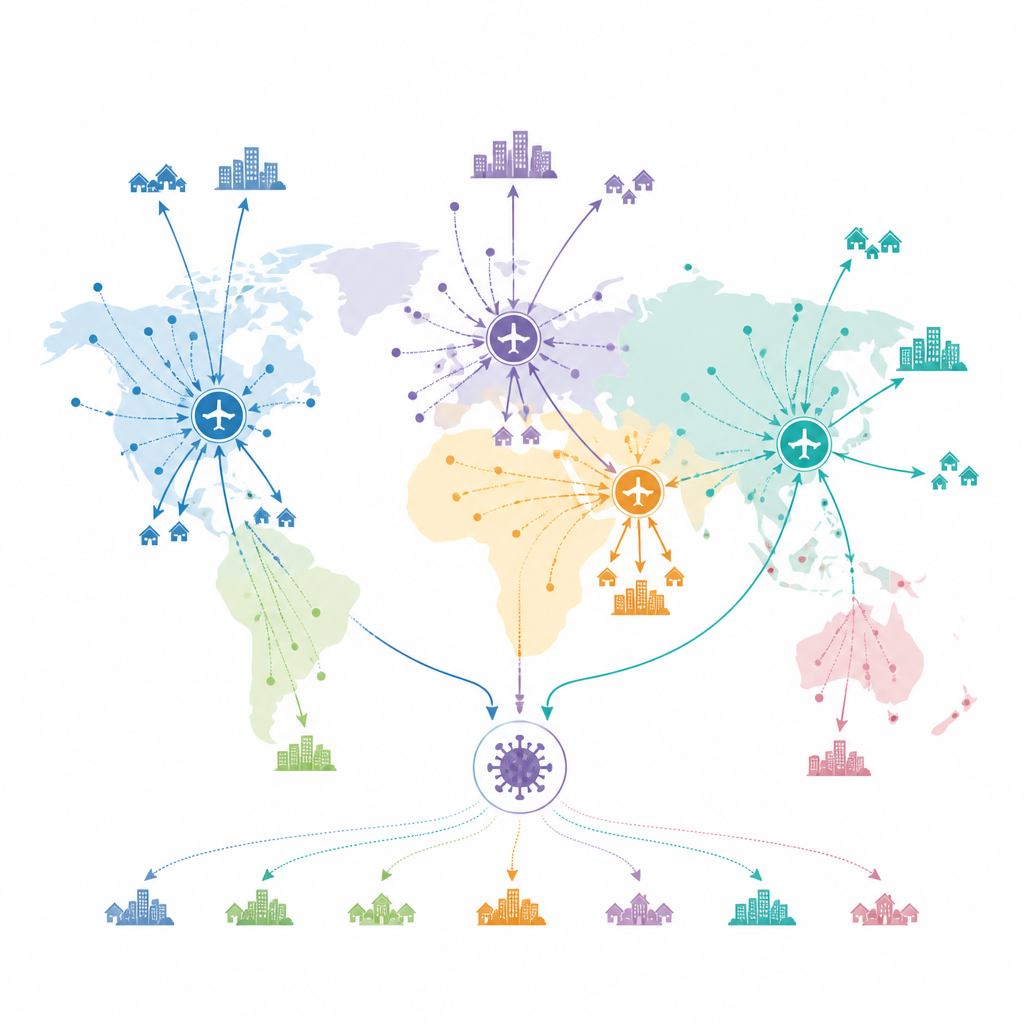
Following the virus across a connected world
The researchers built a detailed computer model of how SARS-CoV-2, the virus that causes COVID-19, moved around the globe during the first Omicron waves (BA.1 and BA.2). They combined case counts, deaths, vaccination coverage, millions of virus genomes, and high-resolution flight and passenger data. The model tracked infections in 29 world regions and distinguished between people infected in their home community and those who carried the virus across borders by air travel. By comparing the model’s output with real-world data, they showed it could realistically reproduce when and where Omicron spread and when countries first detected it.
What really happened with Omicron
The simulations revealed that in the first weeks after Omicron appeared, most international spread came from South Africa, where the variant emerged. Soon after, Europe and North America took over as major sources, sending infections onward to many regions. Yet in most places the first diagnosed and sequenced Omicron cases were not found in travelers but in local outbreaks, because far more people were infected in the community than passed through airports. The time from a variant’s first arrival in a region to its first diagnosis was only about one to two weeks, and sequencing added another one to two weeks. This means the biggest delay for the world was not lab processing but how long it took the virus to reach new regions in the first place.
How much testing and sequencing really help
The team then used the model to test different surveillance choices. They adjusted how many infections were diagnosed with standard tests and how many positive samples were sequenced. When overall surveillance was similar to that during the Omicron wave, simply running more diagnostic tests did little to speed up variant discovery, because sequencing capacity was the real bottleneck. At very low resource levels, however, boosting basic diagnostic testing helped more than extra sequencing, since you cannot sequence infections you never detect. Once routine testing reached about one tenth of the Omicron level, investing additional effort in sequencing, rather than testing, produced the biggest gains in early detection.
Focusing on a few busy travel hubs
The study’s most practical finding concerns where to look. The researchers explored “traveler-targeted strategies” that focus sequencing on people arriving at a small number of major international hubs. In the most realistic versions, each hub used its own resources rather than pulling capacity away from other regions. Prioritizing travelers at just a handful of highly connected airports cut the global time to first detect Omicron-like variants by about a day, and sometimes by several days, while using fewer total tests and sequences. More extreme scenarios that shifted resources away from non-hub regions could shave off even more time but were judged ethically and operationally problematic, especially for countries with already limited surveillance.
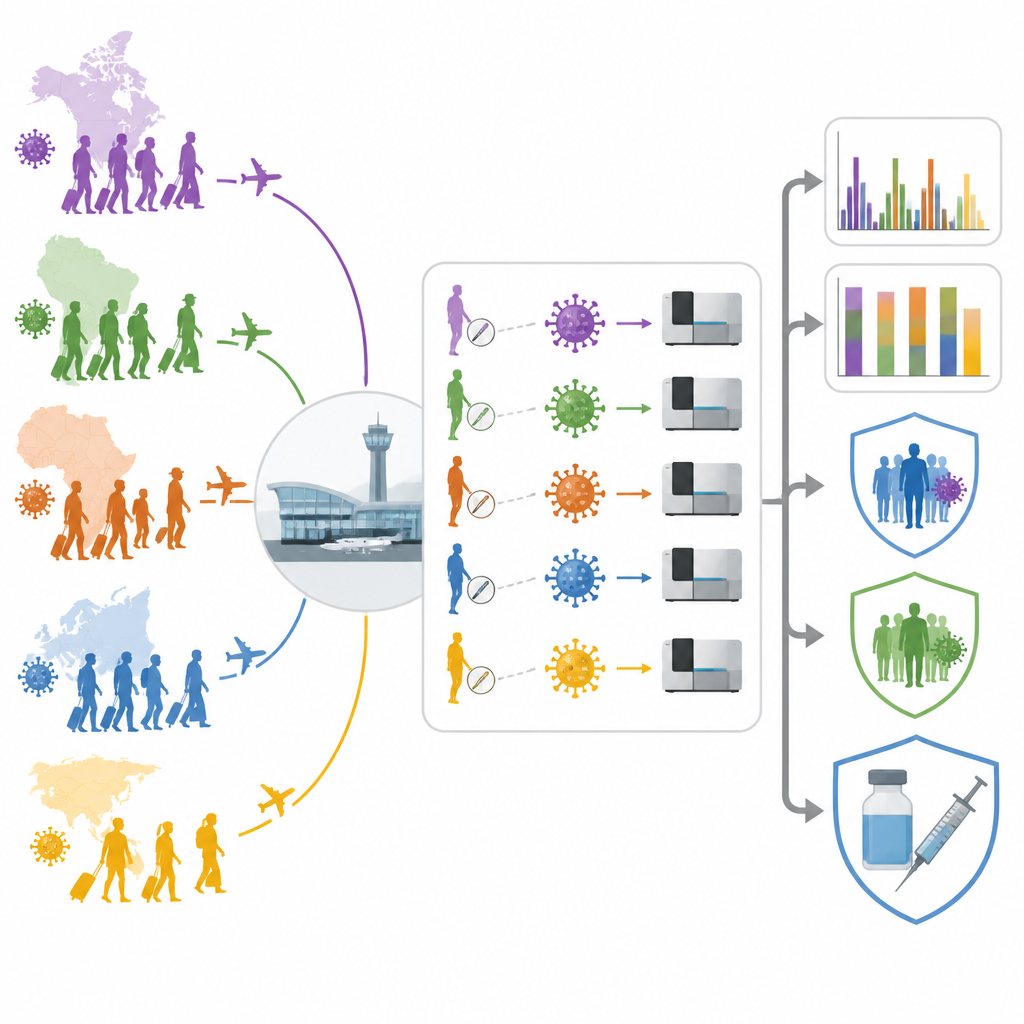
Preparing for future variants with smarter surveillance
Finally, the team asked whether these hub-focused approaches would still work for future variants under normal, pre-pandemic travel patterns. Across many simulated scenarios, including different levels of variant contagiousness and vaccine protection, concentrating traveler sequencing at just two major hubs consistently sped up global detection, even when overall testing and sequencing budgets were cut in half. The biggest benefits appeared when variants arose in regions with weak local surveillance, where a single infected traveler reaching a well-equipped hub could trigger the world’s first genomic warning. The authors conclude that while strong local surveillance everywhere remains essential, adding targeted traveler sequencing at a few key airports is a cost-conscious way to buy crucial days of lead time for labs and health systems before the next threatening variant spreads widely.
Citation: Gu, H., Li, J., Sun, W. et al. Optimizing global genomic surveillance for early detection of emerging SARS-CoV-2 variants. Nat Commun 17, 4322 (2026). https://doi.org/10.1038/s41467-026-70664-0
Keywords: genomic surveillance, SARS-CoV-2 variants, airport traveler testing, pandemic preparedness, virus sequencing