Clear Sky Science · en
Noradrenaline causes a spread of association in the hippocampal cognitive map
Why our memories sometimes blur together
Most of the time, our memories feel precise: we "know" who was at a party, or which colleague shared a project. But under stress or high arousal, we can start to blend related events and people together. This study asks a simple question with far-reaching implications: what chemical signals in the brain decide whether our internal "map" of experiences stays sharp, or becomes smoothed out so that nearby memories bleed into each other?
How the brain builds an inner map
The brain does not just store isolated facts. In a deep structure called the hippocampus, it organises people, places and events into what scientists call a cognitive map: a web of linked experiences that lets us make smart guesses. For instance, if you know two friends usually work together, you might reasonably expect to see both of them at the same conference even if you only heard one was going. This kind of inference is powerful, but it carries a risk: if links in the map spread too far, we can start to "remember" things that never happened, such as confidently recalling that both friends attended when only one did. The authors focused on this trade-off between flexible inference and faithful recall, and on one neuromodulator in particular—noradrenaline—that surges during surprise, stress and heightened attention.
A pill that tweaks brain chemistry
To probe noradrenaline’s role, the researchers recruited healthy volunteers and randomly gave them either a placebo or a single dose of atomoxetine, a drug that temporarily boosts noradrenaline throughout the brain. After a 90-minute wait for the drug to take effect, participants learned relationships between colourful cartoon birds shown in different living-room scenes. Each bird was paired with two others in a ring-like structure, but this underlying pattern was never explained. People simply learned which birds went together in which rooms. This design meant that, later on, the team could test whether people’s internal maps stayed faithful to the actual pairings, or whether they had begun to blur together nearby birds and rooms around the ring. 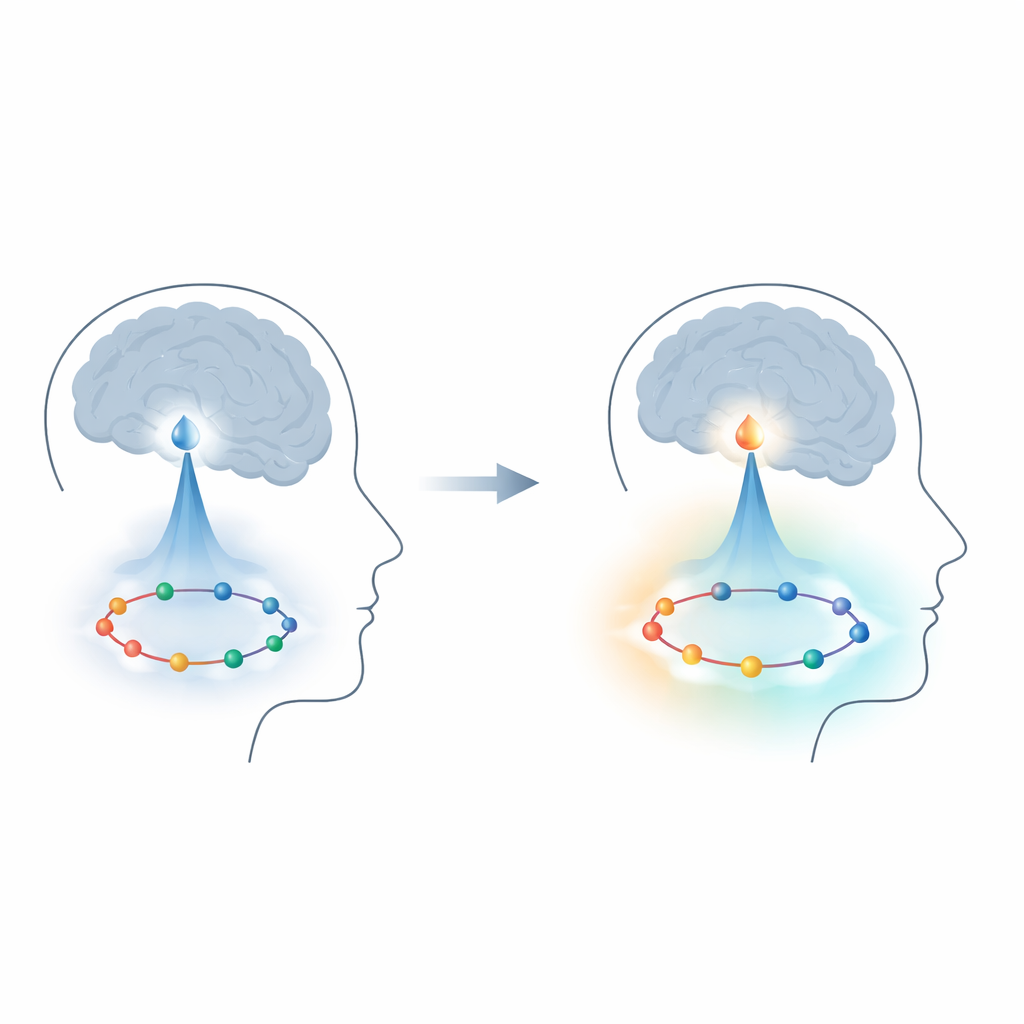
When nearby memories get mixed up
Four days later—long after the drug had left the body—participants returned for memory tests. First, they were asked directly about which birds had appeared together. Both groups did well, and the atomoxetine group was no better or worse than placebo, suggesting that basic memory strength was unchanged. The more revealing test came when people had to match each bird to the sofa that had quietly signalled its room during learning. Here, overall accuracy was modest, providing many error trials to analyse. Crucially, those who had learned under elevated noradrenaline were more likely to make a specific kind of mistake: instead of choosing the correct sofa, they tended to pick a sofa from a room that was adjacent on the underlying ring, rather than a distant one. In other words, their errors followed the hidden structure, as if their internal map had been smoothed so that neighbouring locations bled into each other.
Signals of a more excitable brain
The authors then checked whether atomoxetine had in fact altered brain state during learning. Eye-tracking showed that under the drug, people’s pupils stayed more dilated for several seconds after rare “oddball” images, a known marker of higher noradrenergic arousal. Magnetic resonance spectroscopy, a kind of chemical MRI, revealed that in a visual area important for object recognition, levels of the inhibitory messenger GABA were reduced and the overall balance tipped toward excitation. These physiological shifts fit with earlier animal work showing that noradrenaline suppresses inhibitory cells, making local circuits more excitable and more prone to change.
A network model of spreading links
To understand the mechanism in more detail, the team built a computer model of a brain circuit containing several “nodes” representing different memories arranged in a ring. Under normal conditions, learning strengthened excitatory links between neighbouring nodes, but inhibitory connections grew in step and kept activity tightly contained: triggering one node left the others mostly quiet. Under simulated high noradrenaline, inhibition failed to keep up. When one node was activated, nearby nodes also lit up to a lesser degree, and synaptic changes spread out in a graded fashion. Over time, these adjustments produced overlapping memory assemblies, especially between neighbours, effectively baking a spread of association into the network’s wiring.
Imaging the brain’s warped map
Using functional MRI, the researchers looked for similar effects in the human brain. During scanning, participants viewed the birds again in a carefully shuffled order, while the team measured how much brain responses to one bird were suppressed when it followed another—an index of how much their representations overlap. In the atomoxetine group, but not in the placebo group, the right hippocampus and nearby parahippocampal cortex showed a strong pattern: responses were more suppressed for birds that were close neighbours in the learned ring than for more distant ones. The degree of this neural “spread of association” predicted how strongly each person later overgeneralised in the sofa test, and it was itself predicted by the size of their pupil response and the drop in inhibitory chemicals.
What this means for everyday memory
Put together, the findings suggest that noradrenaline acts like a dial on the brain’s smoothing filter. When levels are modest, the hippocampal map remains crisp and memories stay well separated. When noradrenaline is high during learning, inhibition relaxes, plasticity spreads further, and nearby experiences become more tightly linked. This can be adaptive, allowing us to spot patterns and make clever leaps beyond direct experience—but it also makes us more vulnerable to systematic memory distortions. The work hints that extreme arousal, such as during trauma, might hard-wire overly broad links into memory maps, offering a mechanistic clue to why some people develop intrusive, generalized memories in conditions like post-traumatic stress disorder. 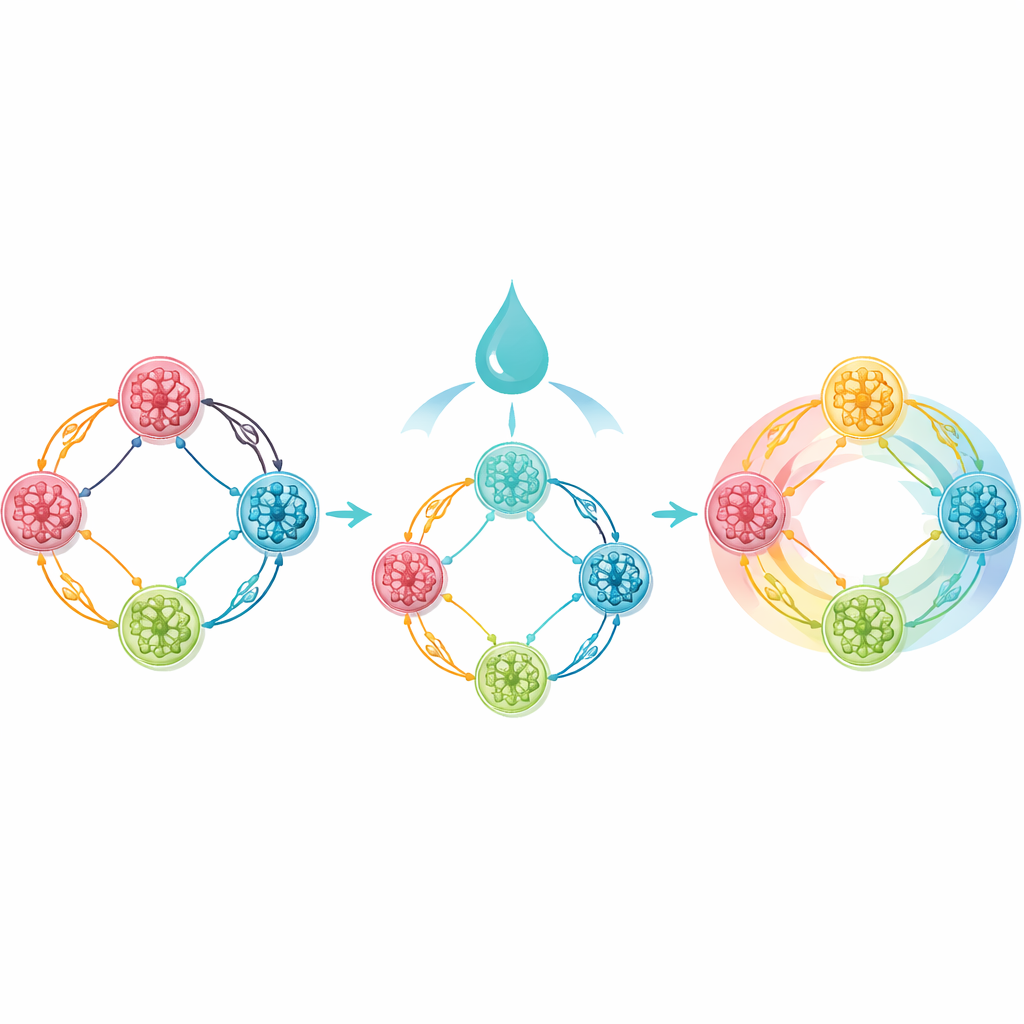
Citation: Koolschijn, R.S., Parthasarathy, P., Browning, M. et al. Noradrenaline causes a spread of association in the hippocampal cognitive map. Nat Commun 17, 3961 (2026). https://doi.org/10.1038/s41467-026-70659-x
Keywords: noradrenaline, hippocampus, cognitive maps, memory generalisation, synaptic plasticity