Clear Sky Science · en
Rapid dynamics of dorsal raphe serotonin neurons regulate the strength of visual attention
A Moving Spotlight in the Mind
When you search for a friend in a crowd or a word on a busy page, your brain quietly turns up a mental “spotlight” on what matters and turns down everything else. Scientists have long studied how this spotlight is pointed to the right place or feature, but far less is known about what controls how bright that spotlight is—how strongly you pay attention. This study in mice shows that a deep-brain source of the chemical messenger serotonin can rapidly dial the strength of visual attention up or down, without changing where that attention is aimed.
Two Separate Knobs for Attention
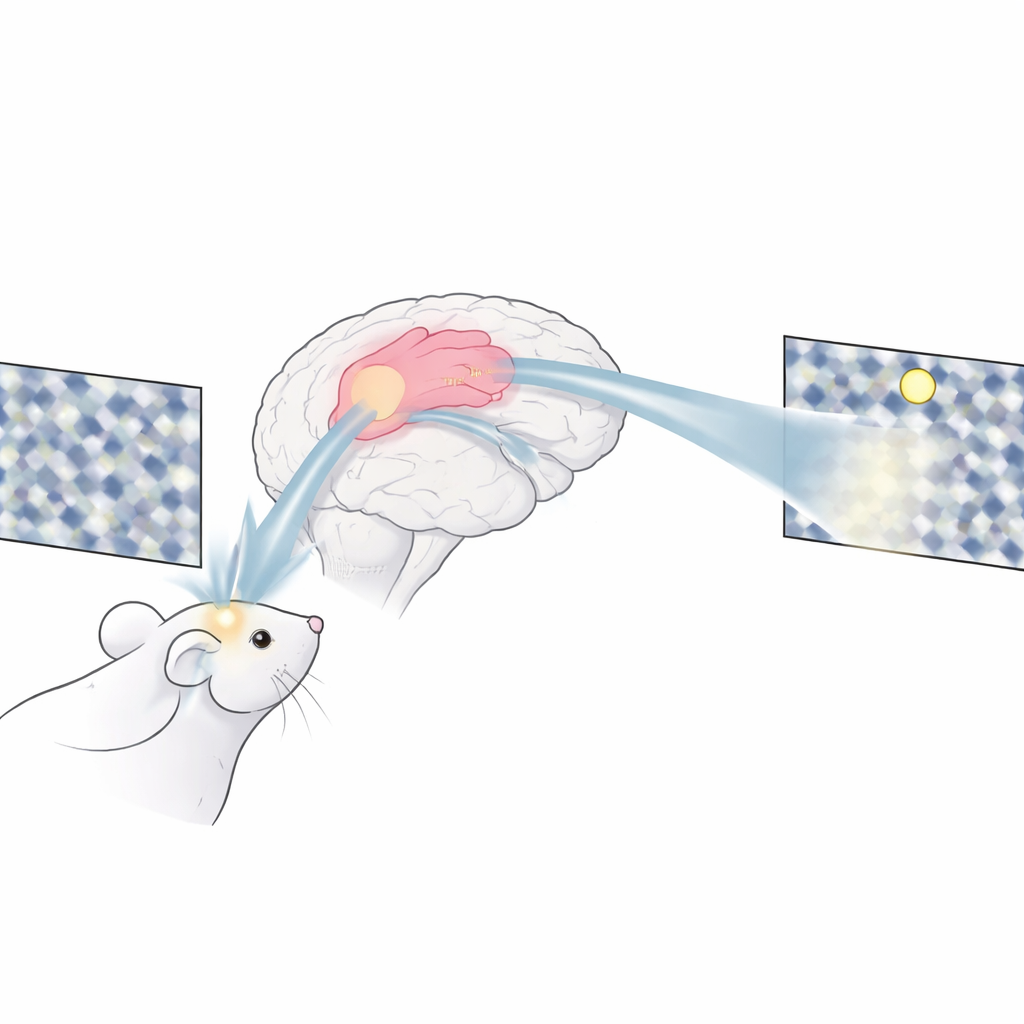
The authors first drew a sharp distinction between two parts of attention. “Focus” is where attention is pointed—such as a particular spot on a screen or a specific pattern. “Strength” is how powerfully that focus boosts incoming information, making faint signals easier—or harder—to detect. Using a challenging visual task, the researchers trained head-fixed mice to lick for a reward when three faint white bars briefly appeared inside a flickering checkerboard of visual noise. A sound and visual cue told the animals which side of the screen to watch, but the exact time the bars appeared and how clearly they stood out from the background changed from trial to trial. This let the team measure how well the mice could detect weak targets and how they weighted information at the cued versus uncued side.
Reading the Brain’s Chemistry in Real Time
To see how serotonin might be involved, the team recorded activity from serotonin-producing neurons in a brainstem region called the dorsal raphe, and separately, serotonin release in the visual cortex. They used light-based sensors that report rapid changes in neural activity or chemical release as tiny flashes of fluorescence. Crucially, they looked at what happened in the brief seconds just before the target bars appeared. When dorsal raphe activity, or serotonin release in visual cortex, dipped to a low level right before a trial, mice were better at detecting weak bar patterns. Their hit rate went up, and they could see fainter gratings, but their reaction times, impulsive licking, and overall motivation did not change. In other words, a quick drop in serotonin signaled stronger attention to the cued pattern, not a general change in arousal or strategy.
Turning the Dial, Not Moving the Beam
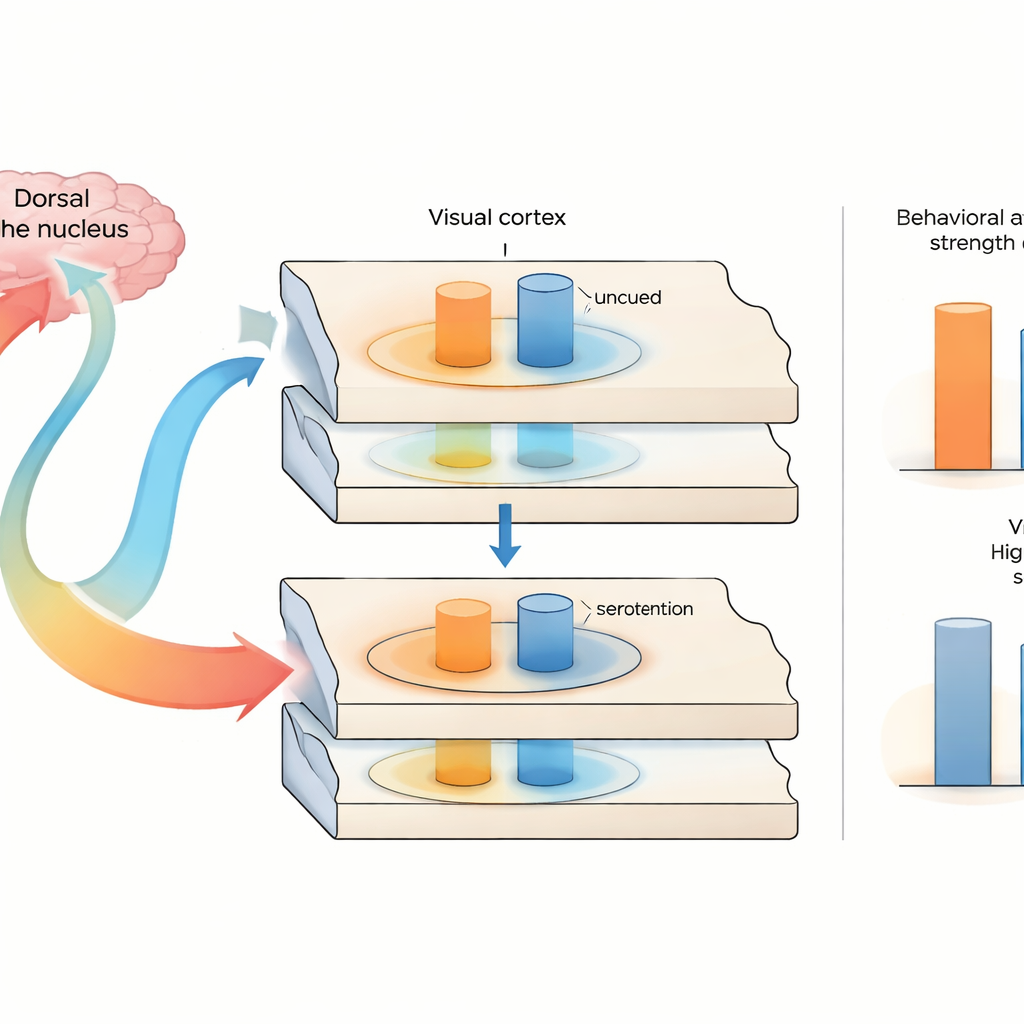
Next, the researchers asked whether serotonin is not just correlated with attention strength, but actually controlling it. They used optogenetics—light-driven tools that can briefly excite or silence specific neurons—to directly manipulate dorsal raphe cells during the task. When they boosted dorsal raphe activity for a few seconds around the expected target time, mice became worse at detecting weak gratings: performance dropped, yet they did not become slower, more impulsive, or less engaged. When the team instead suppressed dorsal raphe neurons, the opposite happened: detection of faint patterns improved. Strikingly, in all of these conditions, detailed analyses showed that the mice still looked in the same place and for the same visual features. The “beam” of attention stayed pointed at the cued side and at bar-like patterns; only the gain on that beam—the strength—changed.
A Simple Circuit Trick Behind a Subtle Skill
How could one deep-brain signal change attention strength without redirecting attention’s focus? The authors turned to a well-established theory in vision science called normalization, in which brain circuits balance excitation with a pooled “suppressive drive” across many neurons. They adapted this framework to include serotonin as a knob on that suppressive drive. In their model, lowering serotonin reduces suppression, allowing the cued representation in visual cortex to stand out more strongly from competing inputs, boosting attentional strength. Raising serotonin does the reverse: suppression grows, the gap between cued and uncued signals shrinks, and attention’s impact weakens, even though the cue and attended location are unchanged.
Why This Matters for Everyday Attention
Taken together, the experiments show that fast, moment-to-moment changes in dorsal raphe serotonin are a powerful regulator of how strongly, but not where, we attend to visual information. The work separates the control of attention into at least two interacting systems: one, likely in frontal and parietal cortex, that aims the spotlight, and another, driven by serotonin, that decides how bright that spotlight should be. Because serotonin is also a target of many psychiatric medications, and altered attention is a hallmark of conditions such as ADHD and autism, understanding this “strength” control system could eventually inform new approaches to tuning attention in human health and disease.
Citation: Lehnert, J., Cha, K., Forestell, J. et al. Rapid dynamics of dorsal raphe serotonin neurons regulate the strength of visual attention. Nat Commun 17, 3464 (2026). https://doi.org/10.1038/s41467-026-70658-y
Keywords: visual attention, serotonin, dorsal raphe, neuromodulation, mouse behavior