Clear Sky Science · en
Diverse organic molecules on Mars revealed by the first SAM TMAH experiment
Ancient Clues Hidden in Martian Rocks
For anyone wondering whether Mars ever had the ingredients for life, this study offers an important new piece of the puzzle. Using a powerful chemistry lab aboard NASA’s Curiosity rover, scientists have uncovered a surprisingly rich variety of carbon-based molecules in rocks that formed about 3.5 billion years ago. These finds don’t prove past life, but they show that complex organic matter has survived on the Martian surface for billions of years, despite harsh radiation and chemical weathering.
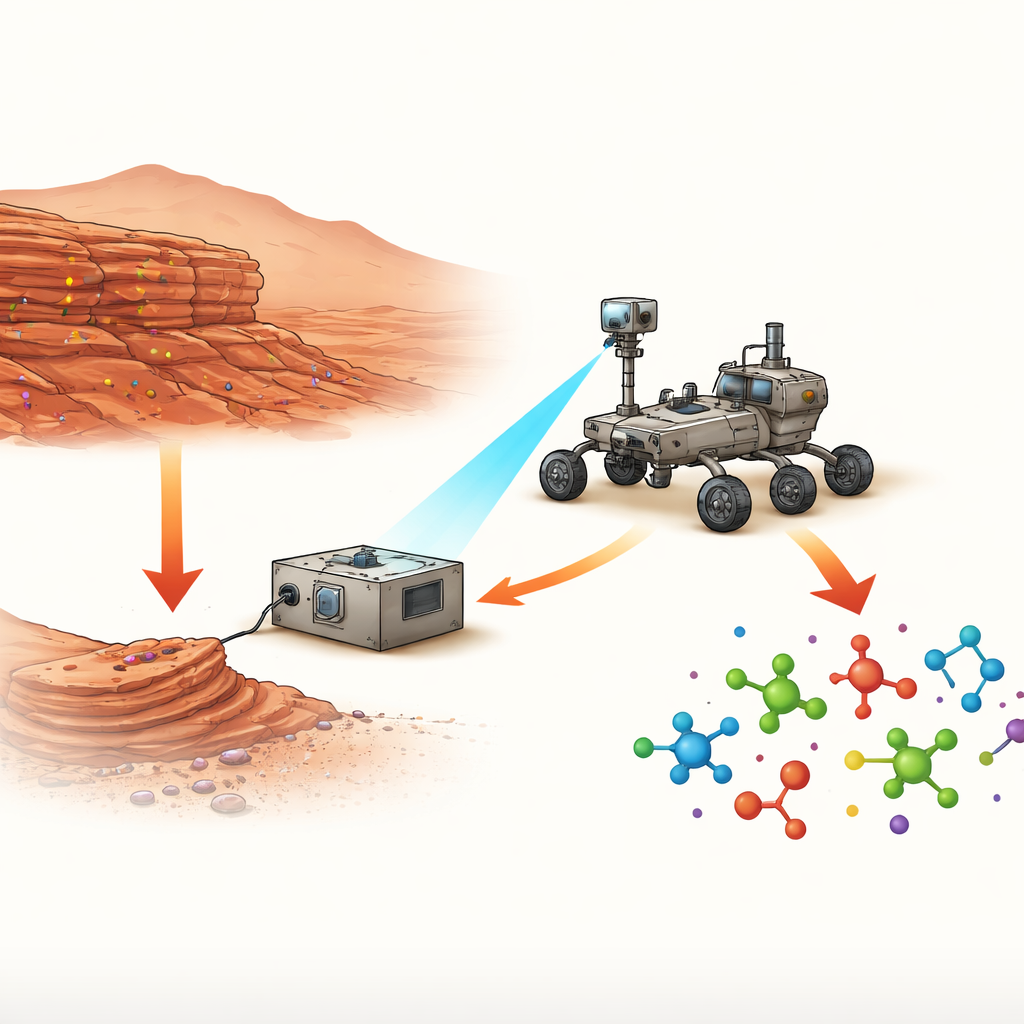
A Rover as a Mobile Mars Laboratory
The discoveries come from Curiosity’s Sample Analysis at Mars (SAM) instrument, which can heat drilled rock powder and sniff the gases that come off. In this experiment, the rover drilled into a clay-rich sandstone called Mary Anning 3, part of the Knockfarrill Hill member in Gale crater’s Glen Torridon region. These rocks were once sediments at the bottom or near the shore of an ancient lake, and their clay minerals are known on Earth to be good at trapping and preserving organic matter. By targeting such rocks, the team hoped to catch long-buried chemical clues from Mars’s distant past.
A Special Chemical Bath for Martian Dust
What makes this experiment different is a reagent called tetramethylammonium hydroxide (TMAH). Instead of simply baking the rock in an oven, SAM added this strongly alkaline liquid and then heated the mixture. On Earth, this approach—known as thermochemolysis—can break apart large, stubborn organic structures and “cap” the pieces in ways that make them easier to detect. Inside SAM, gases released during heating were partly measured directly and partly trapped, separated in gas chromatograph columns, and then analyzed by mass spectrometry to determine their identities.
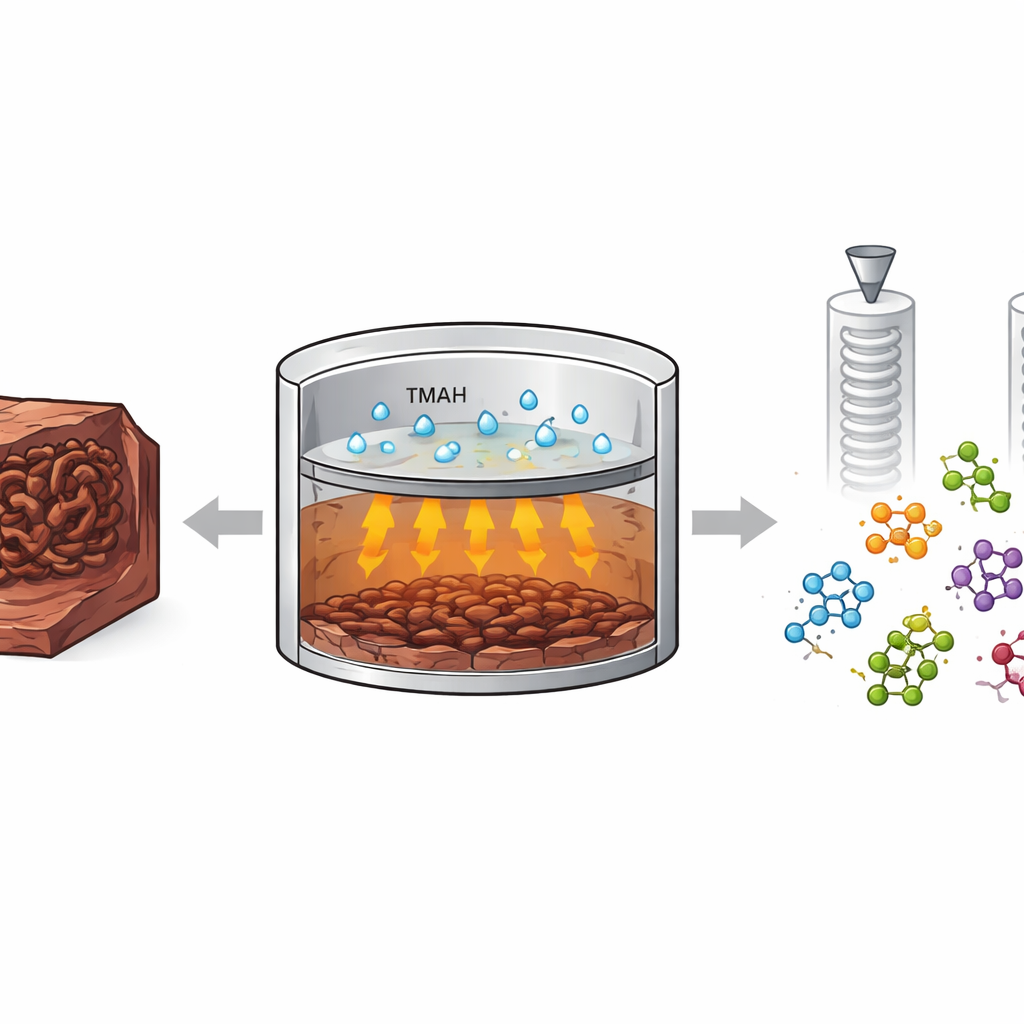
A Gallery of Martian Organic Molecules
The TMAH treatment revealed more than 20 different organic molecules that were either absent or far less obvious in earlier, simpler heating experiments on the same rock. Many of these molecules are ring-shaped, including benzene-like structures, two-ring compounds such as naphthalene, and sulfur-bearing rings such as benzothiophene. Some carry extra chemical groups that contain oxygen, nitrogen, or sulfur. The team even found signs of a nitrogen-bearing ring structure known as an N-heterocycle, a type of motif that, in other contexts, appears in biologically important molecules like nucleic acids. The variety and size of these compounds suggest they are fragments of larger, ancient macromolecular material that TMAH helped to break apart.
Sorting Mars-Born Molecules from Rover Artifacts
One of the biggest challenges is separating what truly comes from Mars from molecules produced elsewhere in the instrument. SAM’s plumbing contains its own organic materials, and a slow leak of another reagent (MTBSTFA) has been known since Curiosity landed. To untangle this, the scientists compared the Mary Anning 3 run with blank and cleanup runs, and with detailed laboratory tests. They also performed matching experiments on the carbon-rich Murchison meteorite, a stand-in for the type of material that may once have fallen on Mars. Many of the compounds seen in the Martian rock, including benzothiophene and various methylated ring systems, show the same behavior in meteorite tests when large carbon networks are broken down by TMAH. At the same time, some contamination markers did not appear, strengthening the case that key molecules, especially the larger aromatic rings, are indigenous to the Martian rock.
What These Chemical Traces Mean for Mars
Together, the results paint a picture of Mars as a world where complex carbon-based material was present early in its history and where some of it has endured in surface rocks for billions of years. The study does not claim that these organics are biological; they could come from meteorites, from non-biological reactions involving water and rock, or from other processes. But the sheer diversity of preserved molecules—including sulfur- and nitrogen-bearing species and possible N-heterocycles—shows that Mars has retained a chemically rich record of its past. This first in situ TMAH experiment proves that Curiosity and future missions can crack open ancient macromolecular material on Mars. With better-optimized runs and new instruments on upcoming rovers and landers, similar techniques could one day reveal whether any of that ancient carbon once formed part of living systems.
Citation: Williams, A.J., Eigenbrode, J.L., Millan, M. et al. Diverse organic molecules on Mars revealed by the first SAM TMAH experiment. Nat Commun 17, 2748 (2026). https://doi.org/10.1038/s41467-026-70656-0
Keywords: Mars organics, Curiosity rover, Gale crater, astrobiology, Martian geology