Clear Sky Science · en
High-Fidelity quantum teleportation mediated by hole transfer in an acceptor–donor–radical molecular triad
Teleporting Information Without Wires
Imagine sending the exact state of a tiny quantum compass from one end of a molecule to the other without physically moving it, and doing so with almost perfect accuracy. That is what this study achieves. The work shows how specially designed organic molecules can act as miniature quantum “wires,” teleporting quantum information in the form of an electron’s spin from one molecular site to another. This kind of capability could ultimately help link together future quantum devices on a chip, allowing them to talk to each other securely and efficiently at the nanoscale.
A Molecular Highway for Quantum States
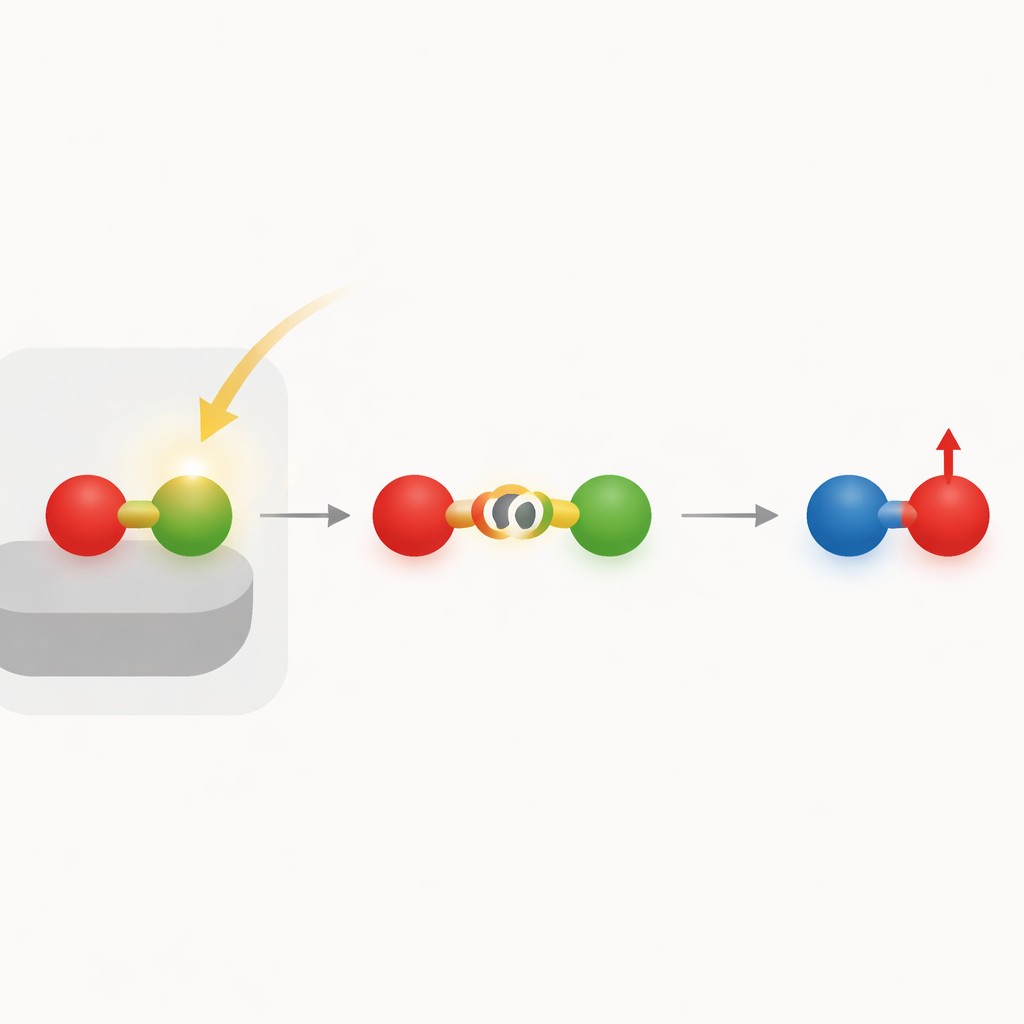
The researchers focus on quantum teleportation, a process where the state of a quantum bit (qubit) is transferred from a sender to a receiver using entanglement rather than physical transport. Here, the qubits are the spins of unpaired electrons localized on different parts of a single, tailor-made organic molecule. This molecule has three connected segments: an electron-accepting unit, an electron-donating unit, and a stable radical that carries an unpaired electron. By shining light on one end of the molecule and using carefully tuned magnetic pulses, the team prepares a spin state on the radical end and then teleports that state to the acceptor end, all within a single molecular framework.
How Light and Holes Drive the Teleportation
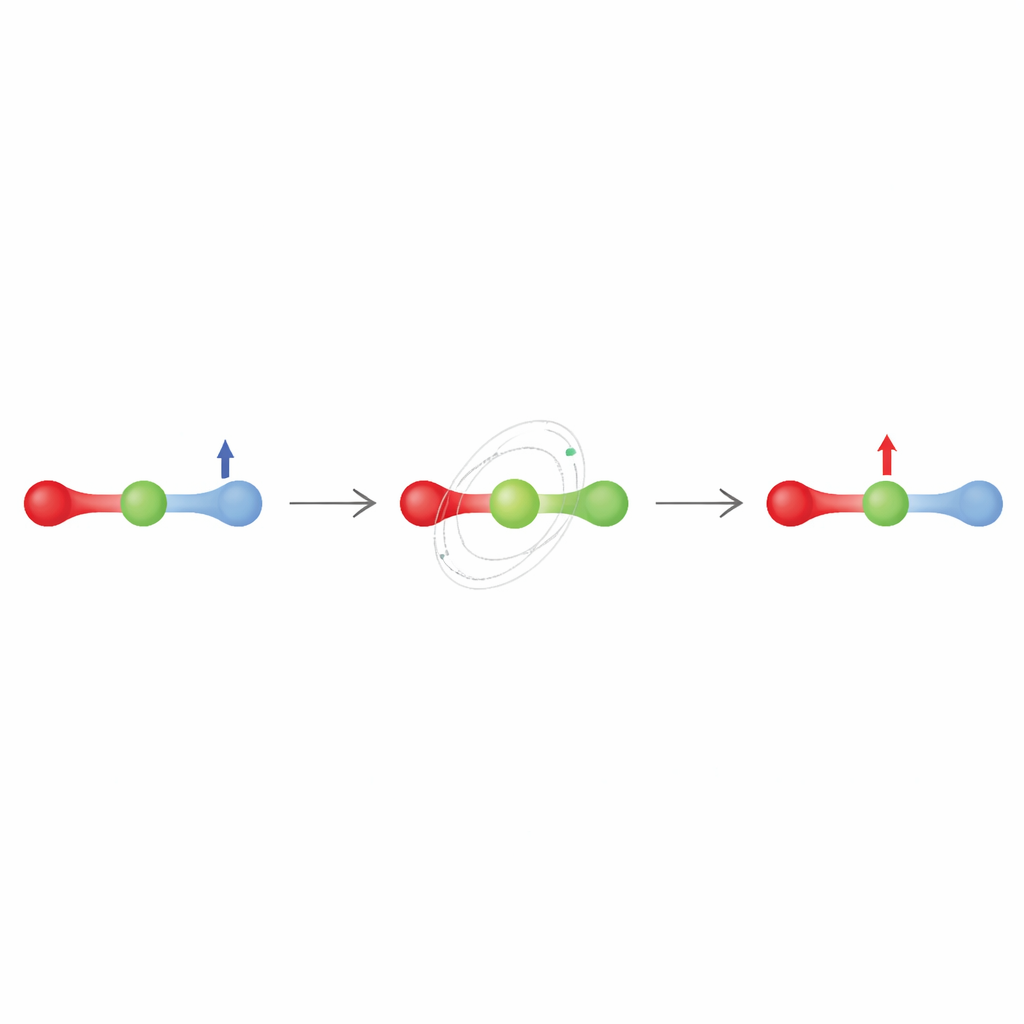
Teleportation in this system hinges on the movement of “holes,” which can be thought of as the absence of an electron in a bonding network. First, the spin on the radical segment is prepared using microwave radiation, aligning it in a chosen direction. Then, a brief flash of green light excites the acceptor segment, triggering a rapid hole transfer to the donor segment. This step creates a pair of spins on the acceptor and donor that are entangled, meaning they are linked in a quantum way no matter how they evolve. A second, spontaneous hole transfer from the donor to the radical segment acts as the crucial joint measurement step. That measurement forces the remaining spin on the acceptor to assume exactly the state that was originally encoded on the radical, completing the teleportation within billionths of a second.
Designing Molecules for Clean Quantum Transfer
Achieving reliable teleportation requires more than just the right sequence of events; it demands a carefully engineered molecular structure. The team chose specific organic building blocks so that the energy landscape favored the desired hole-transfer steps and suppressed unwanted reactions that would scramble the spins. They inserted a spacer group between the acceptor and donor to slow down certain recombination pathways and kept the radical close to the donor so that the second hole transfer, which performs the effective “readout,” happens quickly. At the same time, they increased the distance between the light-absorbing acceptor and the radical to reduce processes that would convert the clean entangled state into a more disordered one. These design choices help preserve the delicate quantum correlations needed for faithful teleportation.
Watching Spins Move With Microwaves
To verify that teleportation really occurred—and not just an ordinary transfer of particles—the researchers used a high-frequency technique known as pulse electron paramagnetic resonance. This method uses sequences of precisely timed microwave pulses to probe how spins behave in a magnetic field. By preparing the sender’s spin in a variety of superposition states and then measuring the spin on the receiver after the teleportation sequence, they could reconstruct the full quantum state on both sides. The patterns of oscillations and echoes they observed showed that not only the population of spin levels, but also the delicate phase relationships between them, were faithfully transmitted. In technical terms, the process reached a teleportation fidelity of about 98%, well above what could be achieved with any classical strategy.
Keeping Quantum Messages in Step
The study also identifies what limits the performance and how to push it further. One key factor is the slight difference in how the spins at the sender and receiver sites precess in the magnetic field, a property tied to their electronic environments. If the teleportation step is delayed, this mismatch causes the sender’s spin to rotate relative to the receiver’s frame, adding an unwanted phase and reducing fidelity. By choosing molecular fragments whose spins have more closely matched magnetic behavior and by minimizing the time between preparing the state and triggering teleportation, the team greatly reduced this problem. They also fine-tuned the microwave frequencies used for preparation and detection to minimize residual mismatches.
From Single Molecules to Quantum Networks
In the end, this work demonstrates that a single organic molecule can act as a high-precision quantum link, teleporting an electron’s spin state from one end to the other with remarkable accuracy via hole transfer. For a non-specialist, this means chemists can now design molecules that not only store quantum information, but also move it around coherently without moving matter itself. Such molecular “quantum interconnects” could become building blocks for future quantum networks on chips, where information is routed through carefully arranged arrays of molecules rather than metal wires.
Citation: Duan, J., Nakamura, S., Greene, C. et al. High-Fidelity quantum teleportation mediated by hole transfer in an acceptor–donor–radical molecular triad. Nat Commun 17, 3973 (2026). https://doi.org/10.1038/s41467-026-70654-2
Keywords: quantum teleportation, molecular spin qubits, electron spin coherence, organic quantum materials, entanglement transfer