Clear Sky Science · en
Astronomical calibration of the middle Cambrian in Baltica: global carbon cycle synchronization and climate dynamics
Reading Earth’s Ancient Rhythms
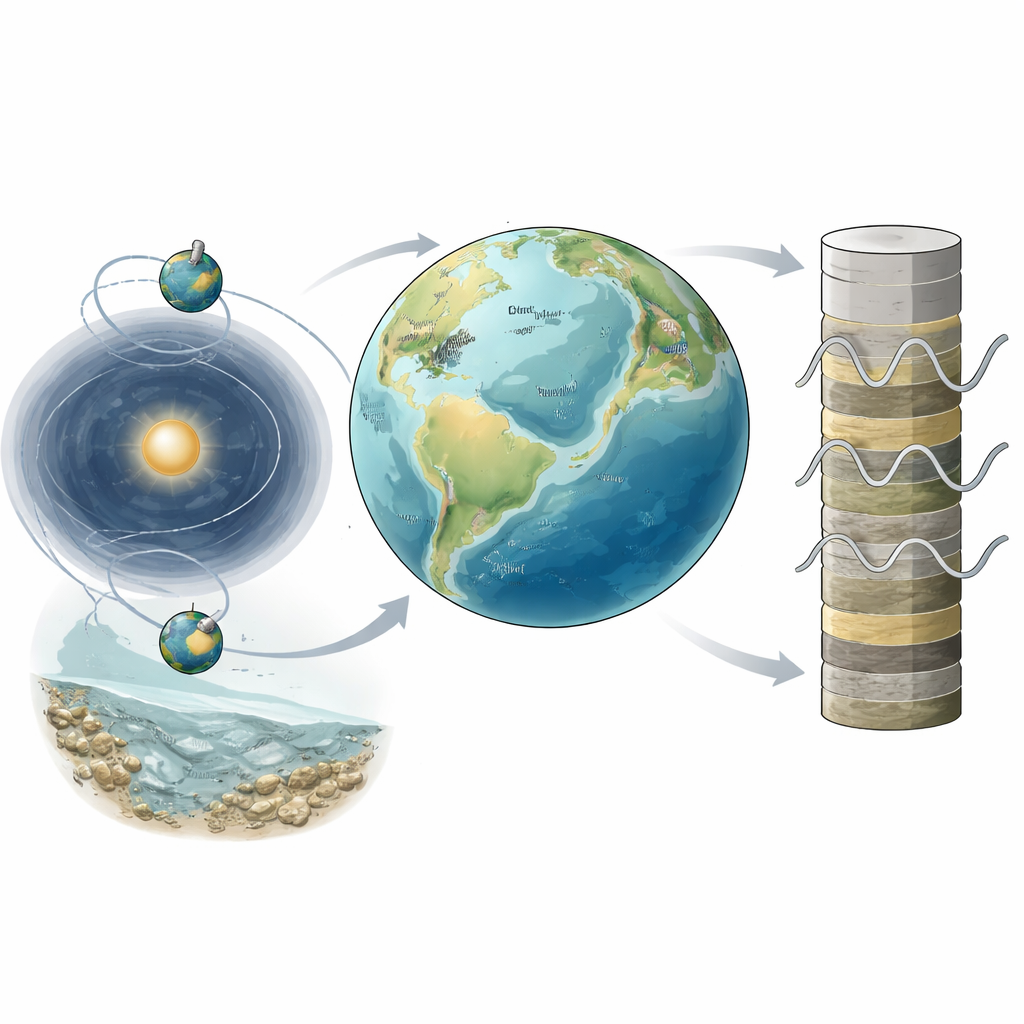
Long before dinosaurs, around 500 million years ago, our planet already pulsed to celestial rhythms. Subtle wobbles and shape changes in Earth’s orbit around the Sun paced ancient climates, reshaped shallow seas, and left a fingerprint in layers of ocean mud. This study digs into that fingerprint in rocks from southern Sweden to build one of the most precise clocks yet for a crucial slice of early animal evolution, revealing how space-driven climate swings synced with global changes in carbon and sea level.
A Time Capsule Beneath the Baltic
The research centers on the Alum Shale Formation, a thick pile of dark mudstones laid down on a broad, quiet sea floor that once covered much of what is now Scandinavia. Because deposition was continuous and rich in fossils, this formation is a prized archive for the Cambrian Period, when complex animal life rapidly diversified and oceans experienced repeated upheavals. The team studied a nearly 20-meter section of the Albjära-1 drill core in Scania, Sweden, representing part of the middle Cambrian “Miaolingian” epoch. This interval brackets several global ecological and chemical disturbances, including a key swing in the carbon cycle known as the Drumian Carbon Isotope Excursion, or DICE. The goal was to tie these events to a precise timeline and to the rhythm of Earth’s changing orbit.
Listening for Celestial Beats in Stone
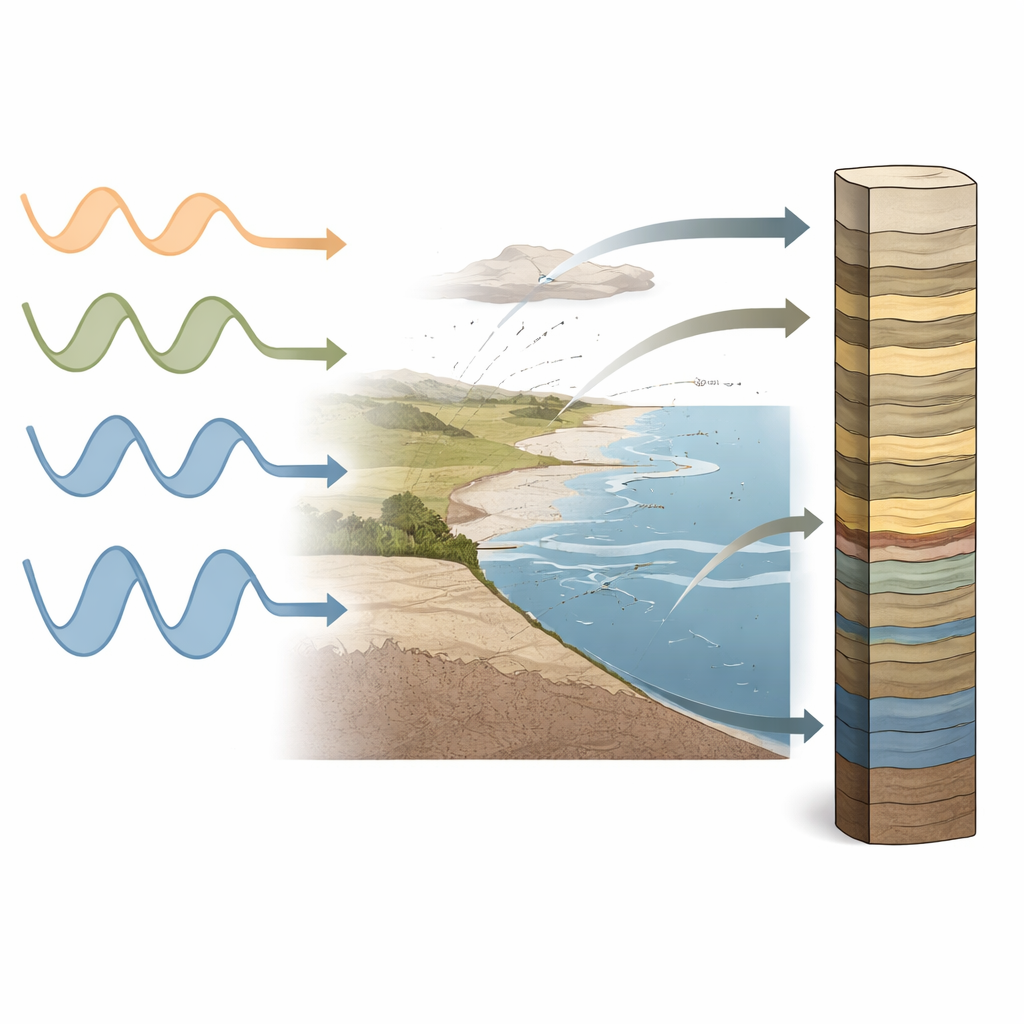
To turn rock layers into a time series, the authors used a multipronged approach. They measured tiny variations in the element titanium along the core at millimeter-scale spacing, analyzed organic carbon isotopes at high resolution, and refined the fossil-based zonation of the strata. Titanium is mostly delivered as fine mineral dust and mud from land, so its ups and downs track changes in sediment supply, which in turn respond to climate. By applying advanced signal-processing methods, the team searched these records for repeating patterns whose spacing matches the well-known cycles in Earth’s orbit: the stretching and squeezing of the orbit (eccentricity), the tilt of Earth’s axis (obliquity), and the wobble of that axis (precession). They found that one particular rhythm—an approximately 173,000-year cycle linked to slow changes in Earth’s axial tilt—stands out strongly and persistently in the core.
Building a Planetary Calendar
Using this 173,000-year “metronome” as a tuning fork, the researchers converted depth in the core into elapsed time and anchored their floating timeline to an exceptionally precise uranium–lead age from volcanic minerals higher in the same borehole. This yielded an astronomically calibrated time scale for the Miaolingian in Baltica, allowing them to estimate the durations of stages, fossil zones, and the DICE event itself with uncertainties of only a few hundred thousand years out of nearly seven million. They show that the Drumian stage lasted about three million years and that the DICE unfolded over roughly three-quarters of a million years. By comparing their carbon isotope curve and fossil sequence to records from China, Siberia, Laurentia, Gondwana, and other regions, they demonstrate that the Swedish core can serve as a global reference, tying together widely separated rock successions into a single, numerically dated framework.
Climate Swings, Dust, and Rising Seas
The calibrated record also sheds light on how orbital forcing shaped Cambrian climate and sediment delivery. During one interval, the 173,000-year tilt-related cycle dominated, and the data indicate that shifts between strong and weak seasonal contrasts altered atmospheric circulation, dust transport, and sea level. When Earth’s tilt effects favored “warm poles” and weaker climatic boundaries, more dust traveled from distant source regions toward the Scandinavian shelf, boosting titanium in the offshore muds. In other intervals, longer cycles in the shape of Earth’s orbit became more important. These eccentricity-driven swings appear to have controlled how much water was locked up in underground aquifers versus the oceans, causing sea level to rise and fall even in a largely ice-free world. Small sea-level drops let storms chew into shallow shelves and remobilize sediment into deeper water; rises drowned these sources and muted the signal of reworked material.
Why This Ancient Clock Matters Today
By decoding the rhythms buried in the Alum Shale, this work turns a remote slice of deep time into a well-dated story of cause and effect: how slow changes in Earth’s path around the Sun cascaded through atmosphere, oceans, and sediments, and how a global carbon-cycle disturbance like DICE fits into that story. For non-specialists, the take-home message is that the same celestial mechanics that still nudge our climate today were already orchestrating subtle but powerful environmental changes half a billion years ago. The new astronomical time scale not only sharpens our picture of early animal ecosystems but also underscores a broader truth: Earth’s climate system has long been exquisitely sensitive to regular, predictable forcing from space, and its responses are faithfully recorded in the rocks beneath our feet.
Citation: JAMART, V., PAS, D., HINNOV, L.A. et al. Astronomical calibration of the middle Cambrian in Baltica: global carbon cycle synchronization and climate dynamics. Nat Commun 17, 3912 (2026). https://doi.org/10.1038/s41467-026-70651-5
Keywords: Cambrian climate, Milankovitch cycles, Alum Shale, carbon isotope excursion, cyclostratigraphy