Clear Sky Science · en
Thermal detection of single photons using Dirac fermions
Why catching single particles of light matters
Being able to detect a single particle of light – a photon – underpins many emerging technologies, from unhackable quantum communication to ultrasensitive space telescopes and even new ways to search for dark matter. Today’s best single-photon detectors work wonderfully for relatively energetic light, but they struggle as photons get weaker, such as in the mid‑infrared or microwave bands that carry crucial information about the universe and quantum devices. This paper shows how an atom‑thin sheet of carbon called graphene, whose electrons behave like so‑called Dirac fermions, can be turned into a new kind of thermal single‑photon detector that overcomes some of these limits.
A new way to sense the faintest light
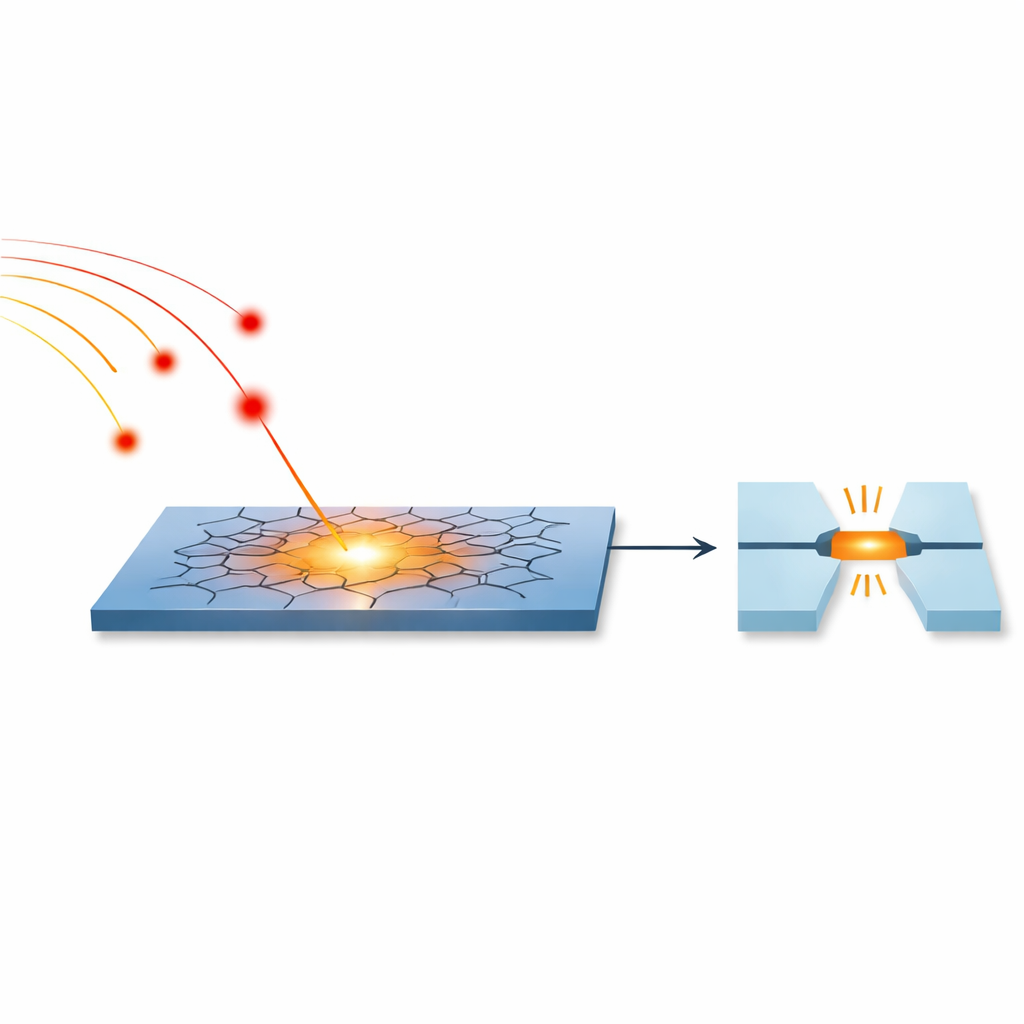
Most existing single-photon detectors rely on knocking electrons across an energy gap in a semiconductor or superconductor. That gap helps distinguish real photons from random noise, but it also sets a hard lower limit: if the photon’s energy is too small, it cannot bridge the gap and goes unnoticed. The authors take a different route. Instead of using a gap, they measure the tiny burst of heat that a single photon deposits in graphene, a material whose electrons have extremely low heat capacity near the “neutral” point where positive and negative charges balance. In this regime, even the energy of a single near‑infrared photon can raise the electron temperature in a microscopic patch of graphene by a couple of degrees, a surprisingly large effect at cryogenic temperatures around a few tenths of a degree above absolute zero.
Turning heat into a clear electronic signal
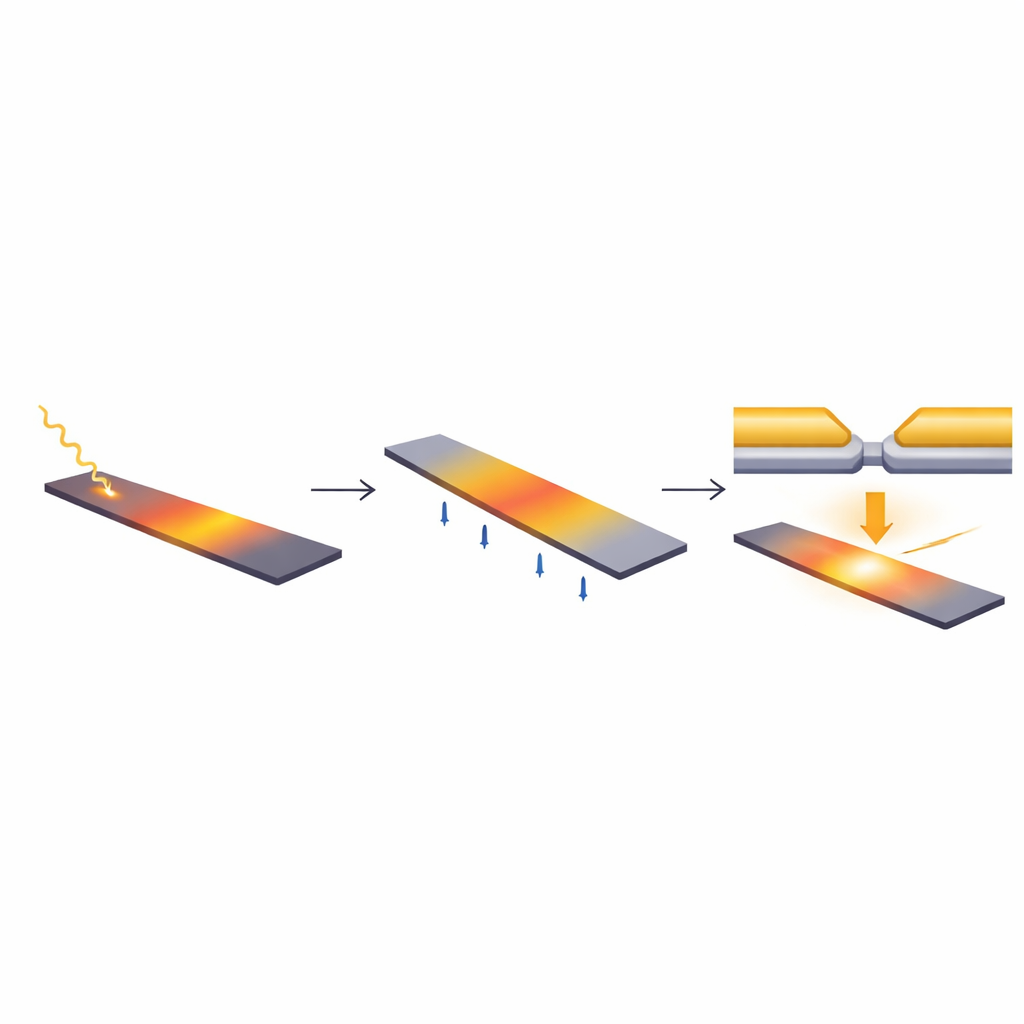
Detecting that brief temperature spike is a challenge: the hot electrons cool in mere tens of billionths of a second. To capture this fleeting event, the team couples the graphene strip to a device called a Josephson junction. Under normal conditions, this junction carries current with no voltage drop, behaving like a perfect conductor. But it is delicately balanced in a state where a small amount of extra thermal energy can push it over a barrier into a resistive state with a measurable voltage. In the experiment, a single photon absorbed by graphene creates a hot spot whose heat rapidly spreads across the whole strip. This uniform warming nudges the adjoining junction over its barrier, causing it to “switch” and latch into the resistive state long enough for the electronics to register a clear voltage pulse – effectively a click for one photon.
Proving true single-photon sensitivity
The researchers place their device in a dilution refrigerator at about 0.02 kelvin and shine in an extremely weak 1550‑nanometer laser, delivering only a few dozen photons per second to the graphene. By carefully mapping how often the junction switches as they vary the laser power, they show that the switching probability grows linearly with photon rate and that the statistics follow the expected Poisson distribution for individual, uncorrelated photons. They also scan the tiny light spot across the chip and find that switching occurs only when the beam overlaps the graphene, confirming that the photons are absorbed in the carbon sheet rather than in the surrounding superconducting contacts. Modeling how heat diffuses along the long, narrow graphene strip reveals that the thermal signal can travel hundreds of micrometers before it decays, so a photon absorbed far from the junction can still trigger a detection event.
Tuning performance with electrical knobs
Because graphene’s electronic properties can be controlled with a gate voltage, the team can fine‑tune how effectively the device works. Adjusting the electron density changes both the junction’s critical current and the graphene heat capacity. At too low density, the junction becomes fragile and prone to random switching; at too high density, the electrons store more heat, so a single photon produces a smaller temperature rise. By sweeping this gate voltage, the authors identify an optimal setting where the detector achieves an intrinsic quantum efficiency of about 87% – meaning nearly nine out of ten absorbed photons are registered – while keeping false alarms, or dark counts, as low as roughly one per second or even as rare as one per week, depending on how aggressively the device is biased. They also measure how performance degrades as the base temperature rises, and show that a simple thermal model of graphene’s electrons and their coupling to vibrations in the lattice explains the behavior up to about 1.2 kelvin.
What this means for future technologies
In accessible terms, this work demonstrates that an ultra‑thin sheet of carbon can act like a tiny thermometer so sensitive that the warmth from a single photon is enough to trip a nearby superconducting switch. Although the current device operates at very low temperatures, its combination of high efficiency, extremely low noise, and a detection principle not tied to a fixed energy gap makes it promising for extending single‑photon detection into lower‑energy parts of the spectrum that gap‑based detectors cannot easily reach. With further engineering, such graphene “bolometers” could help astronomers see faint far‑infrared signals from the early universe, assist searches for dark matter that reveal themselves through minute energy deposits, and broaden the toolkit for quantum communication and sensing across a much wider range of wavelengths.
Citation: Huang, B., Arnault, E.G., Jung, W. et al. Thermal detection of single photons using Dirac fermions. Nat Commun 17, 3845 (2026). https://doi.org/10.1038/s41467-026-70648-0
Keywords: single-photon detection, graphene bolometer, Dirac fermions, Josephson junction, quantum sensing