Clear Sky Science · en
Anterior cingulate neurons combine outcome monitoring of past decisions with ongoing movement signals
Why past choices still matter
Imagine playing a simple game where the rules never change, yet your brain still keeps track of what you just did and whether it worked. This study explores how a key brain region in mice quietly monitors the success or failure of recent choices even when that information is not needed to win the game. Understanding this hidden bookkeeping sheds light on how our brains stay ready to adapt when circumstances shift.
A steady world with hidden habits
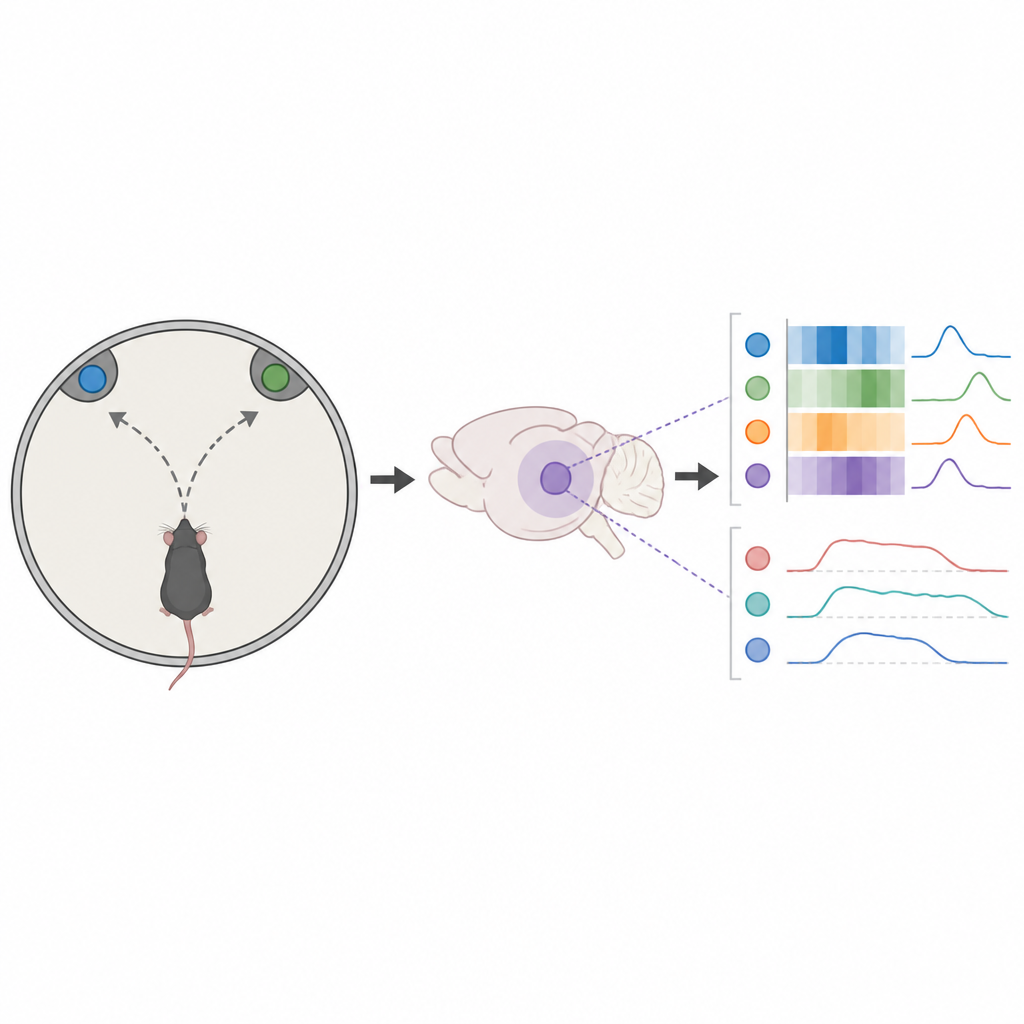
The researchers trained mice to perform a visual task in a very stable setting. On each trial, the animals saw a series of brief light flashes and had to decide whether the flashes came quickly or slowly, then walk to the left or right port for a reward. The rule linking the flash rate to the correct side never changed, and trial types were randomly ordered. In principle, the best strategy was to ignore what happened on earlier trials and focus only on the current flashes.
Choices still lean on recent history
Despite this simple rule, the mice’s decisions were nudged by what had just happened. After a rewarded choice to one side, they were more likely to pick that side again on the next trial. Using statistical models, the authors showed that recent choice-and-outcome combinations shifted the animals’ bias, while their sensitivity to the actual visual evidence remained strong. When the influence of trial history grew larger relative to the influence of the stimulus, overall performance dropped. This revealed that the animals’ natural tendency to rely on recent experience could actually make them worse at this particular task.
A brain area that tracks the recent past
The team next asked how neurons in the anterior cingulate cortex, or ACC, handled this information. Using tiny head-mounted microscopes, they recorded the activity of hundreds of ACC cells in freely moving mice. Many of these neurons responded in different ways depending on the combination of the last choice and its outcome. Computer decoders trained on the population’s activity could reliably tell whether the previous trial had been a correct left, correct right, incorrect left, or incorrect right choice, even as the mouse entered and performed the next trial. These signals persisted for seconds and sometimes remained readable after the animal had already made a new decision.
Separating thought from movement
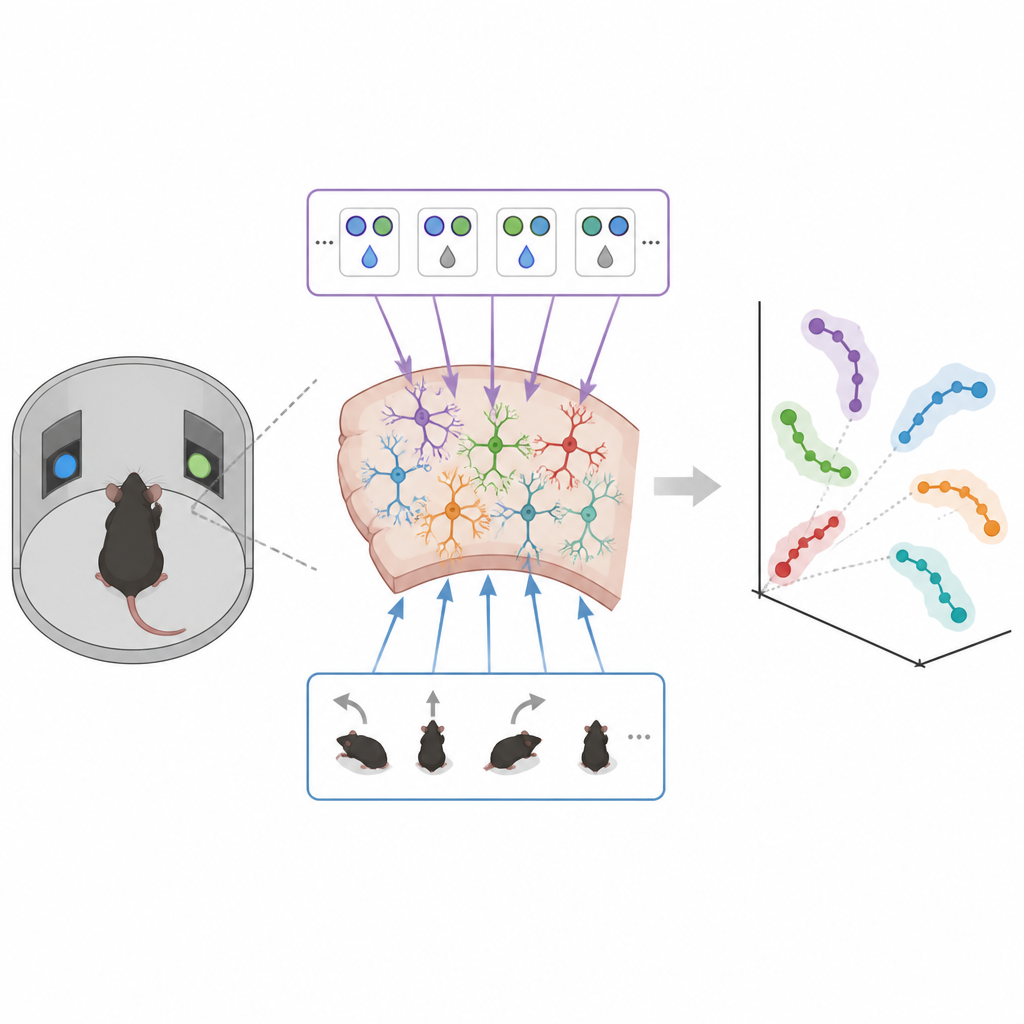
Because movement can strongly shape brain activity, the authors carefully measured the animals’ posture, steps, and head direction along with the neural data. They built models that tried to explain each neuron’s activity using either movements, sensory events, or trial history. As expected, many cells reflected how the body moved. Yet trial history alone also explained a substantial, distinct portion of neural activity that could not be reduced to how or where the mouse moved. This history-related activity was surprisingly compact, relying on a small set of shared patterns across neurons, and looked very similar from one mouse to another, in contrast to the more idiosyncratic movement signals.
Always ready to change course
In everyday life we often face shifting rules and uncertain rewards, but here the world was stable and predictable. Still, ACC neurons in expert mice kept a continuous record of recent choices and their outcomes, using a common population code that stayed largely the same across individuals and was partly independent of movement. To a layperson, this suggests that the brain keeps an internal scorecard of recent behavior even when it is not strictly needed, perhaps as a safety feature. By maintaining this running history, the ACC may allow animals, and likely humans, to quickly revise their strategies if the environment suddenly changes, trading a small cost in efficiency for the benefit of always being ready to adapt.
Citation: Oesch, L.T., Thomas, M.C., Sandberg, D. et al. Anterior cingulate neurons combine outcome monitoring of past decisions with ongoing movement signals. Nat Commun 17, 4354 (2026). https://doi.org/10.1038/s41467-026-70639-1
Keywords: anterior cingulate cortex, trial history, decision making, neural population activity, mouse behavior