Clear Sky Science · en
Global coincident bursts of high frequency oscillations across the human cortex coordinate large-scale memory processing
How the Brain Fires Together to Remember
When you suddenly recall a friend’s name or a word on the tip of your tongue, your brain is not working in just one spot. Instead, many areas light up and coordinate their activity in fractions of a second. This study peeks into that rapid electrical chatter inside the human brain and shows that brief, fast bursts of activity sweeping across distant regions act like a timing signal that helps bind together the pieces of a memory.
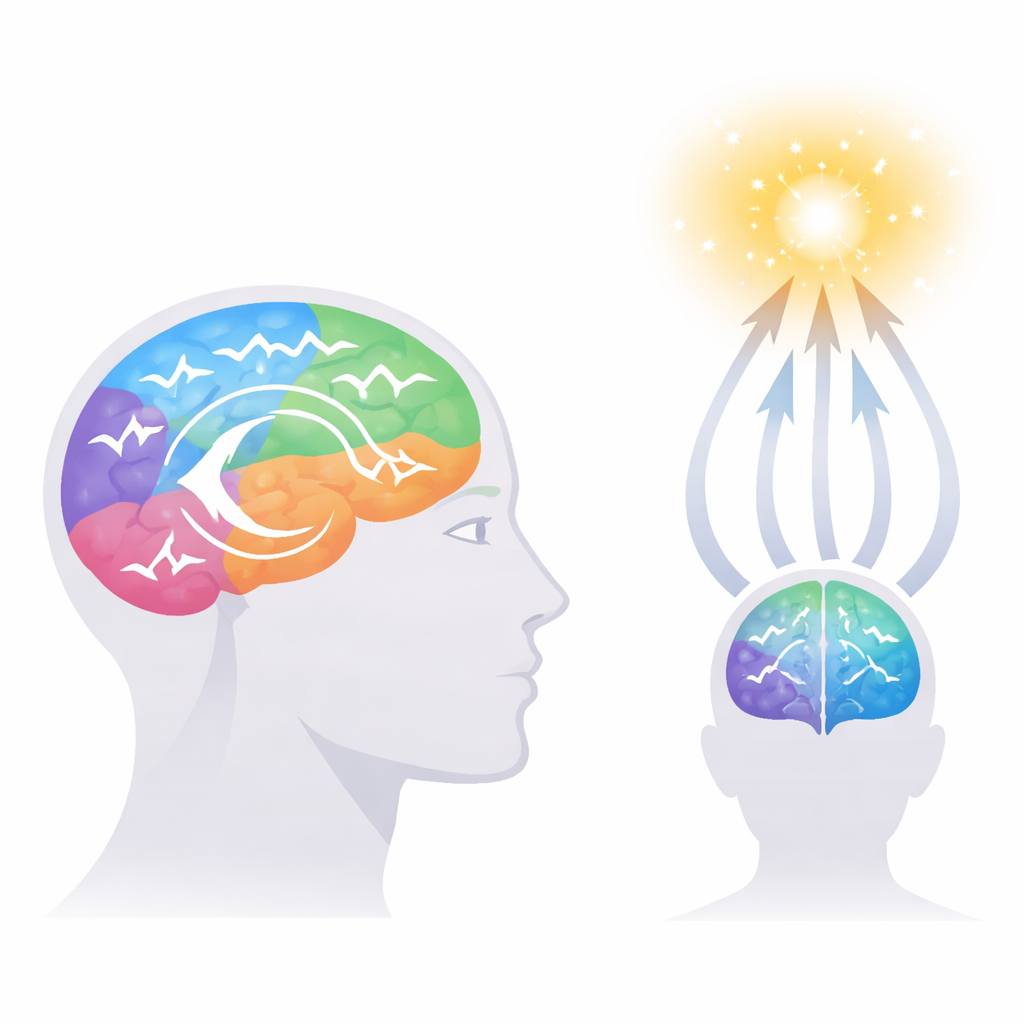
Fast Brain Bursts as a Hidden Signal
Our brains constantly generate tiny electrical waves. Among them are very fast wiggles, hundreds of times per second, that appear in short bursts. These high-speed bursts have long been studied in structures deep inside the brain that are crucial for memory, such as the hippocampus. The new work asks a broader question: do similar bursts appear all over the outer brain surface, and do they fire together at key moments when we form and recall memories? To find out, the researchers recorded directly from the brains of epilepsy patients who had thin electrodes implanted for clinical reasons. While the patients studied and recalled lists of words, the team tracked millions of these fast bursts across thousands of recording sites.
Whole-Brain Coordination During Memory Tasks
The recordings show that fast bursts do not stay local. Instead, many of them occur at nearly the same time in widely separated regions, including visual, frontal, parietal, temporal, and limbic areas. These “co-bursts” appeared during every phase of the word memory task, but their timing was strongly shaped by what the person was doing. When a word appeared on the screen, co-bursts rose across the cortex, matching the period when the brain was actively taking in and storing the new item. During free recall, the probability of widespread co-bursts dipped about a second before people began to speak, then rose sharply and peaked roughly 300 milliseconds before the first sound of the remembered word, suggesting that this coordinated activity is linked to the act of retrieving the memory rather than to moving the mouth.
Clues from Successful and Cued Remembering
The researchers also looked at differences between words that were later remembered and those that were forgotten. Before a new word appeared, co-bursts tended to be more strongly suppressed if the word would later be recalled, as if the brain was briefly quieting widespread activity to prepare for fresh information. During the word’s appearance, remembered items showed stronger co-bursting than forgotten ones. In a separate version of the task, where one word was used as a cue to trigger recall of its partner, the main peak of co-bursting shifted earlier in time, clustering around the moment when the cue was shown—well before the spoken response. This shift reinforces the idea that these fast, coordinated events are tied to the internal act of remembering, not simply to speaking.
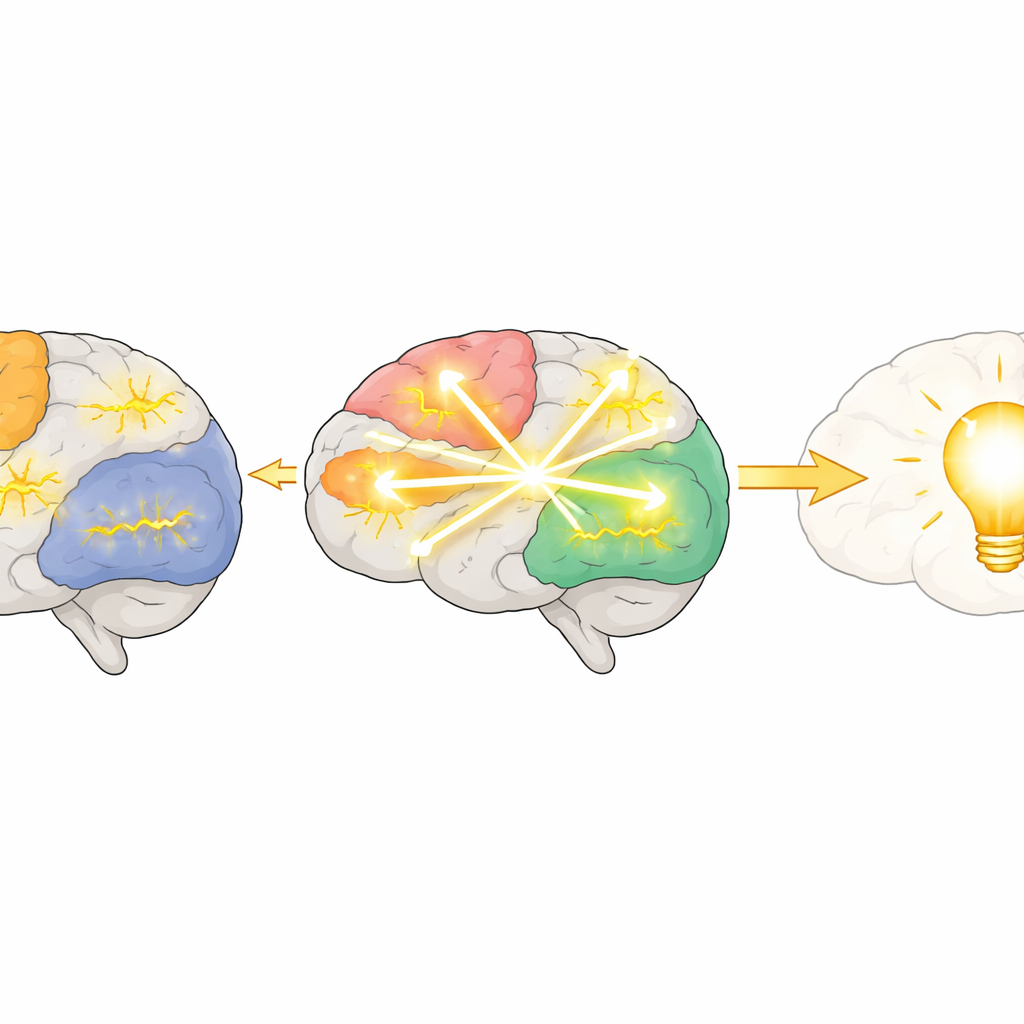
A Network That Spans Half the Brain
One striking result is how widespread these coordinated bursts are. For any given recalled word, roughly half of all recorded sites across the brain joined the co-bursting pattern, with similar involvement from sensory and higher-order regions. Certain areas weighed in differently depending on the phase: visual and parietal regions were more active during encoding, while frontal and limbic areas were more active during recall. Yet individual recording sites were not dedicated to single words. Most participated in co-bursts for many different items, suggesting that memories are supported by overlapping, flexible networks rather than neatly separated circuits for each concept.
Sequential Waves of Activity Form a Memory Chain
Looking more closely at the timing, the team found that global co-bursts are not just single, brief flashes. Instead, they unfold as a series of distinct waves, each involving a different combination of regions that fire together in turn during the recall of a single word. These waves were too orderly to be explained by chance: when the researchers randomly jittered the timing of bursts, the pattern broke down. This layered structure resembles the ordered firing sequences seen in animal studies of navigation and memory, hinting that our thoughts may be supported by cascades of coordinated activity sweeping across the cortex.
What This Means for Understanding Memory
To a layperson, the core message is that remembering a word is not the job of one “memory spot” in the brain. Instead, it relies on rapid, precisely timed bursts of activity that briefly unite many regions into a single working team. These global bursts appear to prepare the brain to store new information, help stamp in items that will later be remembered, and then knit together the pieces needed to call a memory back into awareness. By revealing this hidden timing signal, the study provides a potential handle for future brain therapies that aim to monitor or gently nudge these patterns in conditions that affect memory and cognition.
Citation: Prathapagiri, S., Cimbalnik, J., García-Salinas, J.S. et al. Global coincident bursts of high frequency oscillations across the human cortex coordinate large-scale memory processing. Nat Commun 17, 3996 (2026). https://doi.org/10.1038/s41467-026-70633-7
Keywords: memory networks, brain oscillations, cortical connectivity, human electrophysiology, neural synchronization