Clear Sky Science · en
The evolutionary consequences of behavioural plasticity
Why flexible behavior matters in a changing world
As climates warm, cities spread, and ecosystems are reshaped, animals and other organisms cannot instantly change their bodies to keep up. What they can often change quickly is their behavior: when they are active, where they hide, what they eat, or how closely they huddle together. This fast flexibility can temporarily protect them from harm, but it is not obvious whether it helps or hinders their long-term evolution. This paper uses large-scale computer simulations to ask how such short-term behavioral adjustments shape the pace and pattern of evolution over thousands of generations.
Quick fixes versus slow body change
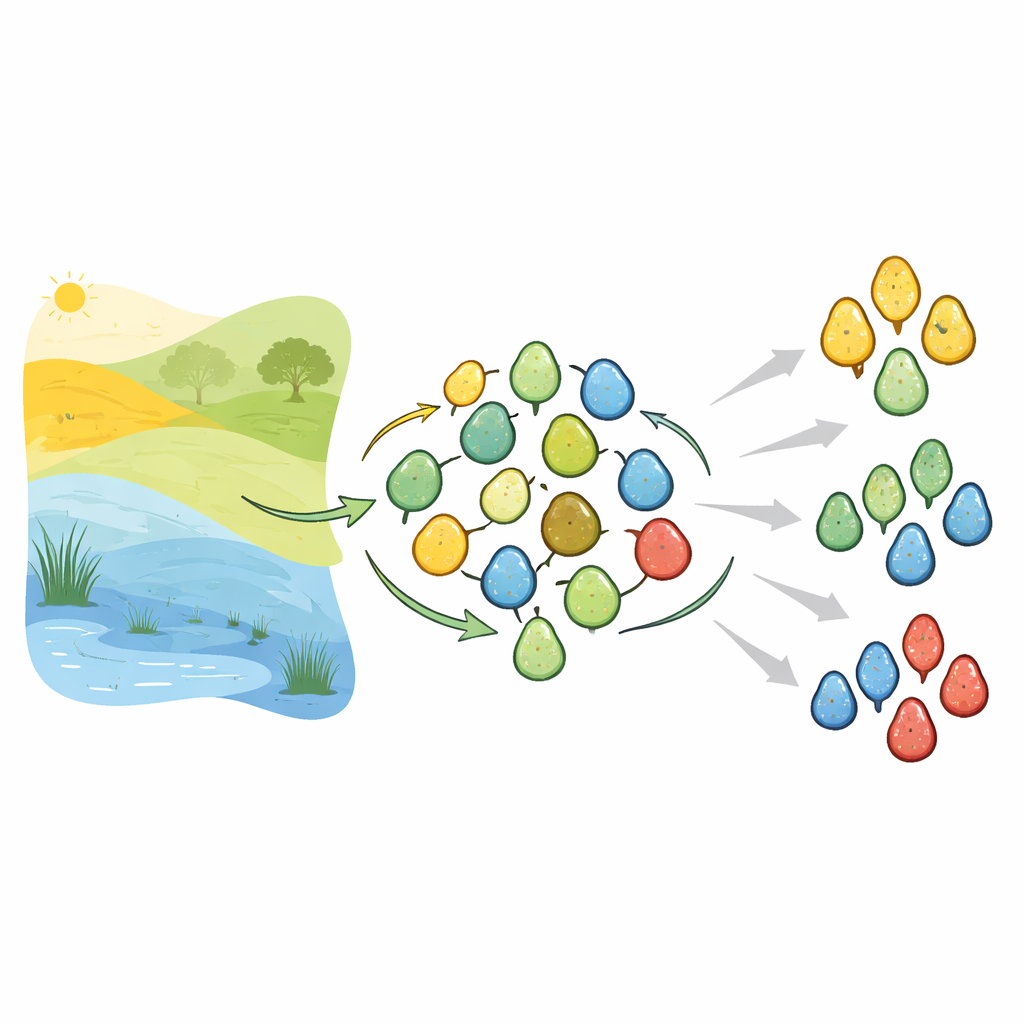
The study focuses on “behavioral buffering” – the ability of organisms to soften the blow of a bad environmental match by changing what they do rather than what they are. For example, an animal with the wrong amount of insulation for a new climate might choose cooler microhabitats, alter its daily schedule, or change its foraging strategy to cope. These changes can happen within a lifetime, unlike deeper shifts in physiology or body form that require many generations of genetic evolution. Two classic ideas make opposite predictions: the “cognitive buffer” view suggests that flexible behavior weakens natural selection and slows genetic change, while the “behavioral drive” view argues that it opens up new habitats and speeds evolution by exposing organisms to more varied conditions.
A digital world of changing climates
To explore these possibilities, the author builds an individual-based simulation of a simple trait: thermal insulation, imagined as fur thickness. Each digital organism carries a genetic value for insulation, and its survival and reproduction depend on how well that value matches the local temperature target. A single parameter represents how strong the behavioral buffer is for an entire lineage. When buffering is weak, even small mismatches between insulation and temperature greatly reduce fitness; when buffering is strong, mismatches matter less. Populations are allowed to evolve through mutation, mating, and selection under a stable climate, then face a moderate shift, and finally a dramatic change when small offshoot groups “colonize” much colder environments.
Slower evolution but deeper genetic reservoirs
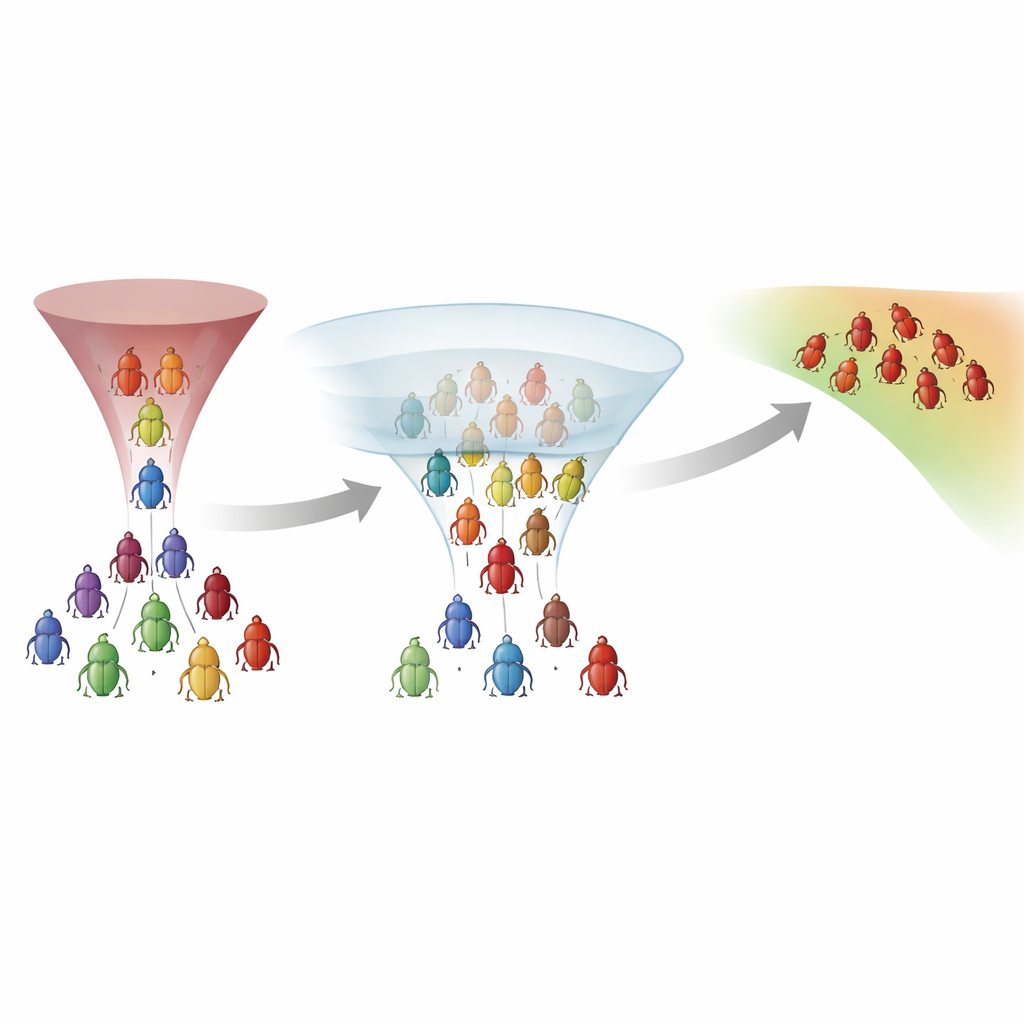
The simulations reveal that stronger behavioral buffering consistently slows the visible evolution of the insulation trait after an environmental shift. When behavior can easily compensate for a poor match, selection on genetic variants weakens and the average trait value moves more slowly toward the new optimum. Yet the same buffering has a second, less obvious effect: it allows a wider range of genetic variants to persist in the population instead of being quickly eliminated. Over time, lineages with higher behavioral flexibility accumulate more standing genetic variation, especially when selection would otherwise be strong or when mutation supplies many new variants. These genetically diverse lineages are better able to withstand sudden, severe environmental shocks, and their small founding groups are much more likely to survive and establish in extreme new habitats.
A “just-right” level of flexibility
When the model is extended to longer time spans and repeated colonization events, an intriguing “Goldilocks” pattern emerges. Lineages with very weak behavioral buffering adapt quickly in the short term but are prone to collapse when conditions change drastically, limiting their chance to diversify. Lineages with extremely strong buffering survive environmental upheavals but evolve their bodies and physiology very slowly, so sister species remain similar and diversification remains modest. In between lies a sweet spot: lineages with moderate behavioral flexibility are buffered enough to persist in many challenging settings, yet not so protected that natural selection on their genetic variation is paralyzed. Over long periods and across many environmental opportunities, these intermediate lineages show the fastest overall evolutionary change and the richest spread of forms.
Implications for conservation and evolution
For non-specialists, the key message is that slow visible evolution does not necessarily mean a species is unable to adapt. Behaviorally flexible animals, such as many big-brained birds and mammals, may look evolutionarily “stagnant” in body form precisely because their behavior shields them from harsh selection while quietly stockpiling useful genetic variation. This work suggests that conservation assessments that equate slow rates of morphological or physiological change with high vulnerability can be misleading. Instead, understanding and measuring behavioral flexibility may be crucial for predicting which lineages can ride out rapid human-driven environmental change and which are truly at risk.
Citation: Botero, C.A. The evolutionary consequences of behavioural plasticity. Nat Commun 17, 3880 (2026). https://doi.org/10.1038/s41467-026-70632-8
Keywords: behavioural plasticity, evolutionary adaptation, phenotypic plasticity, climate change resilience, cognitive buffer