Clear Sky Science · en
Water as a gas separation membrane
A new way to clean industrial gases
Many of the gases that power our world come mixed with carbon dioxide, which is costly to remove and harmful when released in large amounts. This study shows that something as simple as water can be turned into a powerful filter that helps separate carbon dioxide from other gases more efficiently, potentially lowering the energy use and environmental impact of processes like carbon capture, natural gas treatment, and biogas upgrading.
Learning from how trees breathe
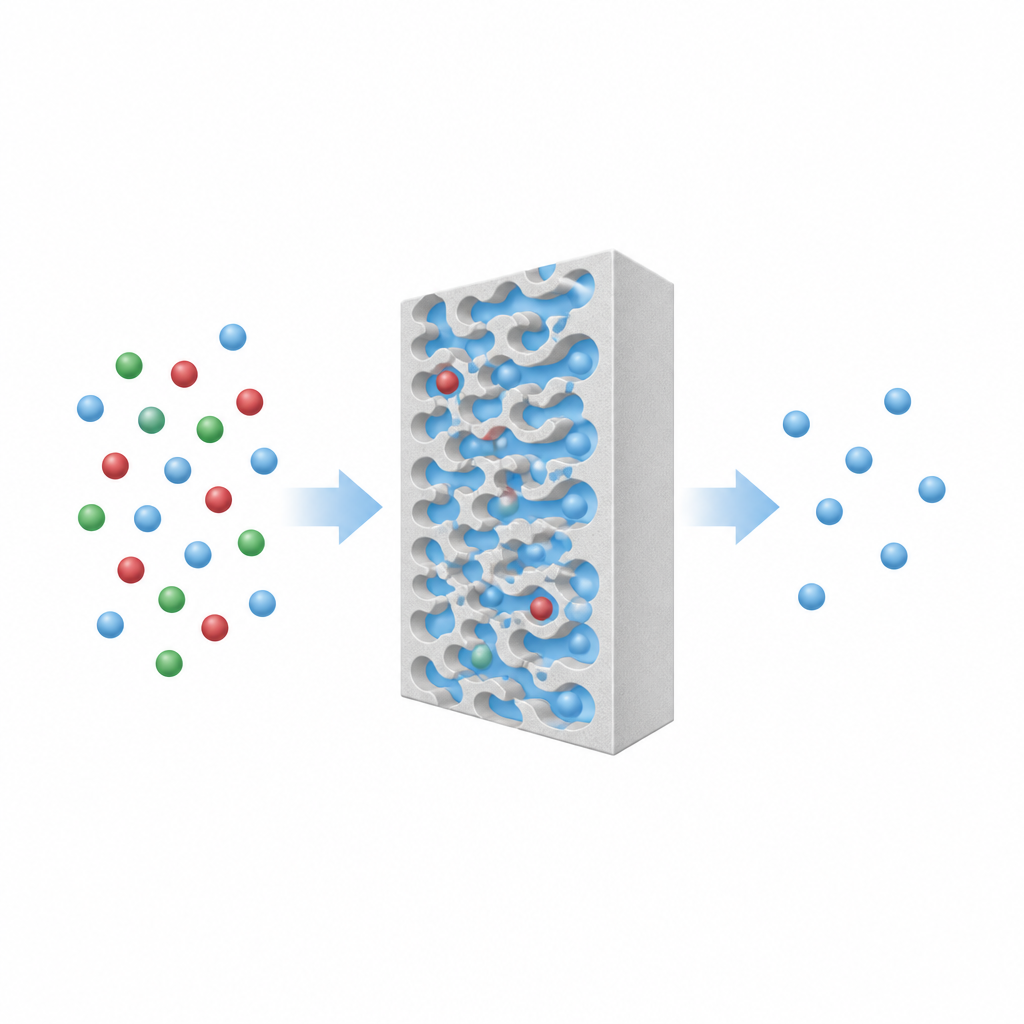
Trees quietly perform a difficult separation job every day. Inside their leaves, carbon dioxide from air dissolves into tiny water-filled channels before being used for photosynthesis. These channels hold water firmly in place even when pressures deep inside the plant become extremely low or high. The researchers borrowed this idea from nature and asked whether a thin layer of liquid water, held inside equally tiny man-made pores, could act as a selective gateway for gases in industrial equipment.
Turning water into a working filter
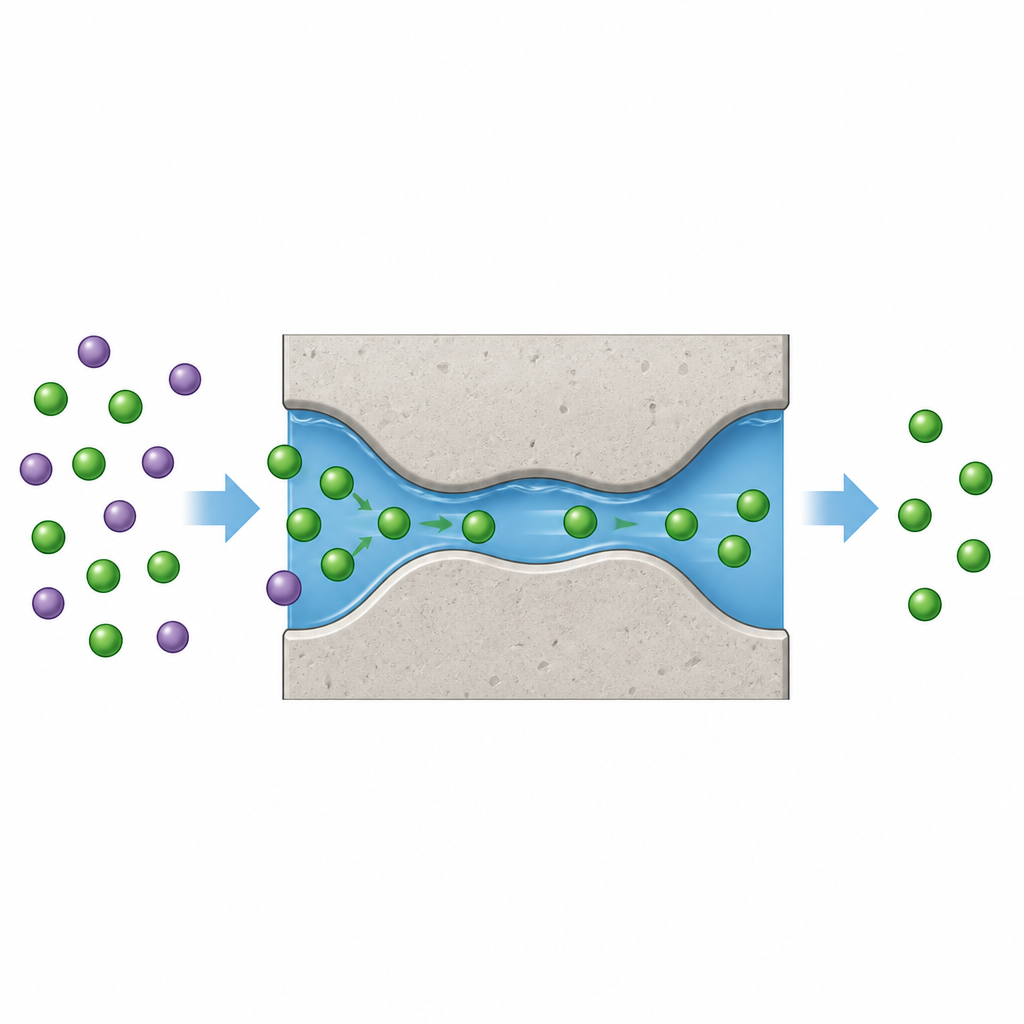
The team built membranes made of porous materials whose inner surfaces strongly attract water. When a small amount of water is added, it wicks into the sub-100-nanometer pores and stays there, forming a continuous liquid layer. Gas on one side of the membrane can only pass through by first dissolving into this water, then slowly diffusing across it, and finally re-emerging as gas on the other side. Because carbon dioxide is much more soluble in water than nitrogen, methane, or hydrogen, it passes through far more easily than those other gases, which are largely held back.
Balancing speed, selectivity, and strength
By carefully controlling how thick the trapped water layer is, the researchers were able to tune how quickly gases move through the membrane. Thinner water layers mean shorter travel distances for dissolved gas molecules, so the overall flow rate increases. Remarkably, shrinking the water layer down to less than 200 nanometers boosted carbon dioxide throughput by nearly three orders of magnitude without sacrificing its strong preference over other gases. The membranes with the thinnest water layers reached very high carbon dioxide flow rates while still separating it from nitrogen, methane, and hydrogen far better than most existing industrial membranes.
Staying stable under harsh conditions
For any new separation technology to matter in practice, it must withstand real-world pressures, dryness, and complex gas mixtures. The nanoscale pores in these water membranes create strong capillary forces that keep the water locked in place even when gas pressures exceed 70 bar, a range relevant to natural gas processing. The team showed that performance remained steady over at least eight days of continuous operation using very dry gas feeds, because water confined in such small spaces evaporates only slowly. They also tested commercially available polymer membranes filled with water and found that, although thicker and less permeable, they showed similar carbon dioxide selectivity and handled mixed gas streams in crossflow, suggesting that scale-up should be feasible.
What this means for future gas cleaning
In simple terms, the study reveals that a thin, well-confined layer of water can outperform many advanced materials used today for separating carbon dioxide from other gases. The key advantages are that water is abundant, non-toxic, and stable under high pressure when held in tiny pores, and that its natural tendency to dissolve carbon dioxide much more readily than other common gases does most of the separation work. With further engineering to refine support materials, pore sizes, and durability in complex gas streams, water-based membranes could become a robust, energy-efficient, and environmentally friendly platform for cleaning industrial gases.
Citation: Lopez, K.P., Saffer-Meng, M., Allouzi, M. et al. Water as a gas separation membrane. Nat Commun 17, 4311 (2026). https://doi.org/10.1038/s41467-026-70630-w
Keywords: water membrane, carbon dioxide separation, gas purification, nanoporous materials, carbon capture