Clear Sky Science · en
Optical imaging of the intrinsic adsorption kinetics in single zeolite nanoparticles
Watching Tiny Sponges at Work
From cleaning up exhaust gases to turning crude oil into everyday chemicals, industry relies on tiny “sponges” called zeolites. They are riddled with nanosized pores that can sort and transform molecules. Yet, surprisingly, scientists have not been able to clearly watch how fast individual molecules move in and out of a single zeolite particle. This study develops a new way to see that hidden motion in real time, revealing that the cramped space inside these pores can flip the usual rules for how quickly molecules stick to a surface.
Why Nanopores Matter
Zeolites and similar porous materials have been industrial workhorses since the 1950s because their pore sizes can be tuned to admit some molecules while rejecting others. Traditionally, their performance has been explained mainly by size and shape: if a molecule fits into a channel, it can react or be separated there. But the extreme confinement inside these pores also changes how molecules interact with the material, affecting which reaction paths they follow and how strongly they are held. Until now, most experiments have measured large piles of particles at once, mixing together slow gas transport, diffusion through many crystals, and the true molecular sticking and release events at the active sites. This has left a major blind spot in understanding the actual step-by-step kinetics of adsorption inside a single nanoparticle.
Seeing Single Nanoparticles Light Up
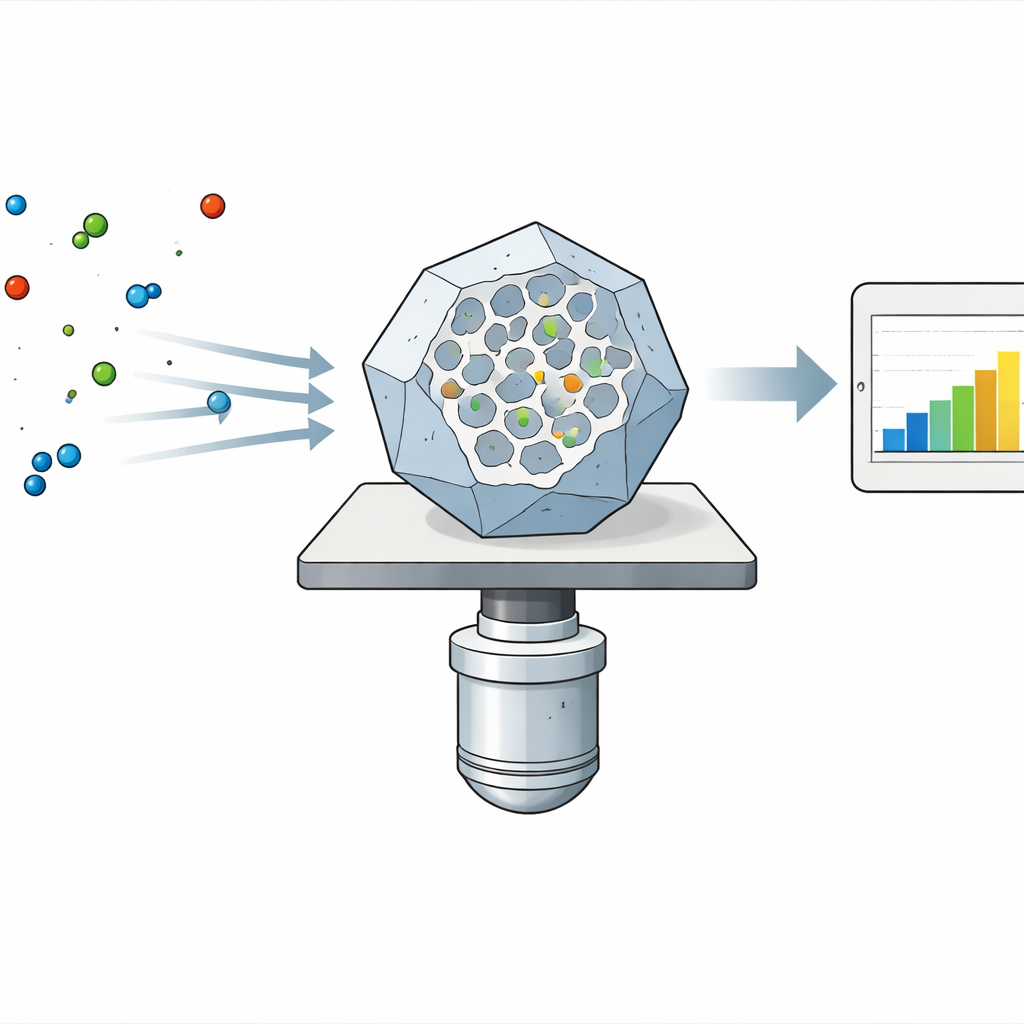
The authors tackled this problem by shrinking the experiment down to single zeolite nanoparticles of ZSM-5, a widely used catalyst. They built a dark-field optical microscope equipped with a tiny gas-flow chamber and a micro-heater. Individual nanoparticles scattered light as bright points against a dark background. When gas molecules such as propene flowed into the chamber, they entered the pores and increased the particle’s mass and refractive index, causing its scattered light intensity to rise. When the gas was switched back to nitrogen, the molecules left and the brightness fell again. Control tests with other gases and with non-porous particles confirmed that these optical changes truly came from adsorption and desorption inside the zeolite. Because the particles were so small and the gas environment was carefully controlled, the measurements largely avoided slow, large-scale transport effects.
Timing the Stick-and-Release Dance
By varying the gas pressure and following the brightness of many single particles over time, the team could fit simple mathematical curves to extract how fast molecules attached to and detached from the active sites. They found that adsorption followed a pseudo-first-order reversible process: the observed rate grew linearly with gas pressure, while the desorption rate stayed essentially independent of pressure. This behavior, and the lack of any dependence on particle size, showed that the observed kinetics were governed by local interactions at specific sites rather than by diffusion through the pores. From these curves, the researchers obtained intrinsic rate constants for adsorption and desorption, and from their ratio they could calculate equilibrium constants—thermodynamic measures of how strongly the gas preferred to be inside the zeolite rather than in the surrounding atmosphere.
When Stronger Binding Means Slower Arrival
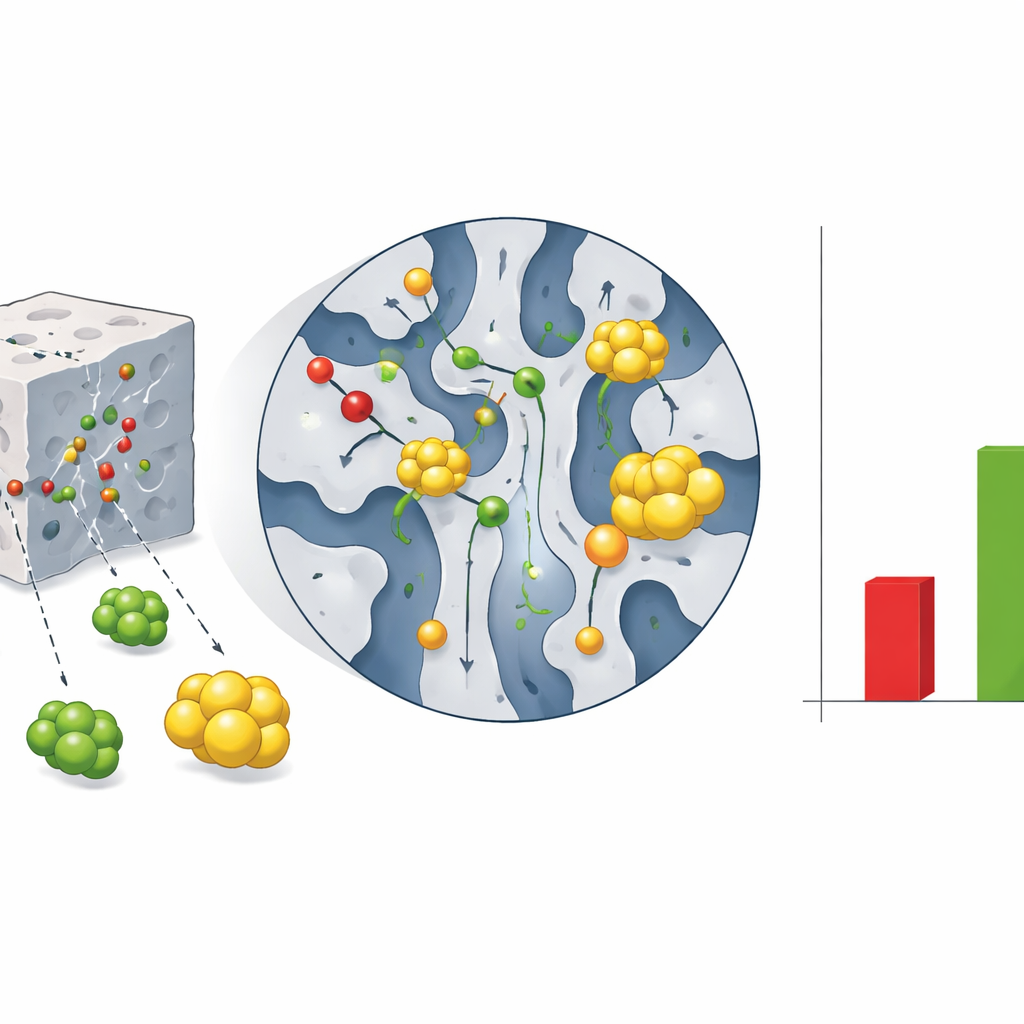
The most surprising result emerged when the team compared three related light olefins—ethylene, propene, and butene—on exactly the same ZSM-5 nanoparticle. All three could enter the pores, and their equilibrium strengths of binding matched theoretical expectations based on how easily they accept a proton: the more basic the molecule, the more strongly it was held. However, the intrinsic adsorption rates showed the opposite trend: molecules that bind more strongly actually stuck more slowly. Detailed temperature-dependent measurements linked this “reversal” to higher energy barriers that larger, more strongly interacting molecules must overcome as they squeeze through the tight pore geometry into the active sites. Experiments on zeolites with smaller and larger pores confirmed that this counterintuitive behavior weakened and eventually vanished as the pores became roomier, underscoring the central role of spatial confinement.
Rewriting the Rules for Tiny Pores
This work shows that, inside the cramped interior of a nanoporous solid, stronger attraction between a molecule and a surface does not always translate into faster sticking. By directly imaging the optical response of single zeolite nanoparticles, the authors separate true molecular kinetics from bulk transport and extract intrinsic rate and energy parameters for adsorption and desorption. Their findings reveal that confinement—not just interaction strength—can dominate how and how fast molecules move in and out of catalytic pores. This new window into nanoscale adsorption could guide the rational design of zeolites and other molecular sieves for cleaner fuels, more efficient chemical separations, and better catalysts tailored to specific molecules.
Citation: Yi, X., Han, H., Chang, A. et al. Optical imaging of the intrinsic adsorption kinetics in single zeolite nanoparticles. Nat Commun 17, 3811 (2026). https://doi.org/10.1038/s41467-026-70625-7
Keywords: zeolites, adsorption kinetics, nanoporous materials, single-particle imaging, catalysis