Clear Sky Science · en
Catalytic enantioselective synthesis of azahelicenes via cascade Pictet-Spengler reaction and dehydrogenative aromatization
Twisted Molecules with a Useful Spin
Many of today’s advanced materials and medicines depend on molecules that are not just built from the right atoms, but also twisted in the right way in three-dimensional space. This paper reports a new way to make such “handed” spiral molecules—called helicenes—that contain nitrogen atoms. These twisted frameworks can interact with light and other molecules in highly selective ways, opening doors to more efficient catalysts, sensors, and next‑generation display or communication technologies.
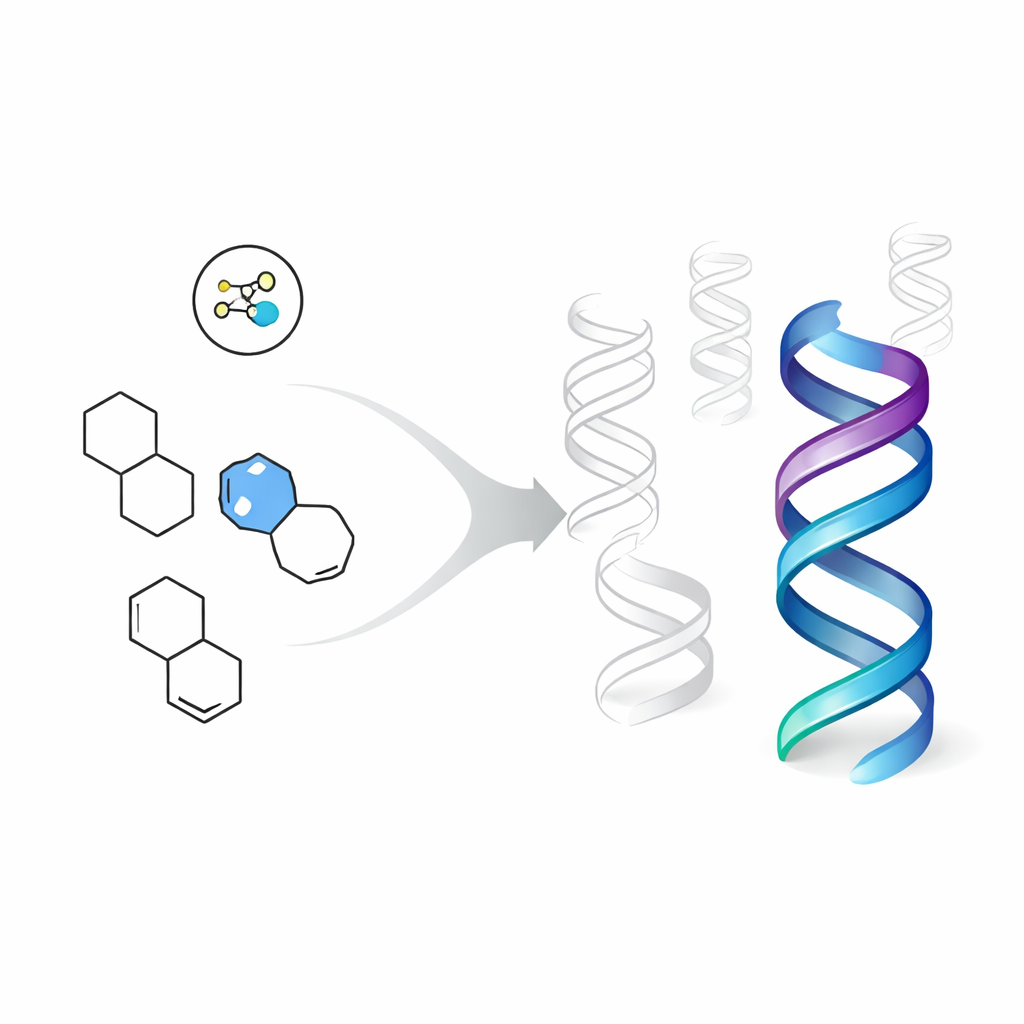
Why Twisted Rings Matter
Helicenes are stacks of ring-shaped units that wind into a screw‑like form, much like a molecular spring. Because they twist either to the left or to the right, each form can behave differently, for example in how it bends light or recognizes other molecules. Swapping one of the usual carbon‑based rings for a nitrogen‑containing ring changes how electrons move along the helix, which in turn tunes color, brightness, and electrical behavior. These nitrogen‑rich “azahelicenes” are therefore attractive as ingredients for chiral catalysts, specialized light‑emitting diodes, and devices that detect circularly polarized light. Until now, however, making one pure “hand” of these molecules in an efficient and scalable way has been difficult.
A Cascade Shortcut to Handed Spirals
The authors devised a compact, two‑step‑in‑one strategy that both builds the helicene framework and selects a single handed form at the same time. They start from an indole‑based molecule already pre‑bent into a partial helix and bearing an embedded aniline group. When this starting material meets a simple carbonyl partner—either an aldehyde or a related compound called an isatin—in the presence of a finely tuned chiral phosphoric acid catalyst, the parts snap together through a classic ring‑forming transformation known in organic chemistry, while regular air quietly completes the job by removing hydrogen atoms and restoring aromatic character. Remarkably, these separate actions flow as a cascade in one vessel, turning fairly simple inputs into elaborate seven‑ring helicenes in a single operation.
Letting Motion Work for Selectivity
A key insight is that the starting material itself can slowly interconvert between left‑ and right‑handed shapes at the reaction temperature. The chiral catalyst, however, reacts faster with one orientation than the other. As the “favored” version is consumed, the “unfavored” one flips into it and is then also transformed, a process known as dynamic kinetic resolution. Through careful mechanistic experiments and temperature studies, the team showed that this interplay between motion and selection allows them to funnel a mixture of mirror‑image starting forms into a single handed helicene product. Once formed, the helical products are rigid enough that they do not easily twist back, giving stable, highly pure enantiomers that survive further chemical modification and even heating with metal catalysts.
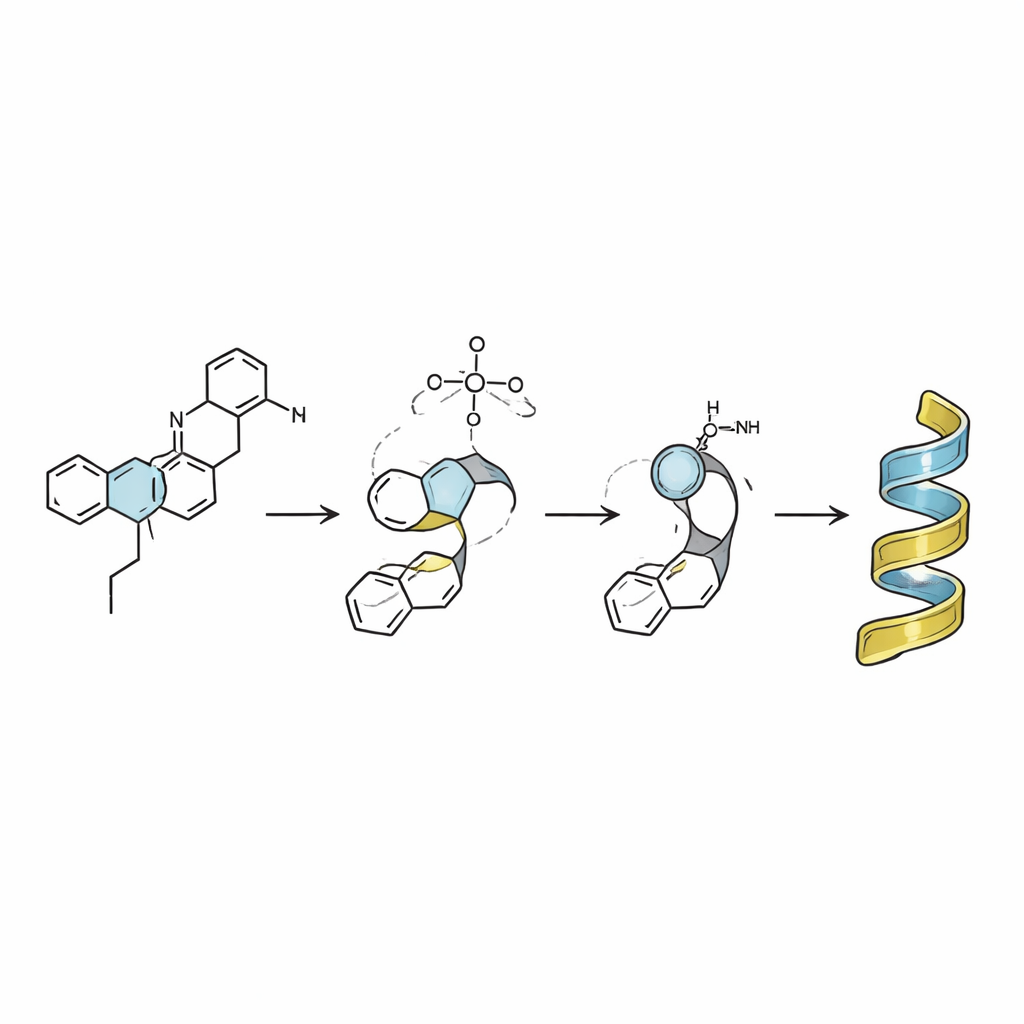
Unexpected Ring Growth and Easy Tailoring
When the researchers swapped aldehydes for isatins, they discovered an unplanned but welcome twist: after the initial ring‑forming step, the isatin framework undergoes an oxidative rearrangement that expands part of the structure into a seven‑membered ring fused onto the helix. This “skeletal editing” produces a new family of azahelicenes with an extra heterocycle, still in a single dominant handed form. Both the standard and expanded helicenes can then be decorated further: rings can be extended, side groups swapped, or new bonds added using well‑known coupling reactions. Importantly, these upgrades do not scramble the helical handedness, showing that the products are both chemically robust and stereochemically locked.
Light, Color, and Catalytic Talent
The team also explored what these twisted frameworks can do. The new azahelicenes absorb and emit visible light, with brightness that surpasses that of closely related all‑carbon helicenes. Because they contain basic nitrogen sites, their color and glow can be switched reversibly by adding or removing acid, hinting at applications as pH‑responsive optical sensors. Measurements of how they interact differently with left‑ and right‑handed circularly polarized light confirmed strong chiroptical signals in both absorption and emission, a key requirement for circularly polarized light sources and detectors. Finally, by converting one helicene into a primary amine derivative, the authors created a small organic catalyst that itself is helical: this compound can drive another asymmetric reaction with high selectivity, demonstrating that the twisted scaffold is not just a passive building block but an active tool for controlling molecular shape in downstream chemistry.
What This Means Going Forward
In plain terms, the authors have shown how to turn simple flat starting materials into sturdy, nitrogen‑containing molecular springs with a chosen twist, using a single chiral acid catalyst and ordinary air. The method is efficient, flexible in the building blocks it accepts, and produces products whose handedness is both high and durable. Because these helicenes combine strong optical activity, tunable fluorescence, and reliable stability with ready further modification, they offer a versatile platform for future chiral catalysts, light‑based devices, and responsive materials that exploit the subtle power of molecular twist.
Citation: Qin, T., Xie, W. & Yang, X. Catalytic enantioselective synthesis of azahelicenes via cascade Pictet-Spengler reaction and dehydrogenative aromatization. Nat Commun 17, 3970 (2026). https://doi.org/10.1038/s41467-026-70617-7
Keywords: helicenes, chiral catalysis, Pictet-Spengler reaction, circularly polarized light, azahelicenes