Clear Sky Science · en
Flash joule heating-induced spinel-phase surface in Ni-rich layered oxide positive electrodes to stabilise lattice oxygen
Why Better Batteries Need Tougher Surfaces
Electric cars and smartphones rely on lithium-ion batteries that can store a lot of energy and last for many years. One of the most promising battery materials, called high-nickel layered oxide, offers high energy but tends to wear out too quickly. This study shows a new way to "toughen up" the surface of these materials so they lose far less capacity over time, using an ultra-fast heat treatment that reshapes only the outer skin of the particles without harming the inside.
The Hidden Weak Spot in High-Energy Batteries
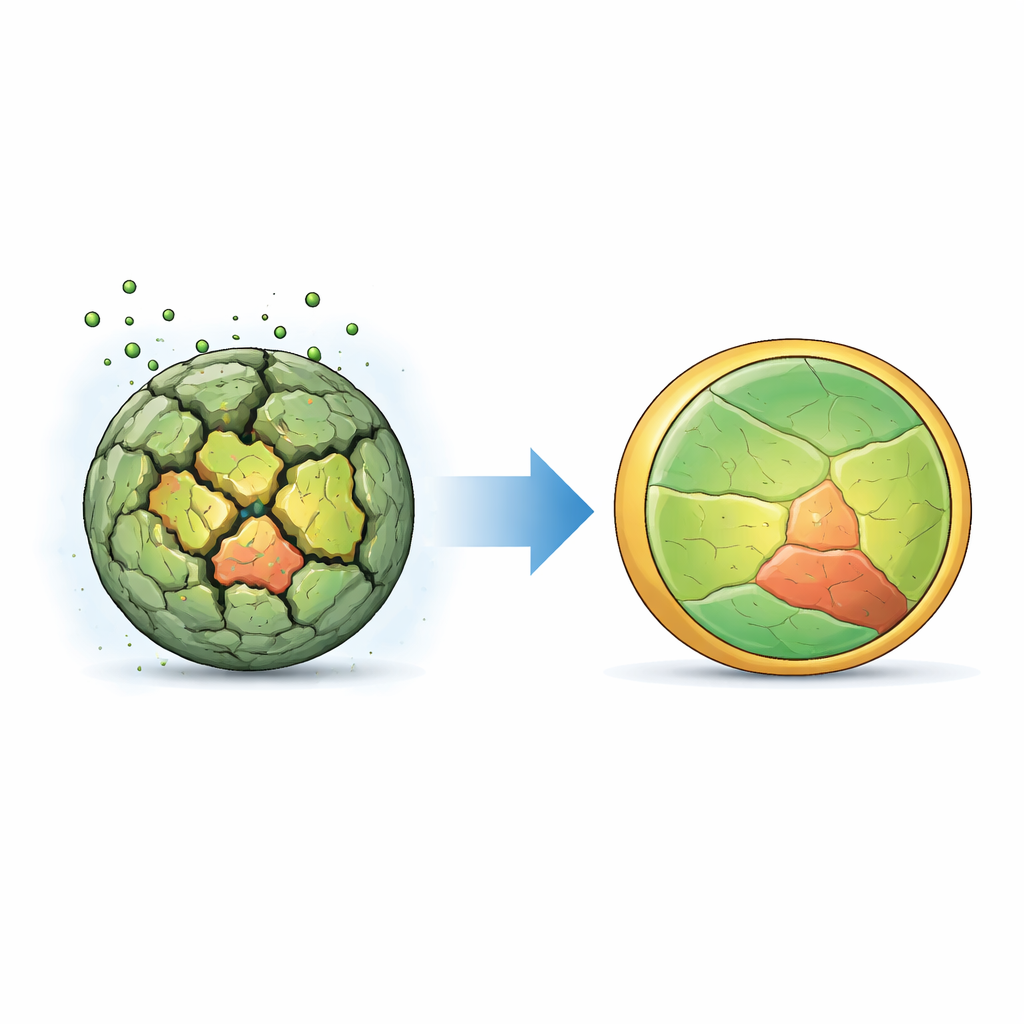
Today’s high-nickel cathodes store plenty of energy, which is why they are attractive for long-range electric vehicles. But when these materials are charged to high voltages, oxygen atoms in their crystal lattice can become unstable and escape. That oxygen loss triggers a chain of damage: the original orderly structure at the particle surface converts into denser, less active forms, and microscopic cracks form inside the particles. These changes block lithium ions and electrons, create uneven charging within each particle, and gradually rob the battery of both capacity and safety.
From Adding Coatings to Carving a Protective Skin
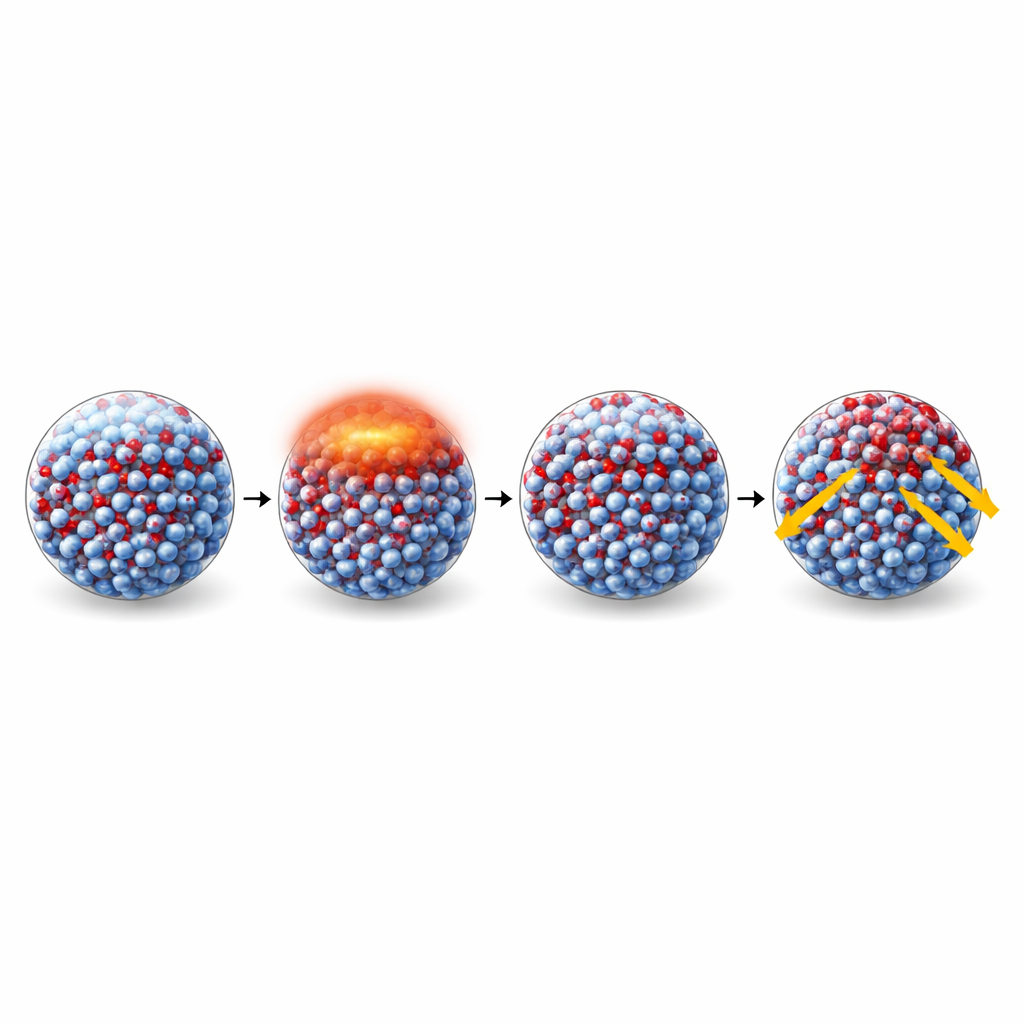
A common fix is to add a thin coating layer onto the particle surface, using extra compounds such as metal oxides or glassy materials. While helpful, these add-on coatings often fail to cover the surface completely, do not match the underlying crystal structure, or slow down lithium movement. Instead of sticking something new on top, the authors propose a subtractive approach: use short, precisely controlled bursts of heat—"flash joule heating"—to gently remove some lithium and oxygen atoms from just the outermost region of the cathode particles. This controlled removal triggers the surface to reorganize itself into a new crystal form known as a spinel, forming a continuous, self-derived shell that is crystal-compatible with the inner layered core.
How an Engineered Skin Protects the Battery
By carefully tuning the temperature and duration of the heat pulse, the team can adjust whether the surface becomes a thin spinel shell or an overly thick, blocking layer known as rock salt. An intermediate condition—around 350 °C for 30 seconds—produces an optimal spinel skin only a few tens of nanometers thick. Microscopy and X-ray studies show that this shell is tightly interlocked with the inner layered structure, like a mortise-and-tenon joint in carpentry. This interlocking skin provides sturdy mechanical support, reduces distortions of the crystal lattice during charging, and keeps reactive oxygen species trapped near the surface so they cannot easily attack the electrolyte or trigger deep structural collapse.
Longer Life and Faster Charging in Practice
Electrochemical tests reveal that particles with this spinel skin deliver both higher initial efficiency and markedly improved durability. The treated material reaches an initial Coulombic efficiency of about 95%, compared with roughly 90% for the untreated version, meaning less wasted lithium during the first cycle. Over hundreds of charge–discharge cycles at practical rates, the coated electrodes retain more than 90% of their capacity, while the untreated ones fall to around two-thirds. Even in pouch cells similar to those used in real devices, the engineered cathodes preserve about 80% of their capacity after 2000 cycles, far outperforming standard materials. Measurements of gas release, surface films, and internal cracking all point to the same conclusion: the spinel skin sharply reduces oxygen release, corrosion, and fracture.
A General Strategy for Tougher, Longer-Lasting Cathodes
To understand why this works so well, computer simulations show that the spinel shell improves both the bonding of oxygen in the structure and the pathways for lithium movement, while moderating volume changes during cycling. The surface spinel also makes it harder for electrons to leak into side reactions at the electrolyte interface. Importantly, the same subtractive heating strategy can be applied to several related high-nickel cathode compositions, suggesting a broadly useful method rather than a one-off fix. In simple terms, the study demonstrates how carving away just the right atoms from the surface can coax the material into growing its own protective armor, paving the way for safer, longer-lasting, high-energy batteries.
Citation: Yang, H., Sun, Z., Zhao, Y. et al. Flash joule heating-induced spinel-phase surface in Ni-rich layered oxide positive electrodes to stabilise lattice oxygen. Nat Commun 17, 4008 (2026). https://doi.org/10.1038/s41467-026-70616-8
Keywords: lithium-ion batteries, nickel-rich cathodes, surface engineering, spinel coating, battery lifetime