Clear Sky Science · en
Revealing multiscale competing processes in the solid-state synthesis of single-crystalline layered oxide positive electrodes
Why this battery study matters to you
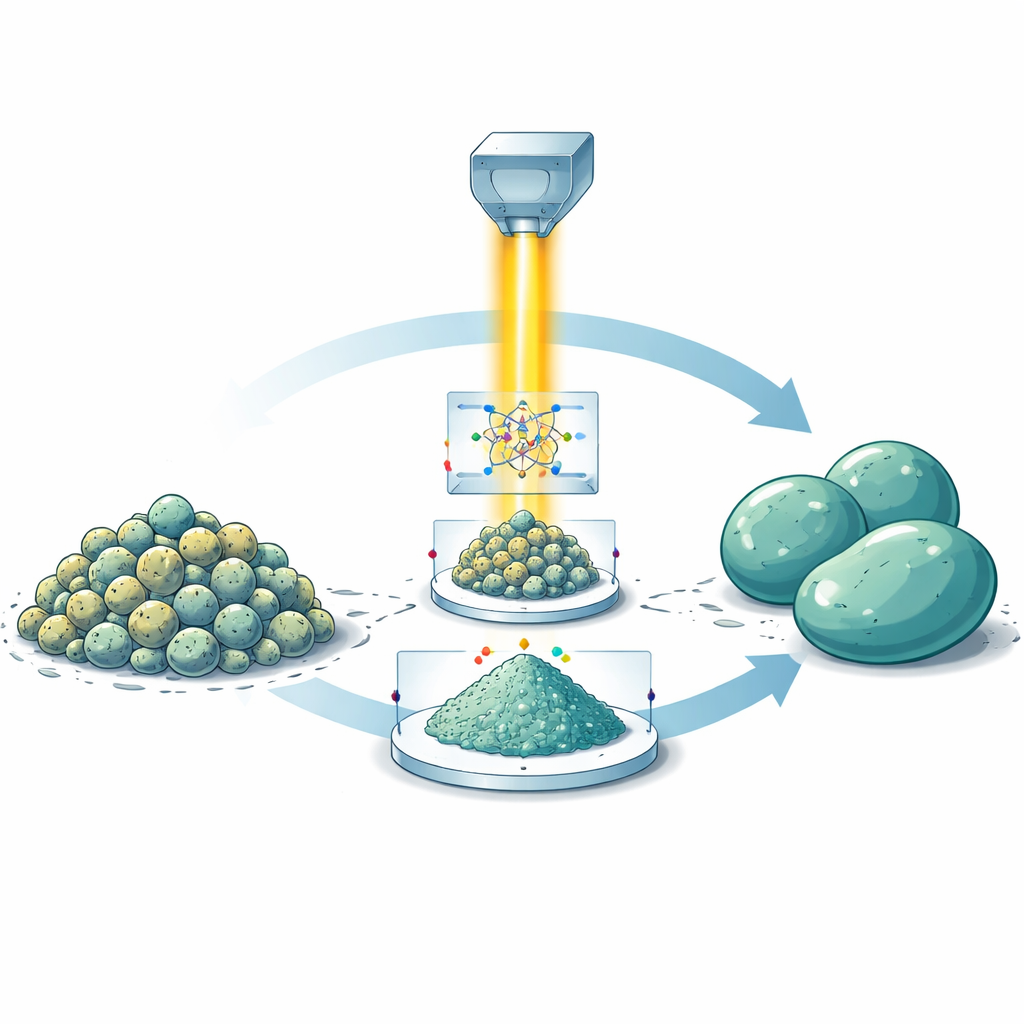
Lithium‑ion batteries power our phones, laptops, and electric cars, yet the way their key materials are cooked together still resembles an art more than a science. Manufacturers heat mixtures of powders until they fuse into the complex crystals that store and release energy, but what actually happens inside these powders during heating has been largely hidden. This article peeks inside that “black box” using powerful X‑ray beams, revealing how tiny structural changes during manufacturing can make batteries last longer and perform more reliably.
From trial and error to seeing inside the furnace
Today, companies typically optimize battery recipes by trial and error: change the temperature or time, make a batch, test its performance, and repeat. That is slow, expensive, and gives only indirect clues about what went wrong when a battery underperforms. The researchers focused on a widely used family of materials called NMC, which serve as the positive electrode in many high‑energy lithium‑ion batteries. They studied a particular version, known as NMC532, that can be made either as many small grains fused together (polycrystalline) or as sturdier single‑crystal particles. Single crystals are attractive because they are less likely to crack as the battery charges and discharges, but they are much harder to produce consistently at industrial scale.
Watching particles transform while they are made
To move beyond guesswork, the team combined several advanced X‑ray techniques at large synchrotron facilities. These bright X‑ray sources allowed them to watch the material as it was heated in real time and in three dimensions, from the overall powder pile down to features tens of nanometres across. X‑ray diffraction tracked how the atomic lattice ordered itself, while micro‑ and nano‑tomography provided 3D pictures of particle shapes and internal pores. They added a small amount of barium‑containing compound as a “sintering aid” and compared its behaviour to material made without this additive, following individual particles, clusters of particles, and even entire heaps of powder through the full heating cycle.
How a tiny additive reshapes the material
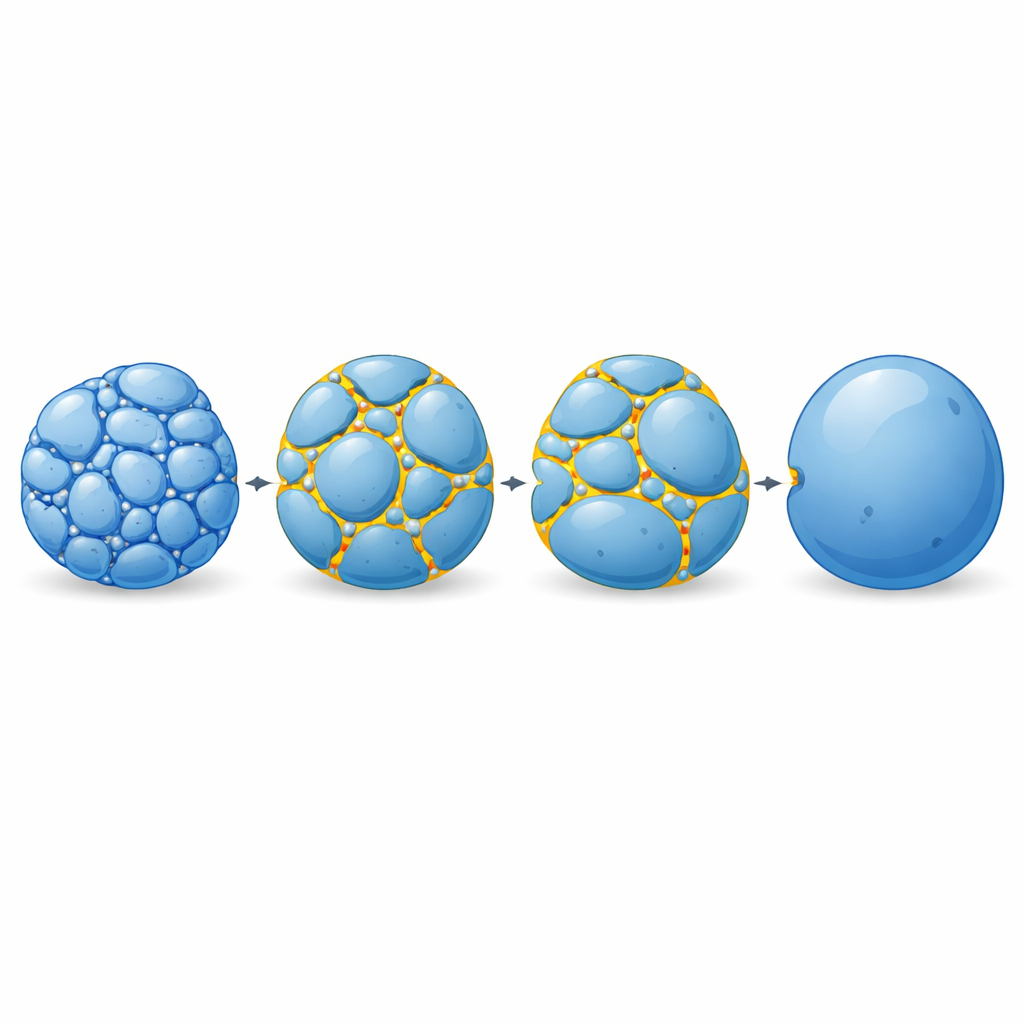
The barium additive turned out to be crucial for producing robust single crystals. Under otherwise identical heating conditions, powders without barium remained polycrystalline, while those with barium converted into smooth single‑crystal particles that delivered better battery performance and more stable cycling at high voltages. High‑resolution X‑ray maps showed that barium does not spread evenly; instead, it migrates toward particle surfaces and grain boundaries, forming thin enriched regions. Along these internal borders it lowers energy barriers for atoms to move, speeding up mass transport and helping neighbouring grains fuse together. At the same time, the team observed pores forming, growing, and then closing inside the particles as temperature rose, revealing that apparently solid grains actually undergo a complex internal reshaping before they become dense single crystals.
Competing processes and a narrow sweet spot
The study also uncovered a tug‑of‑war between helpful and harmful changes during heating. As temperature increases past about 600 °C, the atomic lattice becomes more ordered and internal strains relax, which is good for battery operation. But if the material is held too long at the highest temperature, atoms begin to mix in ways that disrupt the ideal layered structure, slowing lithium movement and hurting performance. At the same time, particle densification and grain fusion continue to improve the mechanical integrity of the material. By systematically varying how long they held the material at 950 °C, the researchers showed that there is an optimal dwell time: too short, and the particles remain structurally uneven; too long, and atomic‑level disorder erodes capacity. An intermediate hold produced the best combination of durability and energy storage.
What this means for better batteries
For non‑specialists, the main message is that how we heat battery materials can be just as important as what they are made of. The work shows that single‑crystal NMC particles owe their advantages to a delicate balance of pore formation, grain fusion, and atomic ordering, all unfolding across different size scales and time windows. By directly watching these changes instead of only testing finished cells, manufacturers can design smarter heat treatments and additives that target the most beneficial pathways and avoid damaging ones. Beyond NMC, the same multiscale, in situ X‑ray approach can help turn many other complex, solid‑state syntheses from slow trial‑and‑error exercises into predictable, tunable processes—paving the way for more reliable, longer‑lasting batteries in everyday technologies.
Citation: Xue, Z., Sun, T., Oruganti, S. et al. Revealing multiscale competing processes in the solid-state synthesis of single-crystalline layered oxide positive electrodes. Nat Commun 17, 3987 (2026). https://doi.org/10.1038/s41467-026-70607-9
Keywords: lithium-ion batteries, cathode materials, solid-state synthesis, synchrotron imaging, single-crystal NMC