Clear Sky Science · en
Biological traits predict species’ time-varying responses to multiple global change drivers
Why tiny seafloor animals matter
Along the shores of New Zealand, a hidden world of clams, worms, snails, and small crustaceans quietly keeps estuaries healthy. These bottom-dwelling animals help filter water, cycle nutrients, and support fish and birds. Yet they now face a changing cocktail of warmer seas, shifting climate patterns, murkier water, and muddier sediments. This study asks a practical question: can we predict which species will cope and which will struggle by looking at simple features such as body size, how fast they live, and how easily they move?
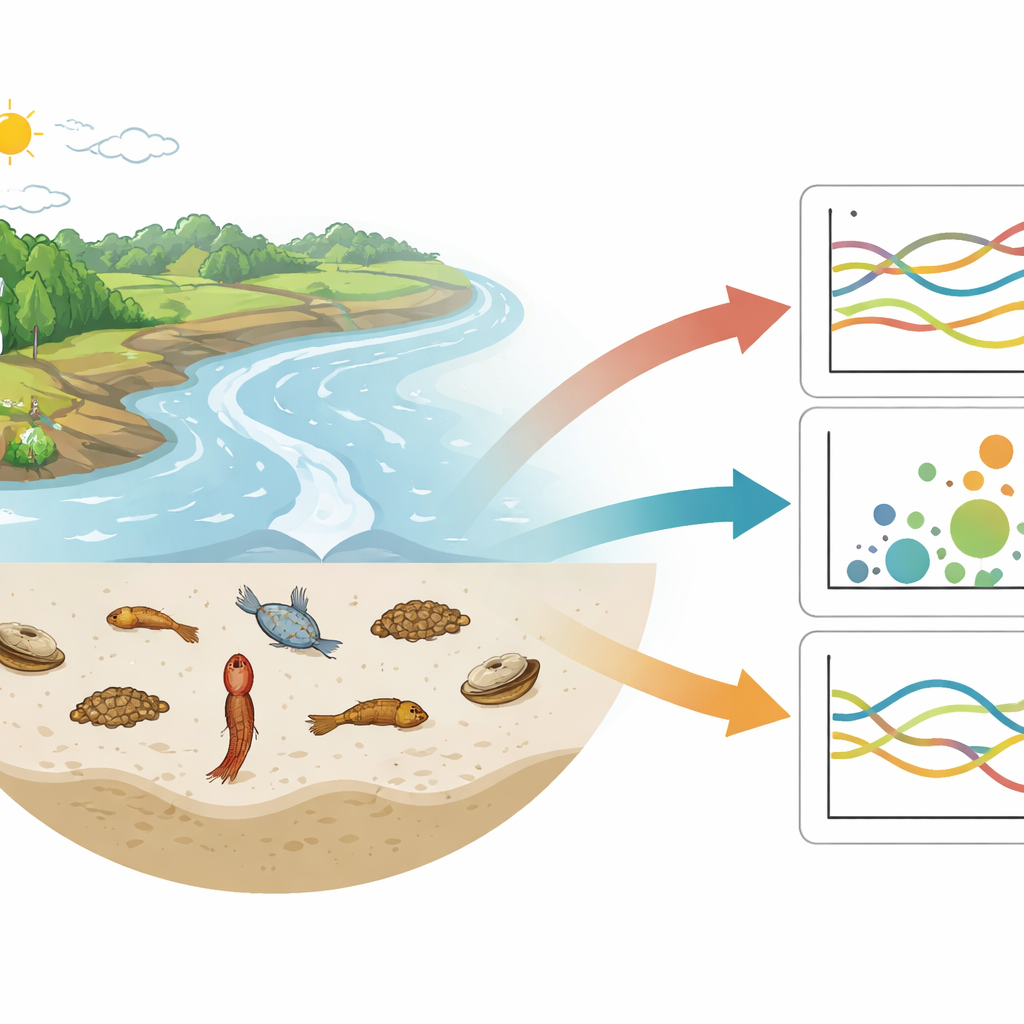
Multiple pressures on coastal life
Estuaries sit at the crossroads of land, rivers, and ocean, so they are hit by many human-driven changes at once. Warmer sea surface temperatures, climate cycles that alter rainfall, soil and silt washing in from farms and towns, and changes in the organic material and mud on the seafloor all affect these habitats. While laboratory and short-term field experiments have offered snapshots of how species respond to single stressors, they rarely capture the messy, overlapping influences found in nature. The authors used decades of seasonal monitoring at 14 New Zealand estuary sites to move beyond snapshots and examine how whole communities of seafloor invertebrates respond through time to several drivers acting together.
Following real-world ups and downs
The research team assembled long-term records of climate measures, such as the Southern Oscillation Index (linked to El Niño and La Niña) and local sea surface temperature, alongside estimates of suspended solids entering estuaries and detailed sediment properties, including chlorophyll, organic matter, and mud content. They paired these data with time series of bottom-dwelling animals: overall numbers, the number of species, and the abundance of 24 especially common species. Using a form of nonlinear time-series analysis designed for complex, feedback-rich systems, they first asked which environmental factors appeared to exert a genuine causal influence on the animals, rather than merely fluctuating in step.
What drives changes in estuary communities
The analyses showed that, across sites, almost all of the environmental drivers examined—especially climate and sediment conditions—had detectable causal effects on total animal abundance and species richness. For instance, community abundance tended to increase with warmer conditions and with more organic material in the sediment, which likely signals more food. Species richness, however, often declined with warmer sea temperatures, suggesting that some species benefit while others are squeezed out. Suspended solids from rivers, which can cloud the water and clog feeding structures, generally had weaker overall effects but still harmed particular sensitive species. These results highlight that different aspects of water and sediment quality can push communities in different directions, even when they change together.
Traits as clues to winners and losers
To turn these patterns into a predictive framework, the authors focused on how individual species’ responses to each driver changed over time. For every species and driver, they estimated not only the average effect (whether a species usually did better or worse as conditions intensified) but also how much that effect fluctuated from year to year. They then linked these response patterns to six basic traits describing each species’ body size, typical lifespan, mobility, movement style, how often they reproduce, and how structurally robust they are. Species with smaller bodies or lower mobility tended to respond negatively to warming seas, while larger or more mobile species were more likely to cope or even benefit, presumably because they can tolerate stress better or move to micro-habitats that suit them. Structural robustness also appeared to buffer species against some climate-related swings.
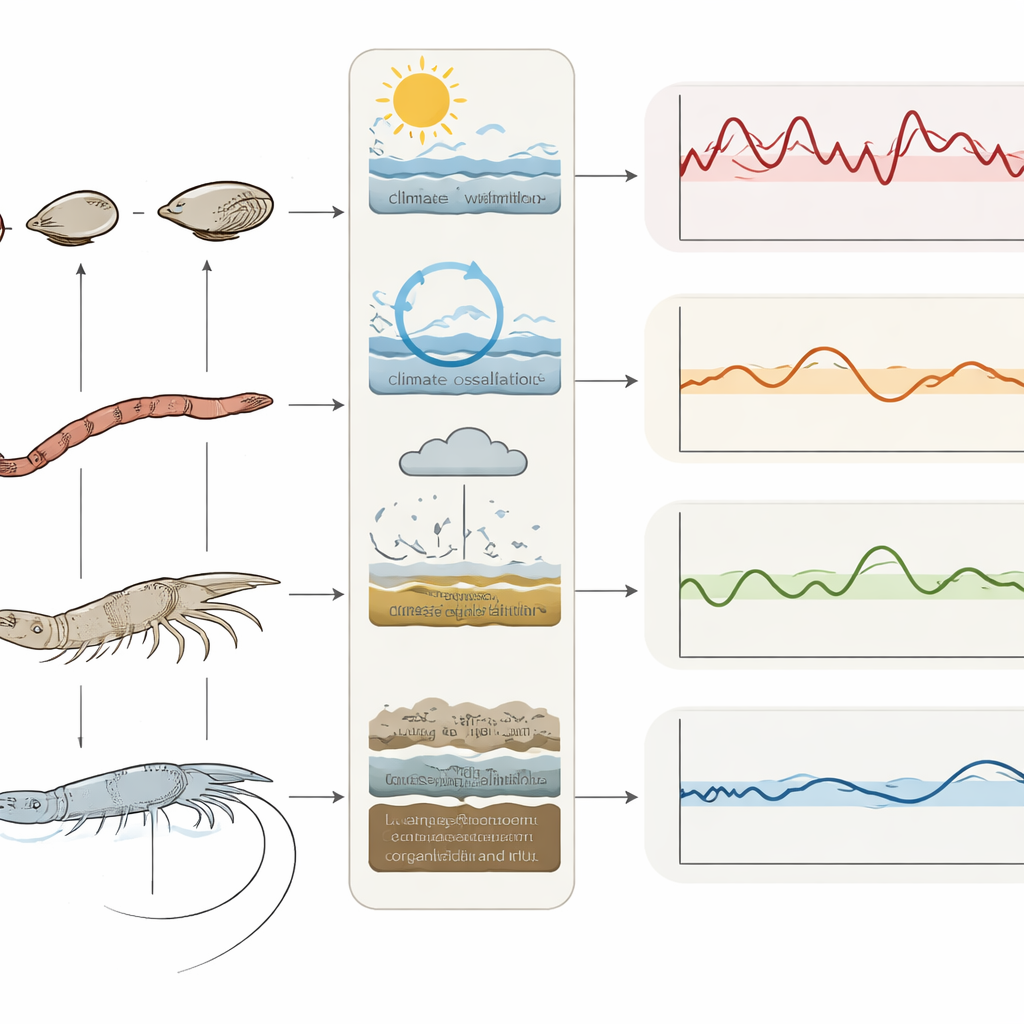
Fast lives, fickle fortunes
One of the most striking findings concerned how variable species’ responses were through time. Short-lived species, which turn over generations quickly, showed much more fluctuation in their sensitivity to changing conditions than longer-lived species. In other words, their fortunes rose and fell more dramatically as climate, freshwater inputs, and sediment properties shifted. Variability in sensitivity also decreased for species that moved more easily or reproduced more frequently in the face of some climate drivers, suggesting these traits can smooth out environmental shocks. Larger-bodied and more robust species sometimes showed particularly variable responses to food-related sediment changes, perhaps because they can exploit short-lived surges in resources.
What this means for protecting coasts
The study concludes that a small set of biological traits—especially body size, mobility, and lifespan—can help explain and partially predict how estuarine invertebrates respond to multiple, overlapping global change drivers. Although traits did not account for all of the complexity in these natural systems, they provided consistent signals that can guide conservation. Managers can use this framework to identify species and communities that are likely to be most vulnerable to warming, increased sediment loads, or shifts in seafloor conditions, even in places where long-term data are just beginning to accumulate. In doing so, the work offers a way to connect the everyday biology of small seafloor animals with big-picture decisions about how to safeguard coastal ecosystems in a rapidly changing world.
Citation: Sasaki, T., Iwachido, Y., Lam-Gordillo, O. et al. Biological traits predict species’ time-varying responses to multiple global change drivers. Nat Commun 17, 3950 (2026). https://doi.org/10.1038/s41467-026-70606-w
Keywords: estuarine ecosystems, macroinvertebrates, climate change, species traits, biodiversity