Clear Sky Science · en
Prediction of thermally driven quasi-1D superionic states in carbon hydride under giant planetary conditions
Strange matter deep inside giant worlds
Far beneath the clouds of giant planets, matter is squeezed and heated into unfamiliar forms that never appear on Earth’s surface. In this study, researchers use powerful computer simulations to predict a new kind of atomic state in a simple carbon–hydrogen material. This exotic phase could help explain how energy and electric currents move inside distant worlds, and why some planets host oddly shaped magnetic fields.
Layers inside ice giants
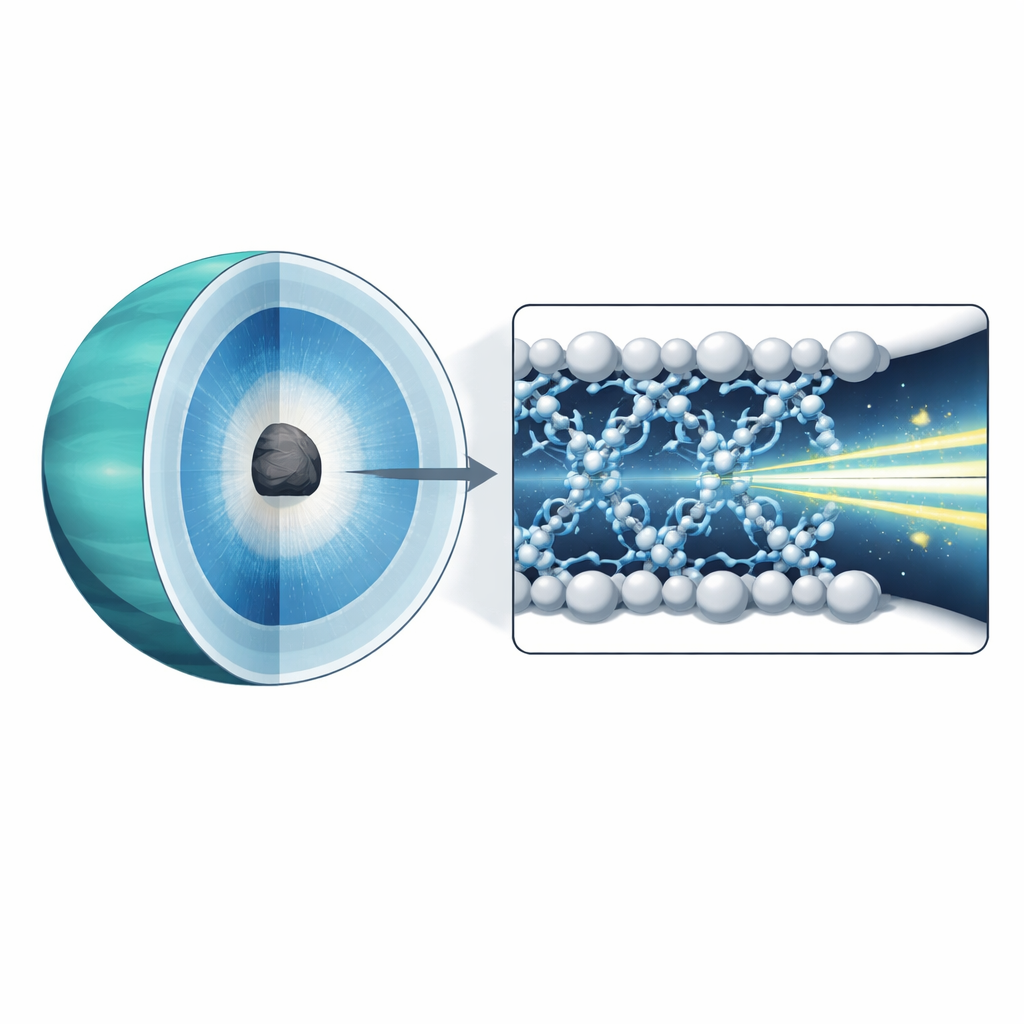
Planets like Uranus and Neptune are thought to contain a thick middle layer made of “hot ices” such as water, ammonia, and methane, crushed under millions of times Earth’s atmospheric pressure. Under these conditions, molecules can rearrange into dense, unfamiliar structures, and atoms can move in ways that do not fit our everyday categories of solid, liquid, or gas. To understand this hidden region better, the authors focus on simple mixtures of carbon and hydrogen, the basic ingredients of methane, and ask what stable structures they form at the enormous pressures found in the deep interiors of giant and sub-Neptune exoplanets.
A twisted atomic scaffold
Using advanced quantum-mechanical calculations combined with machine-learning tools, the team searches through many possible atomic arrangements. They identify a particularly stable compound with equal numbers of carbon and hydrogen atoms (CH) at pressures above about one terapascal—more than ten million times the pressure at sea level. In this phase, the atoms assemble into intertwined helices: a rigid spiral framework of carbon atoms surrounds spiral chains of hydrogen atoms running along the same axis. The structure is chiral, meaning it comes in left- and right-handed versions, much like a pair of human hands. Importantly, the analysis shows that carbon atoms mainly bond to each other and hydrogen atoms to one another, forming two interlocking but electronically distinct networks.
From solid to directional superionic motion
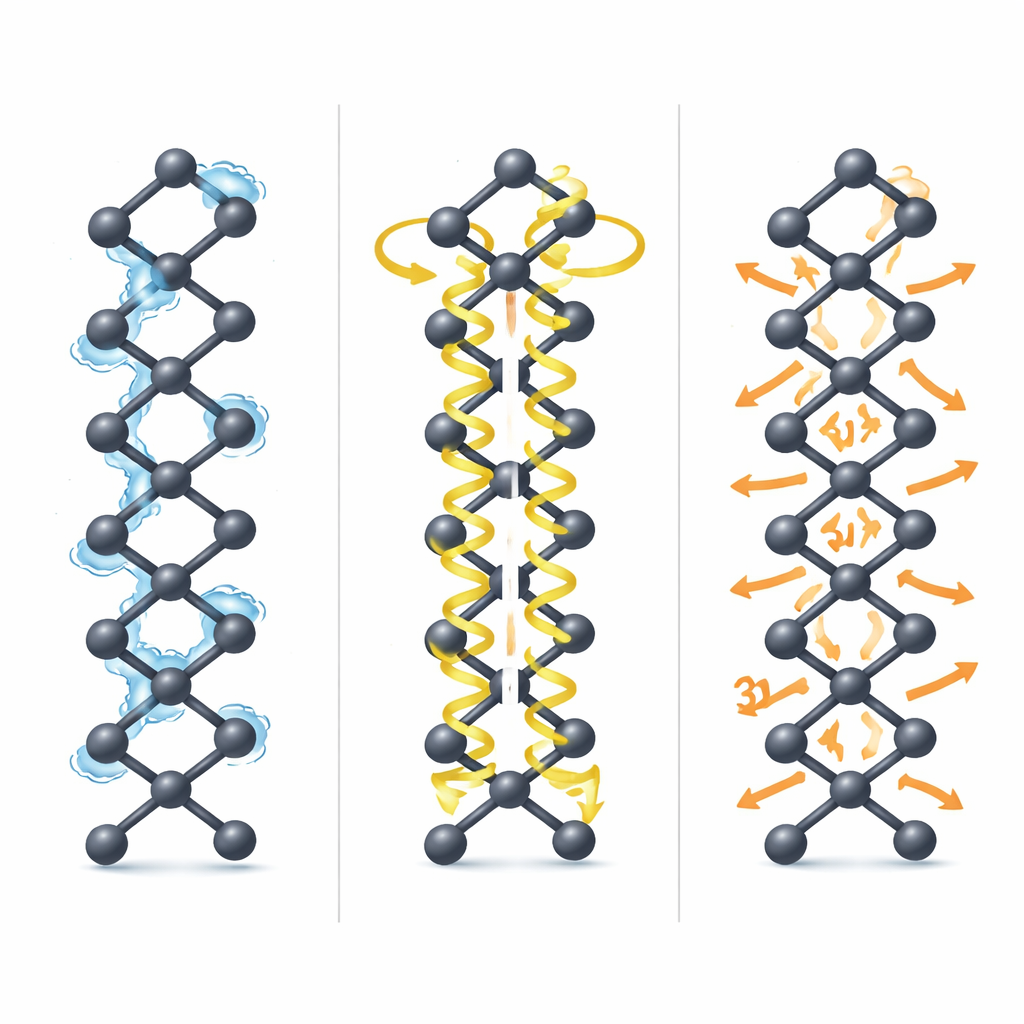
The researchers then heat this helical CH structure in computer simulations that mimic planetary conditions, tracking how the atoms move over time. At low temperature the material behaves like a solid: both carbon and hydrogen merely vibrate around fixed positions. At very high temperature, all atoms move freely as in a fluid. In between, however, the team discovers two unusual “superionic” states, where one kind of atom is mobile while the other remains locked into a crystal framework. In the fully three-dimensional superionic state, hydrogen atoms roam throughout the carbon lattice. At lower temperatures, by contrast, hydrogen atoms are confined near the center of each carbon helix and can move mainly along its length while rotating around the axis. The authors call this confined, helical motion a “quasi-one-dimensional superionic” state because the long-distance diffusion is strongly focused in a single direction.
A roadmap of extreme phases
By repeating their simulations across a wide range of pressures and temperatures, the team builds a phase diagram for this CH compound. As the material heats up, it transitions from a solid to the quasi-one-dimensional superionic state, then to the three-dimensional superionic state, and finally to a fluid. The boundaries between these regimes shift with pressure in a nonintuitive way: in some ranges, increasing pressure actually lowers the melting temperature, a behavior also seen in other dense materials. The authors compare these predicted boundaries with model profiles for Neptune’s interior and find that the three-dimensional superionic state could be present there, while the quasi-one-dimensional state would more likely emerge in even more massive exoplanets with higher internal pressures.
Guided pathways for heat and charge
The distinctive, channel-like motion of hydrogen in the quasi-one-dimensional superionic state has major consequences for how the material carries electricity and heat. Calculations show that when this state forms, both electrical and thermal conductivities become much larger along the helix axis than across it, reflecting the easier movement of charges and energy in that direction. As temperature rises further and hydrogen motion becomes fully three-dimensional, this directional contrast weakens but does not disappear until the material finally melts. Although real planets contain more complex mixtures than pure CH, this work reveals a clear example of how a twisted atomic framework can enforce directional transport deep inside dense matter, potentially affecting how planetary magnetic fields are generated and sustained.
Why this matters for understanding planets
In everyday materials, heat and electric currents usually spread more or less evenly in all directions. This study shows that under the crushing pressures and intense heat of giant planets, a simple carbon–hydrogen compound can instead form a spiral structure that channels motion, energy, and charge along preferred paths. The newly predicted quasi-one-dimensional superionic state serves as a bridge between familiar solids and fully superionic matter, demonstrating how long-range atomic order and rapid ion flow can coexist. While the exact CH phase described here may exist only in the deepest layers of very massive worlds, the underlying idea—that structural asymmetry can create strongly directional transport—offers a powerful new way to think about the hidden physics shaping planetary interiors and their magnetic environments.
Citation: Liu, C., Cohen, R.E. & Sun, J. Prediction of thermally driven quasi-1D superionic states in carbon hydride under giant planetary conditions. Nat Commun 17, 3980 (2026). https://doi.org/10.1038/s41467-026-70603-z
Keywords: superionic phases, giant planet interiors, carbon hydride, anisotropic conductivity, planetary magnetism