Clear Sky Science · en
Solvating magnesium polysulfides enables low–barrier speciation for magnesium sulfur batteries
Why Better Batteries Need Better Liquids
Our phones, cars, and power grids all depend on batteries that are safe, long‑lasting, and able to store more energy in less space. Magnesium–sulfur batteries are a promising next‑generation option because they use abundant materials and can, in theory, pack more energy than today’s lithium‑ion cells. Yet in practice they fade quickly and waste much of their potential. This study shows that a surprisingly subtle player—the liquid surrounding the battery’s charged particles—can make or break magnesium–sulfur performance.
From Simple Liquid to Key Control Knob
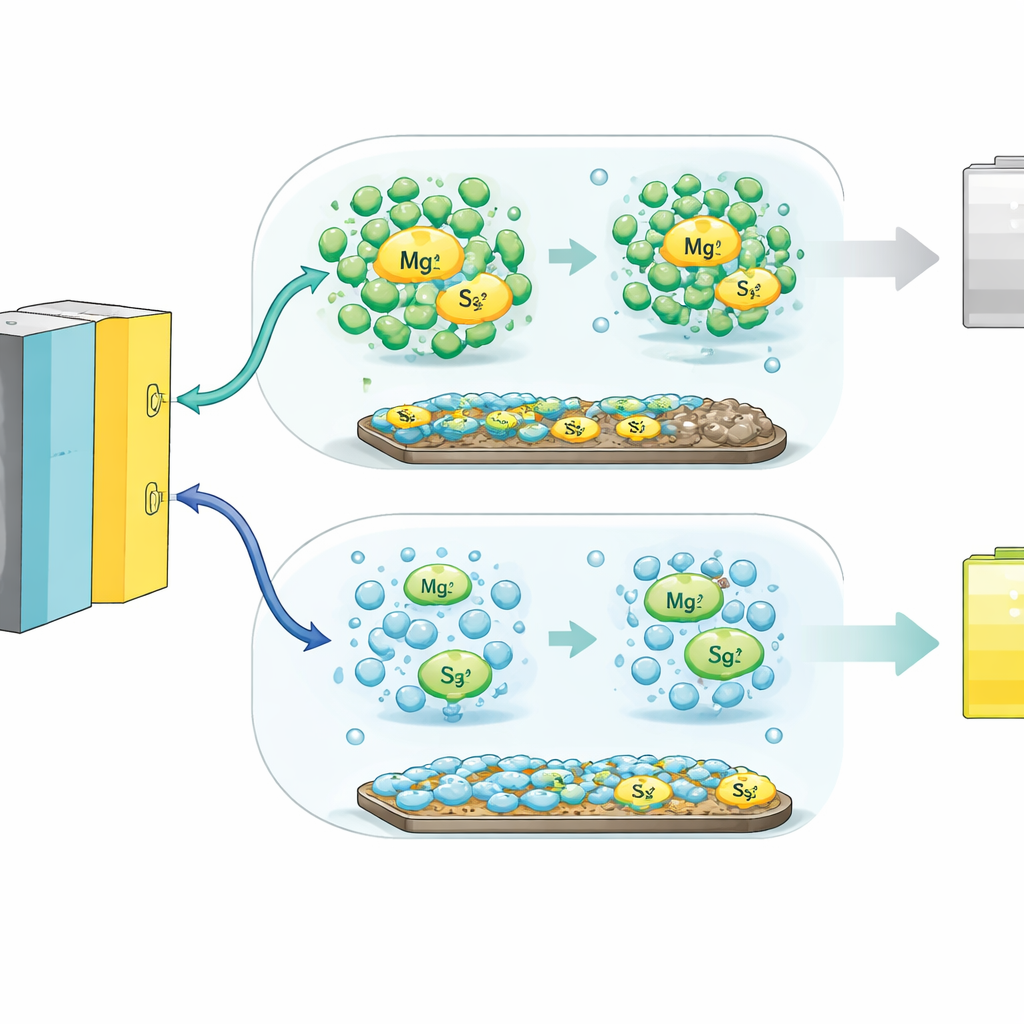
Inside a magnesium–sulfur battery, energy storage depends on how sulfur changes form as the battery charges and discharges. Sulfur does not transform in one step. Instead, it passes through a family of dissolved, chain‑like molecules called polysulfides, each carrying negative charge and pairing with positively charged magnesium ions. The authors realized that the way the solvent molecules in the liquid electrolyte surround these pairs—known as solvation—had been largely overlooked, even though it could strongly affect how easily sulfur moves from one form to another.
Comparing Four Nearly Similar Liquids
To test this idea, the team compared four closely related ether solvents, labeled DME, G2, G3, and G4. On paper, these liquids look very similar: each is built from repeating oxygen‑containing units that can grab onto magnesium ions. Yet when used in otherwise identical magnesium–sulfur cells, they produced very different behaviors. Through computer simulations, the researchers examined how magnesium, sulfur chains, and solvent molecules arranged themselves. They defined a measure of “shielding ability” that captures how strongly the solvent pulls magnesium away from the sulfur chain. The G2 solvent provided the strongest shielding, meaning magnesium interacted more with the liquid and less directly with the sulfur.
Lower Barriers and Smoother Transformations
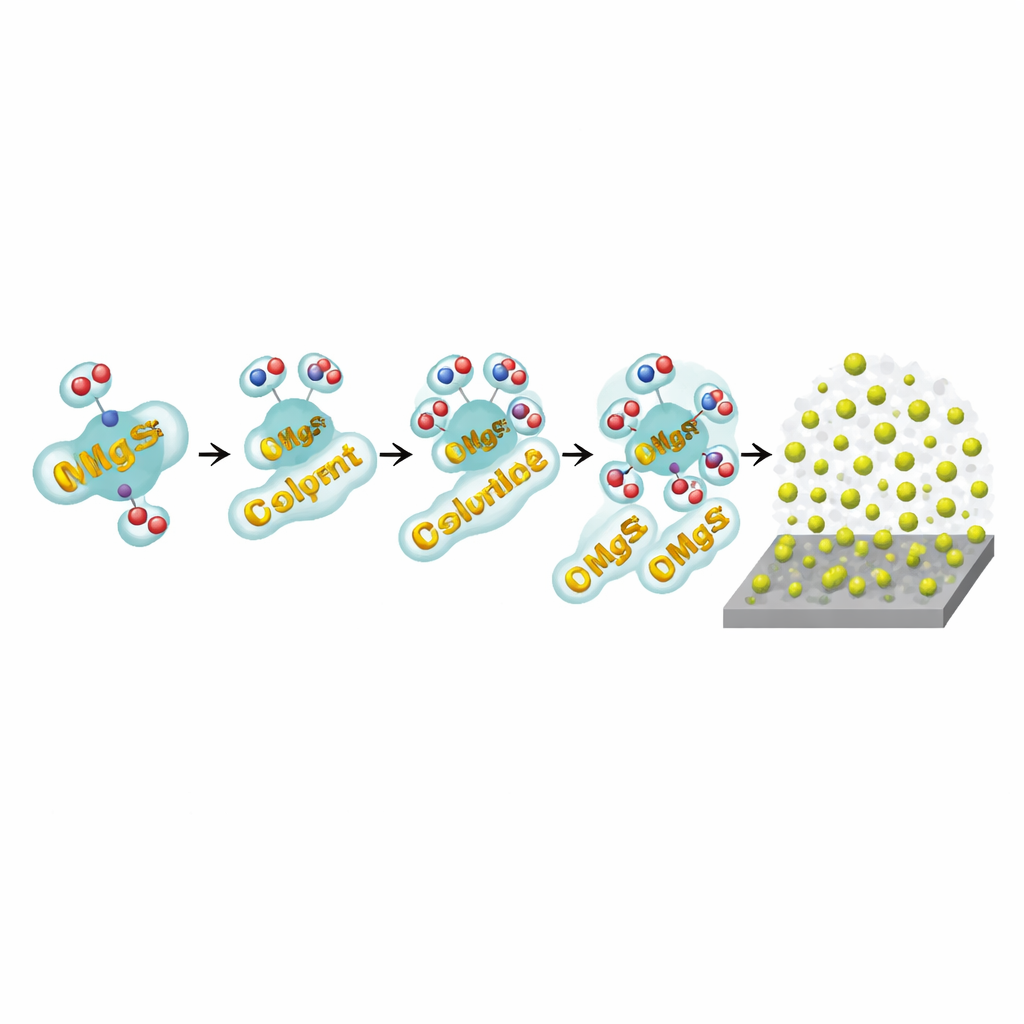
This shielding turned out to be crucial for how smoothly sulfur species could change during battery operation. Quantum‑level calculations showed that when the solvent better shields magnesium, key bonds in the sulfur chain become easier to break, lowering the energy barrier for step‑by‑step conversion from long chains to short chains and finally to solid magnesium sulfide. Electrochemical tests backed this up: cells using G2 showed lower voltage losses, more reversible charge–discharge curves, and higher sulfur utilization compared with the other solvents. Spectroscopic measurements that watched the chemistry unfold in real time confirmed that, in G2, sulfur moves more steadily through dissolved polysulfide stages and lingers in forms that contribute substantial capacity instead of becoming trapped in inactive products.
Building Better Solids from the Liquid Up
The liquid environment also influenced how the final solid product, magnesium sulfide, formed and grew on the sulfur electrode. Using detailed tests of nucleation behavior, simulations, and electron microscopy, the authors found that G2 encourages many small three‑dimensional magnesium sulfide particles to form and spread uniformly. This open, fine‑grained layer leaves plenty of pathways for ions and electrons, so the battery can keep working. In contrast, less favorable solvents lead to sparse, clumped deposits that block pores and cut off active material. The result is faster capacity loss and poorer cycling.
Turning Insights into Practical Performance
When these microscopic advantages are added up, the G2‑based electrolyte delivers markedly better real‑world performance. Magnesium–sulfur coin cells with G2 reach an equilibrium operating voltage around 1.1 volts, maintain stable cycling over more than a hundred charge–discharge cycles, and achieve high capacities close to what theory predicts. Even pouch‑style cells, closer to practical devices, retain more than 600 milliamp‑hours per gram of sulfur after many cycles. In everyday terms, carefully choosing the battery liquid to gently loosen the grip between magnesium and sulfur allows the chemistry to run more smoothly and efficiently.
What This Means for Future Energy Storage
The work shows that the liquid in a battery is far more than an inert filler—it actively choreographs how charged particles meet, move, and assemble into solids. By tailoring solvents to shield magnesium just enough, researchers can steer sulfur through low‑resistance pathways and build better‑behaved electrode layers. This design principle could help close the gap between the impressive theoretical promise of magnesium–sulfur batteries and the reliable, high‑capacity devices needed for electric vehicles and large‑scale energy storage.
Citation: Li, J., Zhao, W., Guo, K. et al. Solvating magnesium polysulfides enables low–barrier speciation for magnesium sulfur batteries. Nat Commun 17, 3751 (2026). https://doi.org/10.1038/s41467-026-70598-7
Keywords: magnesium–sulfur batteries, polysulfides, electrolyte solvents, energy storage, battery chemistry