Clear Sky Science · en
Enzyme-mediated alkynylation enables transcriptome-wide identification of pseudouridine modifications
Why tiny marks on RNA matter
Every cell in your body is filled with RNA, the working cousin of DNA that helps turn genetic instructions into proteins. Many RNAs carry small chemical tags that fine tune how they behave, and one of the most common is called pseudouridine. These tiny marks can influence how cells grow, respond to stress, and even how well mRNA vaccines work. Yet until now, scientists have struggled to see exactly where pseudouridine sits across all the RNAs in human cells.
A chemical twist in the genetic alphabet
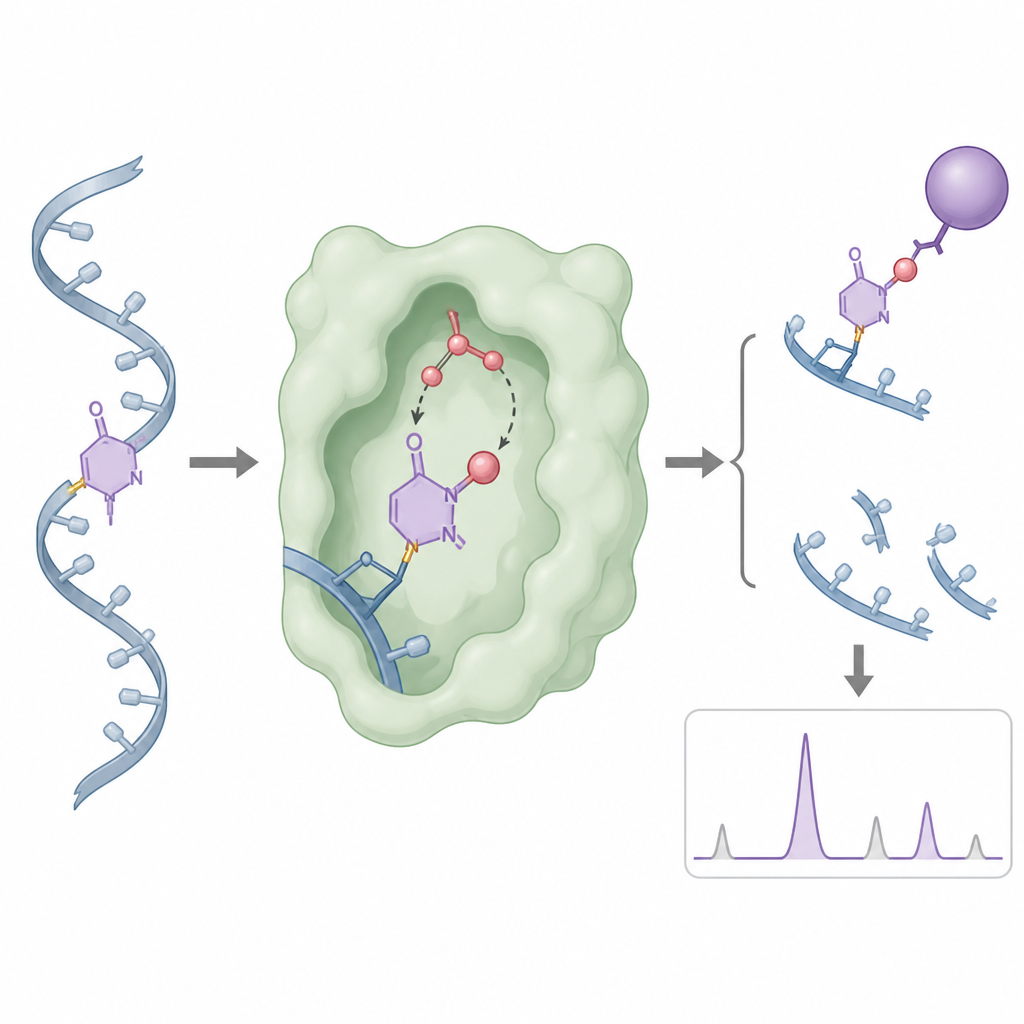
Pseudouridine looks almost identical to the usual RNA letter uridine, but a subtle rearrangement of its atoms changes how it behaves. This quiet tweak can stabilize RNA structures, alter how RNAs are spliced, and adjust how efficiently cells build proteins. Pseudouridine is found in many types of RNA, including those crucial for protein factories, gene regulation, and viral life cycles. It has also been linked to human diseases and is closely related to a modified building block used in today’s mRNA vaccines. Despite this importance, pseudouridine is very hard to spot with standard sequencing, because it still pairs with other RNA letters like normal uridine.
The hunt for a better detection method
Existing approaches to map pseudouridine often rely on harsh chemical treatments that scar the RNA so that reverse transcription stalls or stutters during sequencing. These methods can be accurate but come with drawbacks. They tend to chew up RNA, demand large sample amounts, and require extremely deep sequencing and heavy data analysis to pick out true signals from noise. They also struggle to locate pseudouridine precisely when several uridines sit side by side and do not easily enrich for the rare RNAs or low-level modifications that may still be biologically important. As a result, researchers suspected that many pseudouridine sites in human messenger RNA remained hidden.
Borrowing an enzyme from heat loving microbes
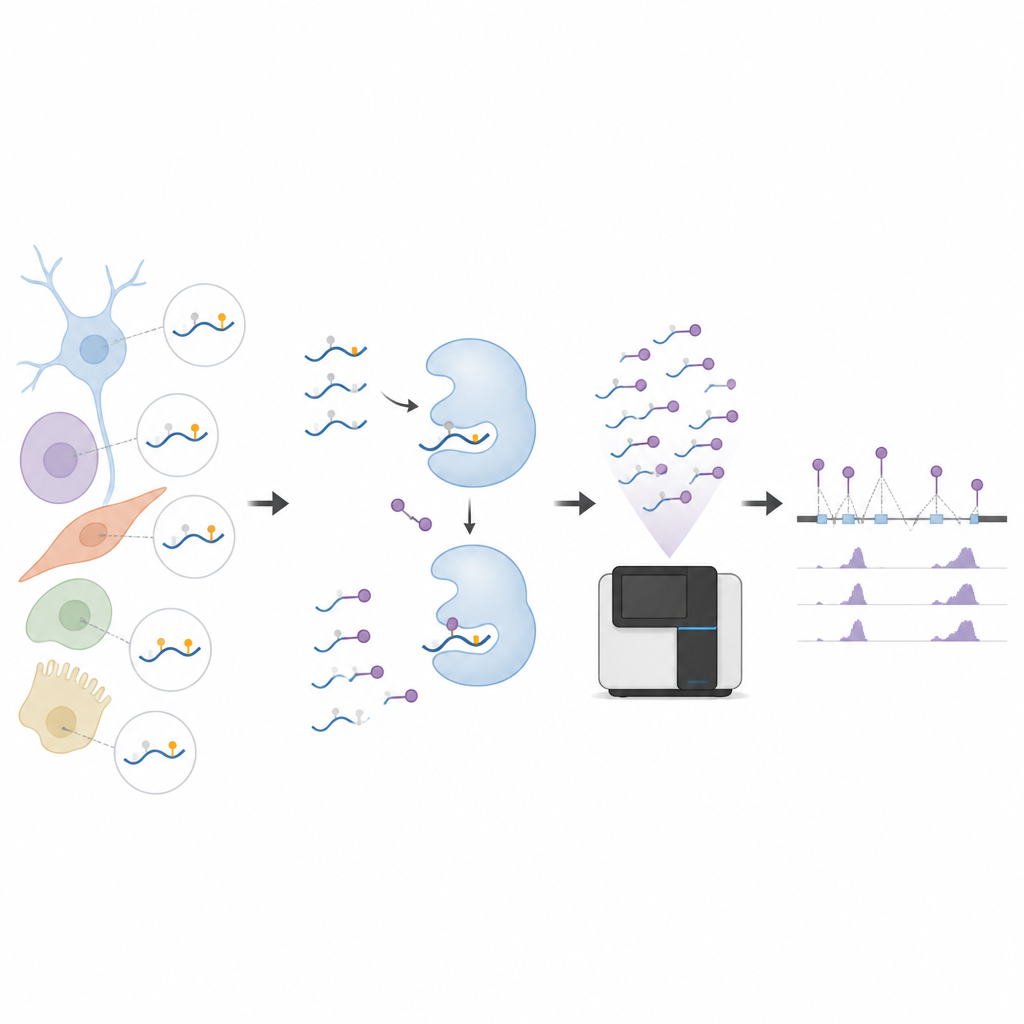
The authors turned to nature’s own toolkit and focused on an enzyme from the microbe Methanocaldococcus jannaschii that normally adds a small methyl group to pseudouridine in transfer RNA. They discovered that this enzyme, called Mj1640, is far more flexible than previously thought. In test tube experiments it efficiently labeled pseudouridine in short synthetic RNAs and in complex cellular RNA, while leaving ordinary uridine untouched. Even more usefully, the enzyme could be supplied with a specially designed cofactor that lets it attach a small “handle” based on an alkyne group to pseudouridine. This handle can then be snapped onto fluorescent dyes or biotin using mild click chemistry, all under conditions gentle enough to keep the RNA largely intact.
From tagged RNA to a transcriptome wide map
Building on this chemistry, the team created ELAP seq, which stands for Enzymatic Labeling and Pull down for Sequencing. First they fragment the RNA from human cells and use Mj1640 plus the alkyne cofactor to tag every pseudouridine they can reach. Next they click on biotin, fish out the tagged RNA pieces with magnetic beads, and convert the enriched fragments into sequencing libraries. A clever tweak to the reverse transcription step makes the polymerase tend to stop right at the labeled base, creating a sharp signal at single nucleotide resolution. Because only pseudouridine containing fragments are enriched, the method greatly boosts signal to noise and lowers the amount of sequencing and computation needed, while still working across many sequence contexts.
What the new map reveals about cell biology
Applying ELAP seq to two common human cell lines, HeLa and HEK293T, the researchers uncovered more than five thousand candidate pseudouridine sites in each. Many overlap with positions seen by earlier chemical methods, strengthening confidence in the overall landscape, but thousands are newly reported. These marks appear throughout protein coding regions and the tail ends of messenger RNAs, often in flexible or mismatched parts of the RNA structure rather than tightly paired stems. Pseudouridine rich transcripts are enriched for roles in protein production, energy generation in mitochondria, and DNA repair, hinting at ways these marks could tune cell metabolism and stress responses. By comparing normal cells with cells depleted of a known pseudouridine forming enzyme, they further confirmed that hundreds of sites depend on this machinery.
Why this work matters for medicine and technology
To a non specialist, the key message is that scientists now have a gentler and more sensitive way to see where pseudouridine sits across the vast collection of RNAs in human cells. ELAP seq uses a borrowed enzyme to tag these elusive marks, enriches the tagged fragments, and then reads out their exact locations. This opens the door to studying how pseudouridine patterns change in disease, how they shape cellular energy use and protein synthesis, and how they might be harnessed or adjusted in RNA based therapies and vaccines.
Citation: Wang, Y., Pajdzik, K., Zhao, Y. et al. Enzyme-mediated alkynylation enables transcriptome-wide identification of pseudouridine modifications. Nat Commun 17, 4318 (2026). https://doi.org/10.1038/s41467-026-70597-8
Keywords: pseudouridine, RNA modification, ELAP-seq, transcriptome mapping, mRNA vaccines