Clear Sky Science · en
Polarity-tunable field-free room-temperature spin orbit torque switching via topological symmetry breaking in an all-vdW heterostructure for spin logic applications
New Ways to Shrink and Speed Up Computers
Today’s computers burn a lot of power just moving electric charges around. Researchers are exploring "spintronics," a different way of storing and processing information that relies on the tiny magnetic orientation, or spin, of electrons instead. This paper reports a key advance: a tiny, ultra-thin device that can flip its magnetic state at room temperature without needing an external magnetic field, and can even reverse the direction of its response on demand. That combination could make future memory and logic chips faster, cooler, and far more compact than what is possible with today’s silicon technology.
Building with Ultra-Thin Lego-Like Layers
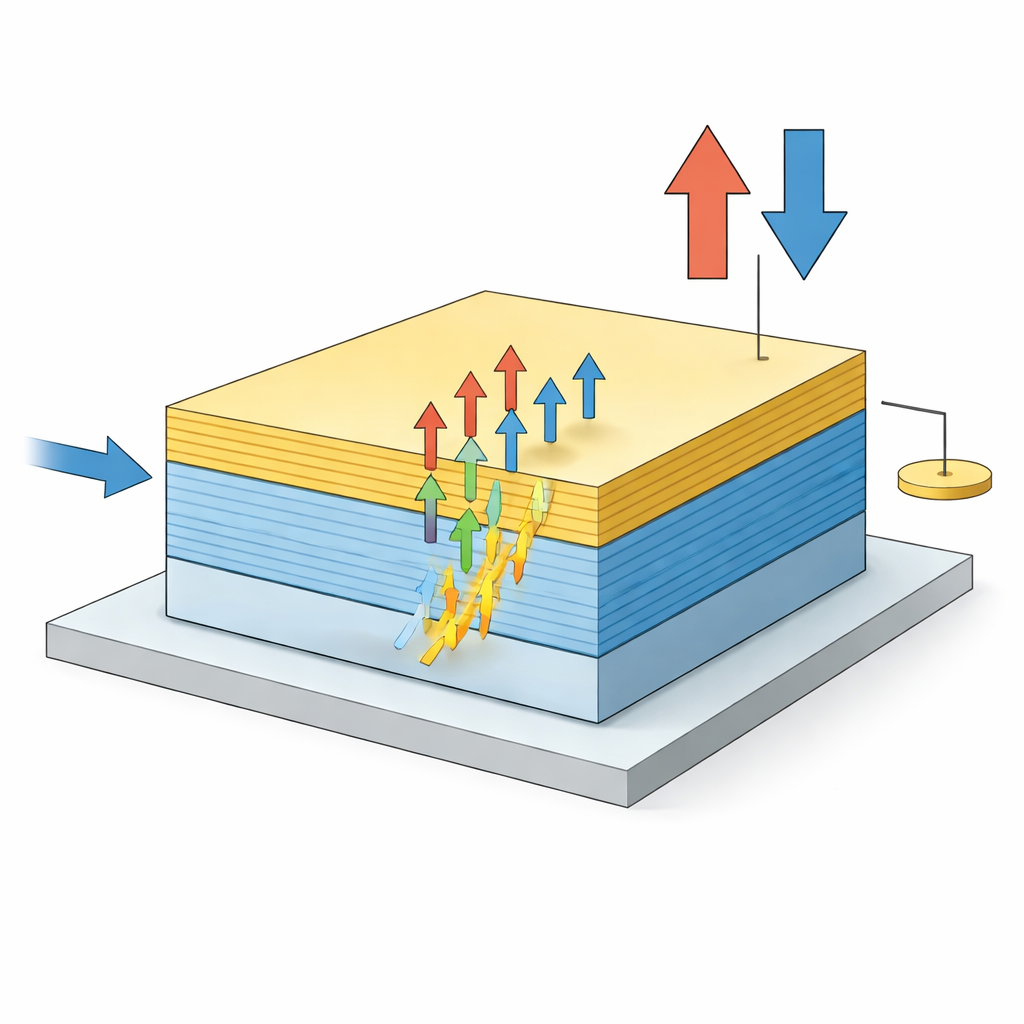
The device at the heart of this work is built from "van der Waals" materials—crystals that can be stacked like sheets of paper with atomically smooth interfaces. The team used molecular beam epitaxy to grow wafer-scale films of a topological insulator, Bi2Te3, directly on top of a two-dimensional ferromagnet, Fe4GeTe2. These two materials play complementary roles: Bi2Te3 is excellent at turning electrical current into a flow of spins, while Fe4GeTe2 provides a magnetic layer whose direction encodes digital information. Because their surfaces are extremely flat and clean, spins can move efficiently across the interface, reducing energy loss compared with more traditional metal stacks.
Hidden Magnetic Structure Enables Field-Free Control
Careful magnetic measurements revealed that the Fe4GeTe2 layer near the Bi2Te3 interface behaves as if its magnetization prefers to point out of the film (perpendicular anisotropy), while regions farther away prefer to lie in the plane of the film (in-plane anisotropy). This means that within one continuous sheet of Fe4GeTe2 there are two magnetic "personalities" coexisting. The authors show that the interface with Bi2Te3 strengthens the perpendicular component, likely through the special surface states of the topological insulator, which enhance coupling between iron atoms. At the same time, the upper portion of Fe4GeTe2 retains its in-plane preference. Together, these parts act like a built-in internal magnetic field that breaks symmetry, removing the usual need for an external applied field to steer the switching.
Flipping Magnetization with Gentle Currents
When a current is sent through the Bi2Te3 layer, it generates a spin flow into the adjacent Fe4GeTe2. This spin flow exerts a spin-orbit torque on the magnetization, nudging it to reverse direction. The researchers measured how large a current is needed and how efficiently charge is converted into spin. They found an unusually high spin-torque efficiency of about 0.8 and achieved reliable switching at room temperature with a current density around 1.55 × 10^6 A/cm²—significantly lower than in many earlier spintronic devices. Crucially, because of the internal in-plane component of the magnetization, the device can switch without any external magnetic field. By first applying a one-time preset in-plane magnetic field to orient the in-plane part, the device "remembers" this configuration and then performs repeated, fully field-free current-driven switching.
Reversing the Logic by Flipping Polarity
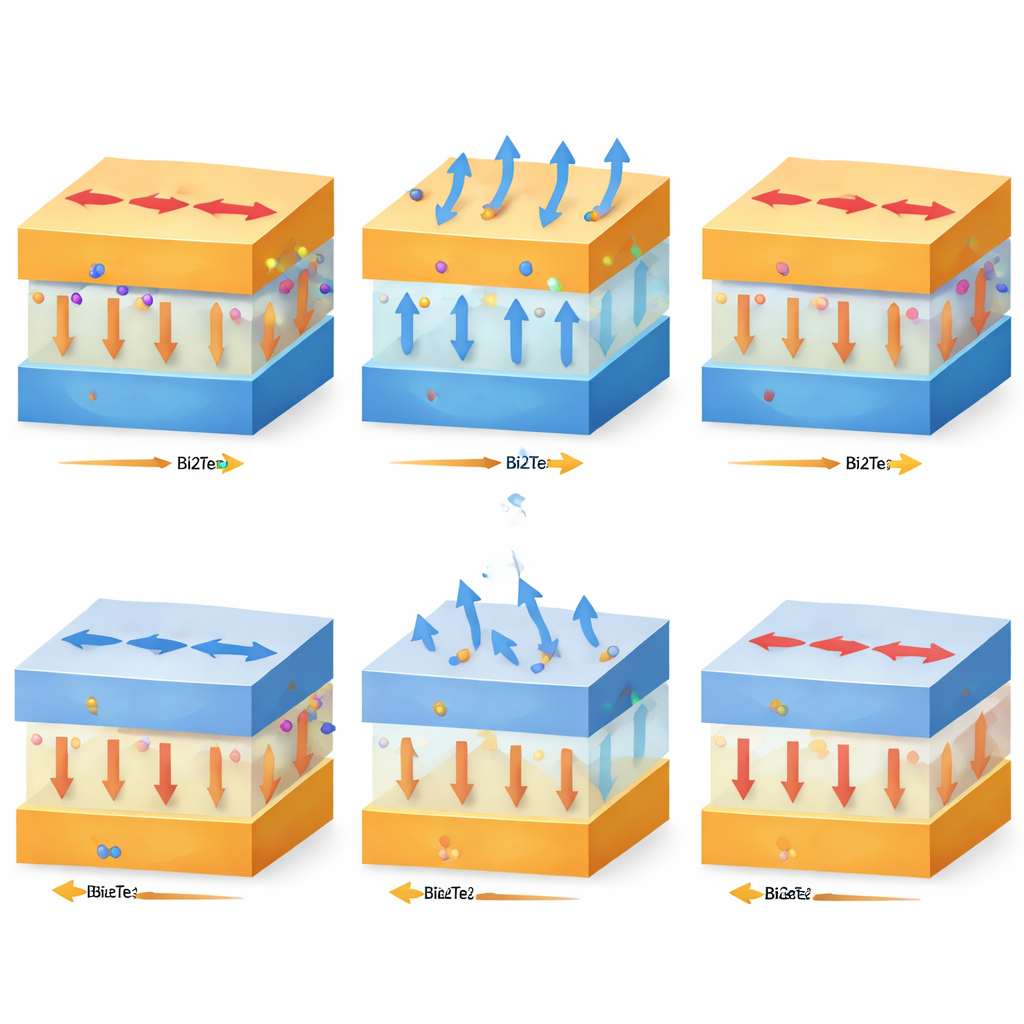
A particularly striking feature is that the direction of switching—whether a positive current pulse turns the magnet "up" or "down"—can be reversed at will. The team showed that by presetting the in-plane magnetization in one direction or the other, they can flip the polarity of the field-free switching. Micromagnetic simulations with a three-layer magnetic model support this picture: an in-plane top layer acts as a built-in helper that biases the perpendicular bottom layer via exchange coupling, and reversing that helper reverses the effective bias. Once set, this internal configuration is robust against moderate disturbing fields, and the amplitude of the switching grows as the preset field more strongly aligns the in-plane layer.
From Single Device to Reconfigurable Logic
Because the magnetic state can be deterministically controlled and its polarity reprogrammed, the authors go beyond simple memory and demonstrate logic directly in the same device. They treat the preset magnetic field and a series of current pulses as digital inputs, while the measured Hall voltage (which reflects the perpendicular magnetization) serves as the output. By choosing different combinations and timing of these inputs, the same physical structure can realize all 16 possible three-input Boolean logic functions, including NAND and others that form a complete logic set. This means one compact, nonvolatile element can be reconfigured to perform many different logical roles without hardware changes.
Why This Matters for Future Electronics
In plain terms, the study shows that a carefully engineered stack of two ultra-thin materials can act as a low-power, rewritable magnetic bit and a flexible logic gate at room temperature, all without the bulky magnets usually needed to control spin-based devices. The device’s ability to switch with modest currents, to reverse its switching direction on demand, and to implement many different logic operations in the same tiny footprint points toward future chips where information is processed and stored using electron spins rather than just charge. Such spin-based, all-van-der-Waals architectures could help overcome power and scaling limits of conventional electronics and move spintronics closer to practical mainstream applications.
Citation: Gao, F., Wang, Z., Zhao, R. et al. Polarity-tunable field-free room-temperature spin orbit torque switching via topological symmetry breaking in an all-vdW heterostructure for spin logic applications. Nat Commun 17, 3826 (2026). https://doi.org/10.1038/s41467-026-70590-1
Keywords: spintronics, spin-orbit torque, van der Waals heterostructure, topological insulator, magnetic logic