Clear Sky Science · en
Exploring electron spin dynamics in spin chains using defects as a quantum probe
Hidden quantum spins at the edges of tiny chains
Inside certain crystals, electrons behave like tiny bar magnets lined up in chains only one atom wide. When these chains are slightly distorted, they can host special “edge” spins at their ends that are remarkably well shielded from their surroundings. This study explores how such edge spins lose and maintain their quantum character, a crucial question for future technologies that might use them as building blocks for quantum computers or ultra-sensitive sensors.
Crystals that turn chains into quiet backgrounds
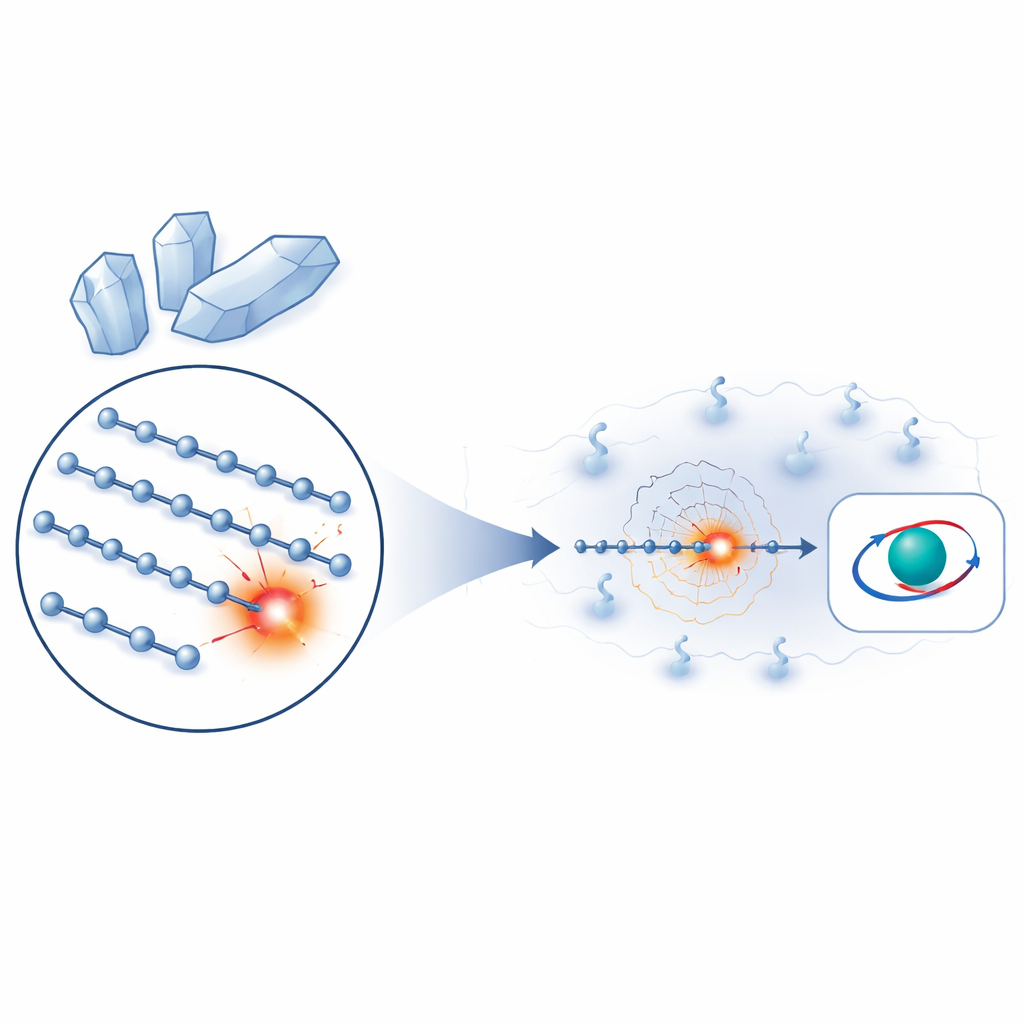
The researchers focus on an organic family of materials called (o-DMTTF)2X, where X can be chlorine, bromine, or iodine. At high temperatures, electrons in these crystals form uniform magnetic chains. As the crystals are cooled below about 50 kelvin, the chains “dimerize”: neighboring spins pair up, opening an energy gap that turns the bulk material into a quiet, non-magnetic background. Imperfections in the crystal—such as breaks or stacking faults—interrupt this perfect pairing, leaving behind unpaired spin clusters at the chain ends. These clusters behave collectively like a single spin-1/2 object, known as a quantum spin chain edge state, that sits inside an otherwise silent environment, making it ideal as a clean quantum probe.
Using defects as quantum probes
Because the bulk of each chain is magnetically gapped and nearly invisible to electron spin resonance, the edge states can be studied in isolation with exceptional clarity. The team uses pulsed electron spin resonance at several microwave frequencies and low temperatures to track how these edge spins relax back to equilibrium and how long they preserve a well-defined quantum phase. Advanced numerical simulations show that each edge state is not a single localized spin but a many-body object: a cluster of dozens of coupled spins whose size is controlled by how strongly the chain is dimerized. This many-body nature turns out to be central to how the edge states interact—very weakly—with their environment.
How vibrations and interactions drain quantum memory
The authors first map out how edge spins exchange energy with the crystal lattice, a process known as spin-lattice relaxation. At the lowest temperatures, the data do not follow the usual linear temperature trend expected when spins simply emit or absorb single lattice vibrations (phonons). Instead, the relaxation rate grows roughly with the square of temperature and scales linearly with magnetic field, revealing a “phonon bottleneck”: phonons emitted by the spins do not escape quickly and are reabsorbed, slowing down relaxation. At higher temperatures, the behavior changes. For the chlorine and bromine compounds, relaxation proceeds through a real excited state set by the “spin-Peierls” gap of the chain, a mechanism called the Orbach process. In the iodine compound, the gap is too large for this route, and a more gradual two-phonon Raman process dominates.
Surprisingly weak magnetic noise between edge states
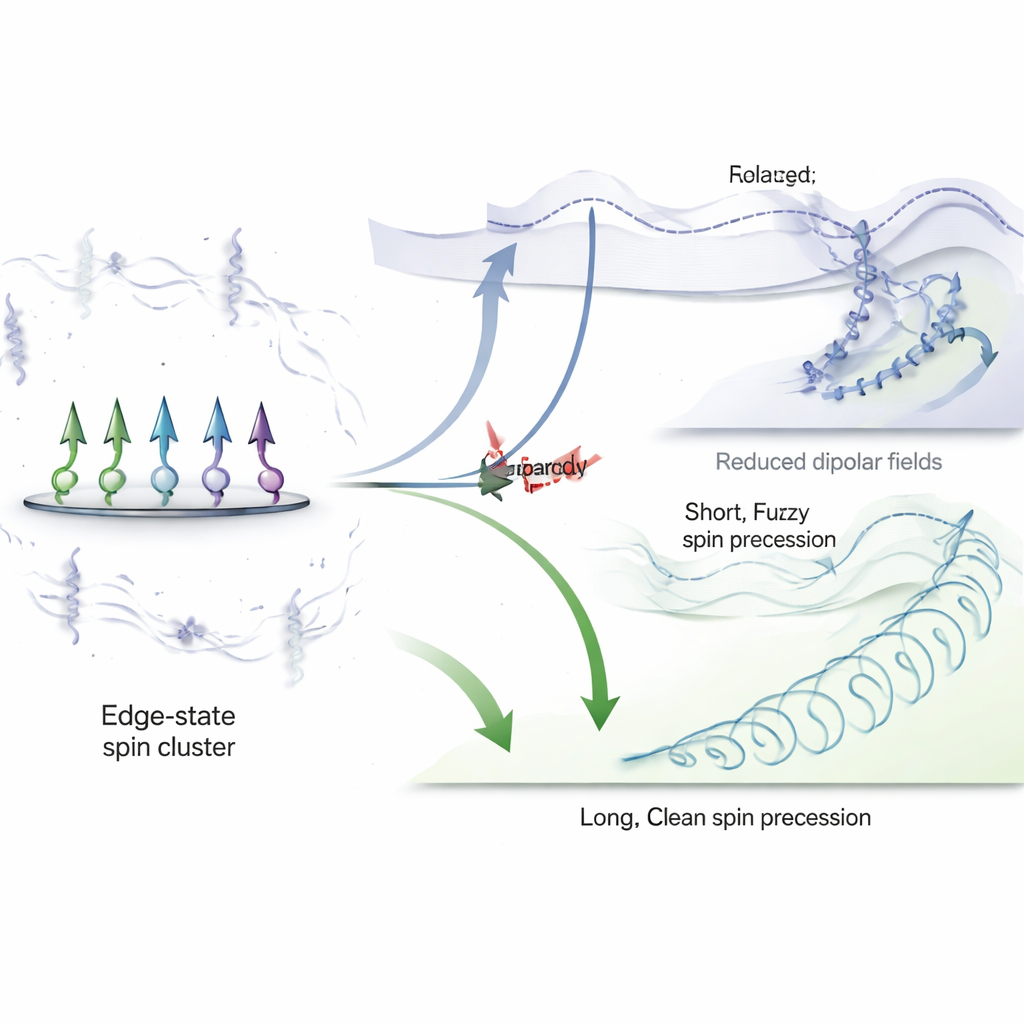
Next, the team investigates decoherence—how quickly edge spins lose their phase information due to fluctuating magnetic fields. By carefully analyzing different pulse sequences, they disentangle several contributions: instantaneous diffusion caused by the measurement pulses themselves, slow spectral diffusion from spin flips in the environment, and an underlying homogeneous broadening. A key surprise is that the effective dipolar magnetic fields between edge states, inferred from these measurements, are two to three times weaker than one would expect if the defects were ordinary isolated spins with the same density. Simulations show that the strong exchange coupling within each chain distributes the edge spin over many sites and thereby screens its dipolar field. Even hyperfine interactions with nearby nuclei are suppressed, leading to coherence times in the microsecond range despite relatively high spin concentrations.
Design rules for better quantum materials
By combining experiments and theory, the authors infer design principles for optimizing coherence in future materials based on spin chains. The dimerization strength is identified as a central tuning knob. If it is too strong, edge states behave like simple localized spins that strongly disturb one another. If it is too weak, the edge states spread out and can suffer from internal decoherence. The (o-DMTTF)2X crystals sit near a sweet spot where internal many-body correlations strongly reduce harmful dipolar interactions. Further gains could come from increasing the exchange coupling to narrow the intrinsic linewidth, reducing nuclear spins through chemical substitution, and fine-tuning the dimerization. In essence, the work shows that collective quantum behavior in spin chains can itself act as a built-in shield against environmental noise, pointing toward a broader strategy for engineering robust quantum states in complex materials.
Citation: Soriano, L., Manoj Kumar, A., Gerbaud, G. et al. Exploring electron spin dynamics in spin chains using defects as a quantum probe. Nat Commun 17, 4046 (2026). https://doi.org/10.1038/s41467-026-70589-8
Keywords: quantum spin chains, topological edge states, spin coherence, spin-Peierls materials, electron spin resonance