Clear Sky Science · en
Vacuum-induced interfacial compaction for scalable fabrication of high-performance organic solar cells
Why better solar films matter
Solar panels are no longer confined to rooftops and solar farms. Organic solar cells—made from carbon-based materials—promise light, flexible sheets that could be wrapped around buildings, woven into clothing, or carried on backpacks. But turning record-breaking lab devices into large, reliable panels has been difficult. As these delicate layers get bigger or are placed on bendable plastics, tiny gaps and weak contacts build up between them, causing power losses and premature failure. This article reports a simple, low-temperature way to “tighten” the contacts between layers using vacuum, paving the way for more powerful and durable organic solar panels that can be produced at scale.
A gentle squeeze instead of harsh heat
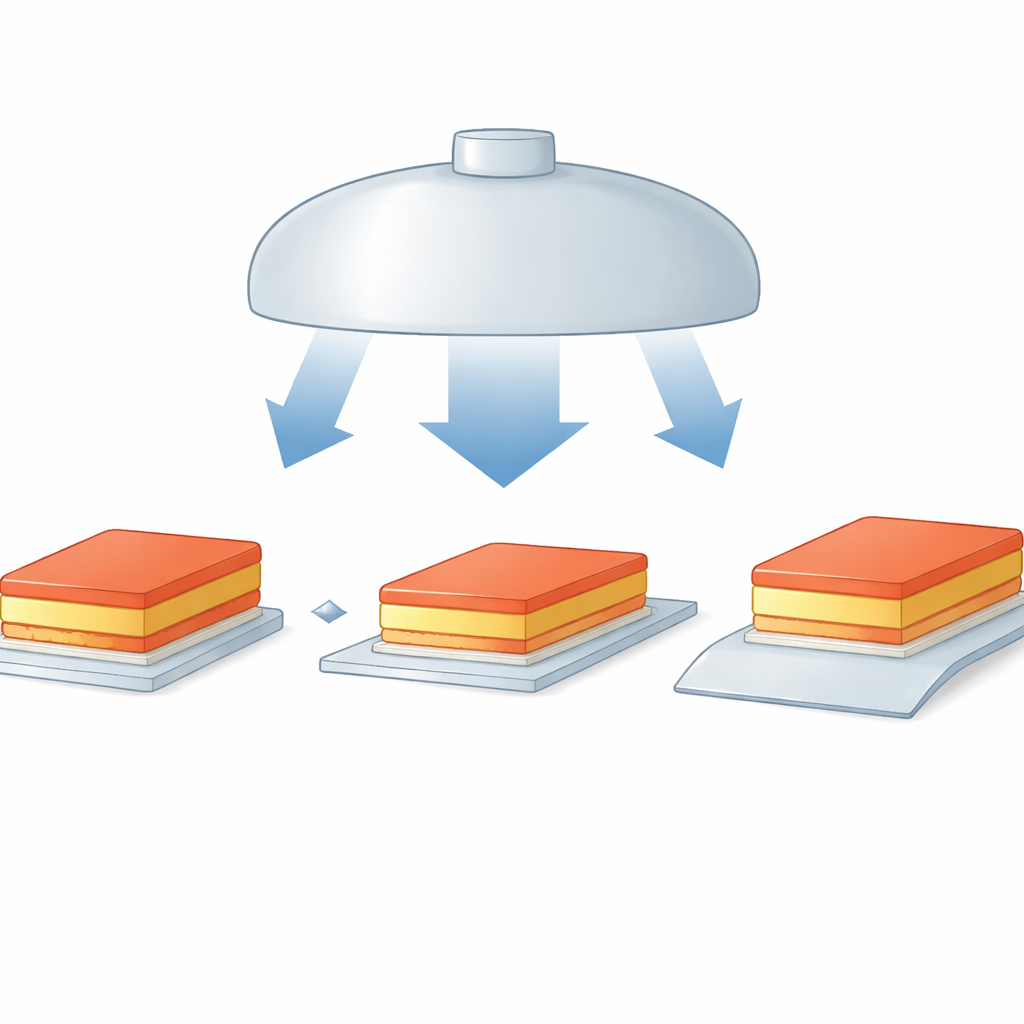
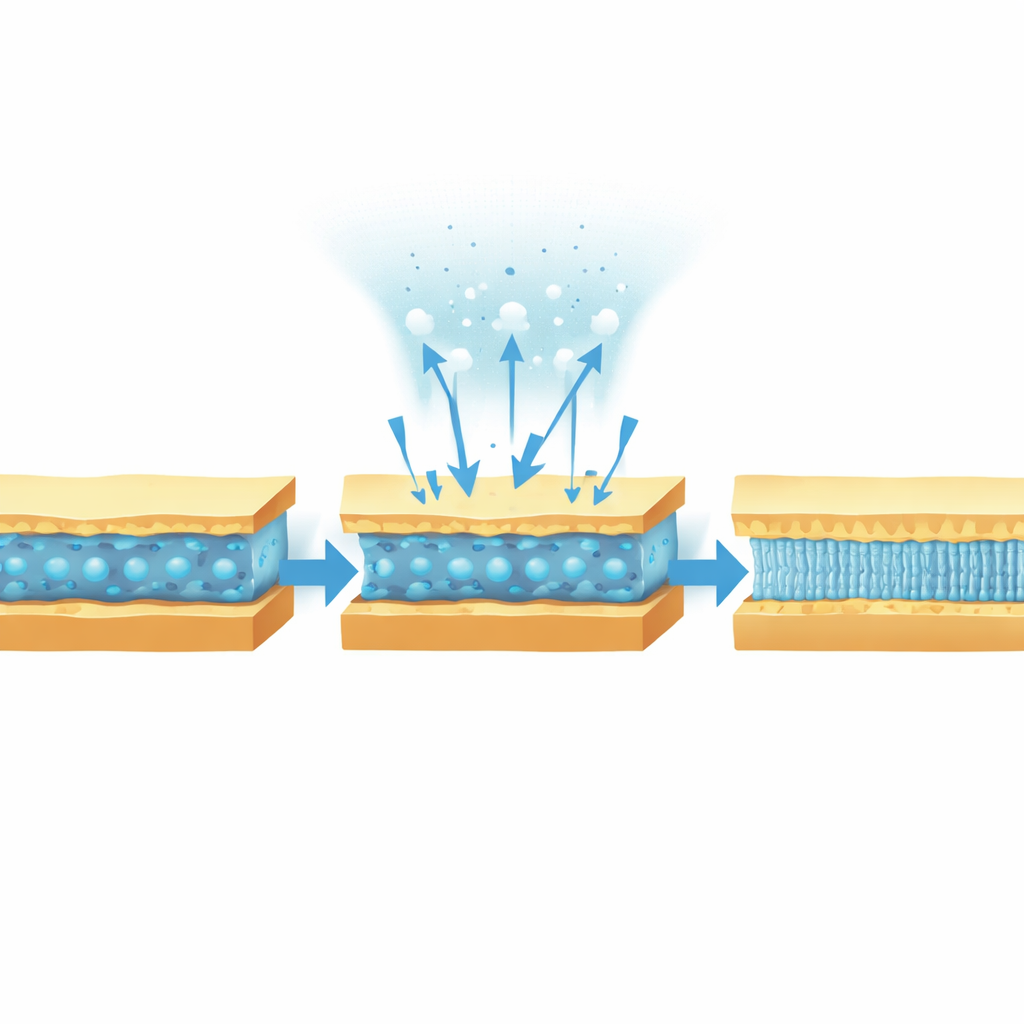
Traditional organic solar cells often rely on heating or solvent-based treatments after the active light-harvesting layer is deposited. These steps help the molecules pack more neatly, but they also create problems: heat can spread unevenly across large areas, stress can build at the interfaces, and flexible plastic substrates may be damaged. The authors introduce a different approach called vacuum-induced interfacial compaction. Instead of baking the device, they place it under controlled low pressure. The reduced pressure draws out leftover solvent and air trapped between layers and gently pulls the surfaces into closer contact, much like pressing two sheets together by removing the air between them. This layer-by-layer consolidation avoids high temperatures and preserves the delicate internal structure of the active film.
Making cleaner, tighter solar layers
Using advanced microscopy and X-ray techniques, the researchers show that vacuum-treated films become smoother and more uniform. The interfaces between the key layers—such as the contact layer that collects positive charges and the main light-absorbing blend—develop fewer voids and a more even topography. At the molecular scale, the vacuum step encourages denser packing of the active materials, improving the pathways along which charges can move. The surfaces also become more water-repellent, which helps keep moisture out and slows long-term degradation. Chemical mapping in depth reveals slightly broadened interfacial regions and stronger mixing where it is beneficial, leading to better adhesion between layers and much higher resistance to peeling, scratching, or cracking during bending.
More power from small cells to large modules
The vacuum strategy is tested in high-performance organic solar cells based on a state-of-the-art donor–acceptor blend. Compared with devices made by conventional heating, the vacuum-treated cells deliver higher power conversion efficiencies and more consistent results. Rigid, small-area cells reach over 20.5% efficiency, while flexible versions exceed 19%, placing them among the best reported for their class. Crucially, the method scales: one-square-centimeter devices still achieve about 19% efficiency, and larger modules of 15.7 and 67.2 square centimeters maintain impressive efficiencies of roughly 17.5% and 15.4%, respectively. The drop in performance with increasing size is significantly smaller than for heat-treated devices, highlighting the method’s suitability for real-world panel manufacturing.
Charges move more freely and waste less energy
Beyond raw efficiency numbers, the team probes how charges behave inside the solar cells. Measurements of current–voltage response, light-intensity dependence, and impedance show that vacuum-treated devices offer faster and more balanced transport of positive and negative charges. There are fewer “trap” sites where charges can get stuck and recombine uselessly, and the overall electrical resistance landscape is more favorable for extracting current. Time-resolved optical experiments reveal that charges separate more swiftly and recombine more slowly after the vacuum treatment. An energy-loss analysis confirms that non-radiative losses—where energy disappears as heat instead of useful electricity—are reduced. In simple terms, more of the absorbed sunlight is converted into usable electrical power instead of being wasted inside the device.
Flexible solar sheets that last longer
Because vacuum compaction strengthens the bonding between layers while slightly softening them mechanically, the resulting devices stand up better to real-world stresses. Flexible cells treated with vacuum keep over 90% of their original efficiency after thousands of bending cycles and show longer lifetimes under continuous illumination and elevated temperatures than their heat-treated counterparts. Peel tests, nano-scratch experiments, and nanoindentation all point to tougher, better-anchored interfaces that resist delamination and spread mechanical stress more evenly. This combination of strong adhesion and controlled softness is key for future applications in wearable electronics and curved surfaces, where repeated flexing is unavoidable.
What this means for future solar technology
To a non-specialist, the central message is that the authors have found a simple way to “vacuum press” the many layers of an organic solar cell so they fit together more snugly, conduct electricity more efficiently, and survive bending and aging. The method avoids harsh heating, works on both rigid glass and flexible plastic, and scales from tiny test devices to large modules while maintaining high efficiency. By solving long-standing problems of weak interfaces and unstable morphologies, vacuum-induced interfacial compaction brings lightweight, rollable, and high-performance organic solar panels a step closer to everyday products such as power-generating windows, smart textiles, and portable chargers.
Citation: Wang, S., Ding, R., Zhang, Z. et al. Vacuum-induced interfacial compaction for scalable fabrication of high-performance organic solar cells. Nat Commun 17, 3955 (2026). https://doi.org/10.1038/s41467-026-70579-w
Keywords: organic solar cells, flexible photovoltaics, vacuum processing, solar module scaling, interface engineering