Clear Sky Science · en
Strategic synthesis of FLPClusters toward catalysis
Turning Tiny Metal Clusters into Smart Catalysts
Chemists have long dreamed of catalysts that can be built like LEGO, with each atom placed for a specific job. This paper shows how to do exactly that for copper-based “molecular nanoparticles,” using a clever design that positions reactive pairs of atoms with near-atomic precision. The result is a new family of tiny copper clusters that use ordinary water to upgrade common industrial chemicals, hinting at cleaner, cheaper routes to many useful products.
Why Reactive Pairs Matter
At the heart of this work is the concept of “frustrated Lewis pairs” (FLPs). In simple terms, an FLP is a matched pair of sites: one likes to accept electrons (a Lewis acid), the other likes to donate electrons (a Lewis base). Normally they would neutralize each other by bonding together, but if they are held just far enough apart, they stay “frustrated.” That tension makes them excellent at grabbing and splitting small, stable molecules such as hydrogen or carbon dioxide. Until now, most FLP systems were either dissolved molecules or solid surfaces where the reactive sites were not precisely arranged. The authors bring the FLP idea into a new regime: atomically precise copper clusters protected by organic ligands, aiming to place every active pair exactly where they want it.
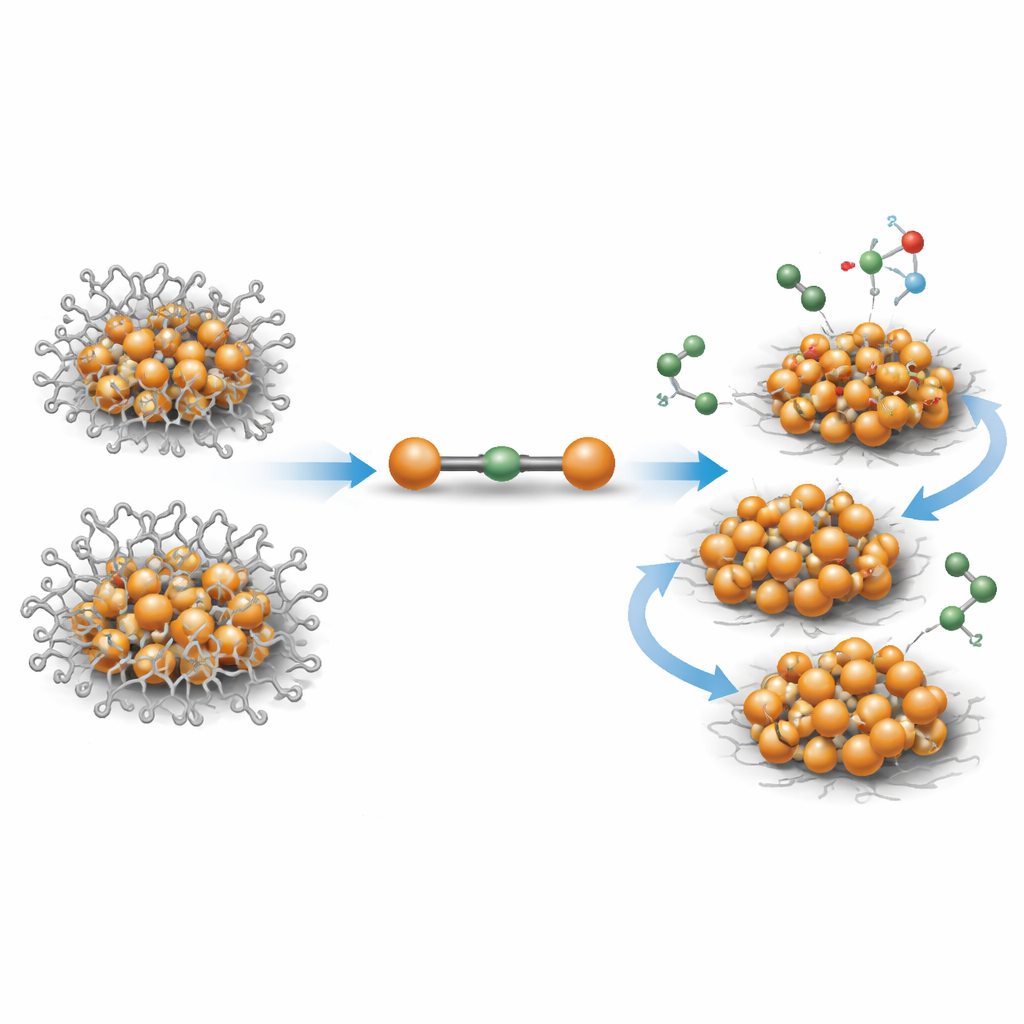
From Floppy to Fixed: Designing Better Copper Clusters
Earlier copper clusters with FLP-like behavior relied on flexible surface ligands. These floppy molecules tended to fold back and bind directly to the copper atoms, forming stable copper–oxygen bonds instead of the desired separated acid–base pairs. As a result, only a small fraction of potential FLP sites actually remained active. To solve this, the team turned to a rigid ligand called DPEphos. It has two phosphorus “arms” that clamp onto two neighboring copper atoms while a central oxygen atom hangs over the surface. The stiffness of this framework prevents the oxygen from collapsing into a normal copper–oxygen bond, keeping it close enough to interact but too constrained to neutralize the copper center. This enforced geometry reliably produces surface copper–oxygen pairs that behave as FLPs rather than shutting themselves off.
Building Three Tailored Nano-Objects
Using a simple one-pot synthesis, the researchers assembled three different copper clusters, dubbed Cu4, Cu22, and Cu28, that all carry DPEphos ligands but differ in size and supporting sulfur-based ligands. High-quality single crystals allowed them to determine each structure in detail by X-ray diffraction. In all three, the DPEphos ligand bridges two copper atoms through its phosphorus ends, while its oxygen remains “dangling” above the surface at a distance too long for a normal bond but close enough to interact. This arrangement repeats around the cluster, creating a controlled number of copper–oxygen FLP sites. Additional spectroscopic tests confirmed that copper stays in the same oxidation state and that the clusters remain intact and well ordered in solution and on supports.
Making Water Do Useful Work
With the structure under control, the team asked whether these clusters could harness water as a gentle oxidant. They focused on converting organosilanes—compounds widely used in coatings, electronics, and synthesis—into silanols, which are key intermediates in many chemical processes. By anchoring the clusters on carbon black, they created solid catalysts that could be stirred with silanes and water in an organic solvent. The smallest cluster, Cu4, nearly completely converted triethylsilane to its silanol product within a day at moderate temperature and could be reused at least six times with little loss of activity. Control experiments ruled out the carbon support, free ligands, and conventional copper clusters as the active species. Only clusters that actually contain accessible copper–oxygen FLP sites were highly effective, highlighting that the carefully designed surface architecture—not just the presence of copper—drives the chemistry.
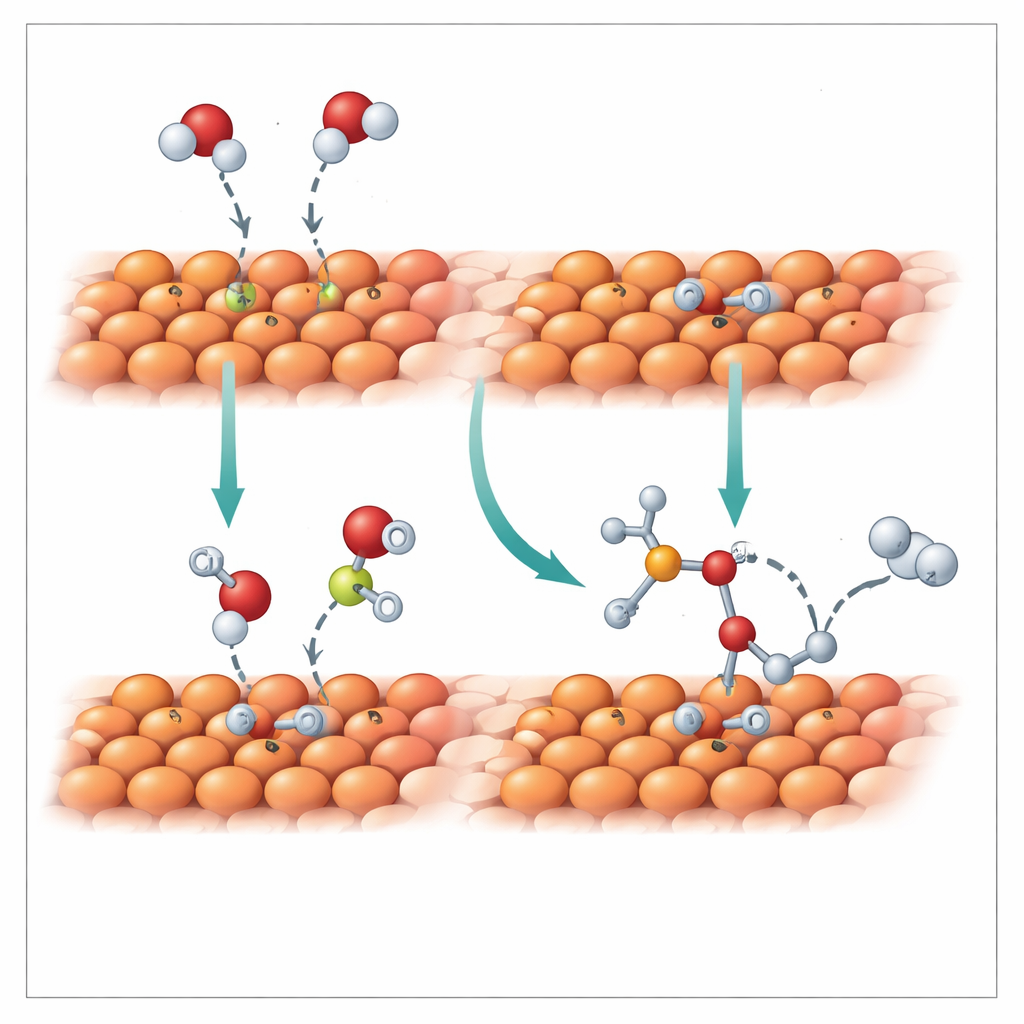
Unraveling How the Reaction Proceeds
To understand the mechanism, the researchers combined experiments with computer modeling. Infrared studies showed that ammonia binds to copper sites while carbon dioxide binds to oxygen sites, confirming that both acidic and basic centers are present and accessible. Further tests using inhibitors that mimic acids or bases selectively shut down the reaction, proving that both parts of the FLP must work together. Calculations support a stepwise picture: first, water approaches a copper–oxygen pair and splits unevenly, with the hydroxyl fragment attaching to copper and the proton attaching to oxygen. Then an organosilane comes in, reacts with the activated water fragments at the same site, and releases a silanol molecule along with hydrogen gas. The computed energy barriers along this pathway are reasonable for a room- to moderate-temperature process and much lower than for alternative sites on the cluster, confirming that the designed FLPs are indeed the preferred route.
More Active Sites, More Power
A striking outcome of this study is how directly performance tracks the number of FLP sites. When the larger Cu22 and Cu28 clusters—each carrying three FLP sites—were used at equal total FLP loading, they outperformed Cu4 by roughly one and a half times, in line with their greater site count. Increasing the amount of Cu4 catalyst increased the reaction rate in a nearly proportional fashion. These simple trends show that once the geometry is optimized, the main way to boost activity is to add more of the same high-quality sites.
What This Means Going Forward
For non-specialists, the key message is that the authors have shown how to “wire in” reactive pairs on the surfaces of tiny metal clusters with molecular precision. By freezing a normally floppy ligand into a rigid posture, they keep copper and oxygen atoms frustrated but cooperative, turning water and simple silanes into more valuable products while resisting degradation. Just as important, the work demonstrates a clear, tunable link between structure and performance: design the cluster to host more well-positioned FLP sites, and the catalyst gets better. This level of control could be extended to other metals and reactions, opening the door to custom-built catalysts that perform demanding chemical tasks using abundant elements and mild conditions.
Citation: Geng, Z., He, A., You, X. et al. Strategic synthesis of FLPClusters toward catalysis. Nat Commun 17, 3836 (2026). https://doi.org/10.1038/s41467-026-70577-y
Keywords: frustrated Lewis pairs, copper nanoclusters, heterogeneous catalysis, silanol synthesis, water activation