Clear Sky Science · en
Patterns and determinants of mitogenomic evolution in Bilateria
Why tiny powerhouses matter
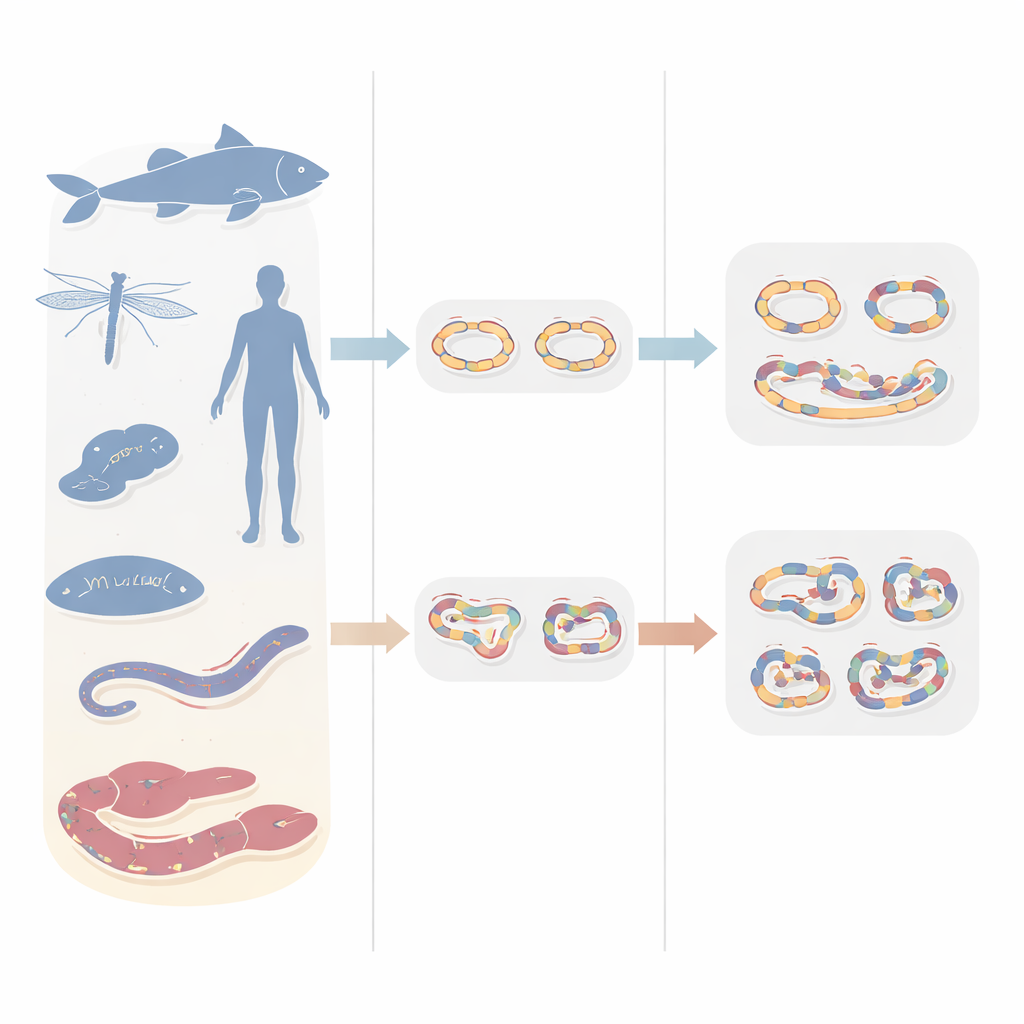
Mitochondria—our cells’ energy factories—carry their own small DNA circles. In many animals, this mitochondrial DNA has barely changed in layout for hundreds of millions of years, while in others it has been shuffled and rewired again and again. This study asks a deceptively simple question: why are some animal lineages so conservative about this crucial bit of DNA, while others are evolutionary daredevils? By analysing mitochondrial genomes from almost 11,000 animal species with left‑right body symmetry (the Bilateria, from worms to humans), the authors link patterns of change to how animals live and move.
Ancient blueprints that mostly stayed put
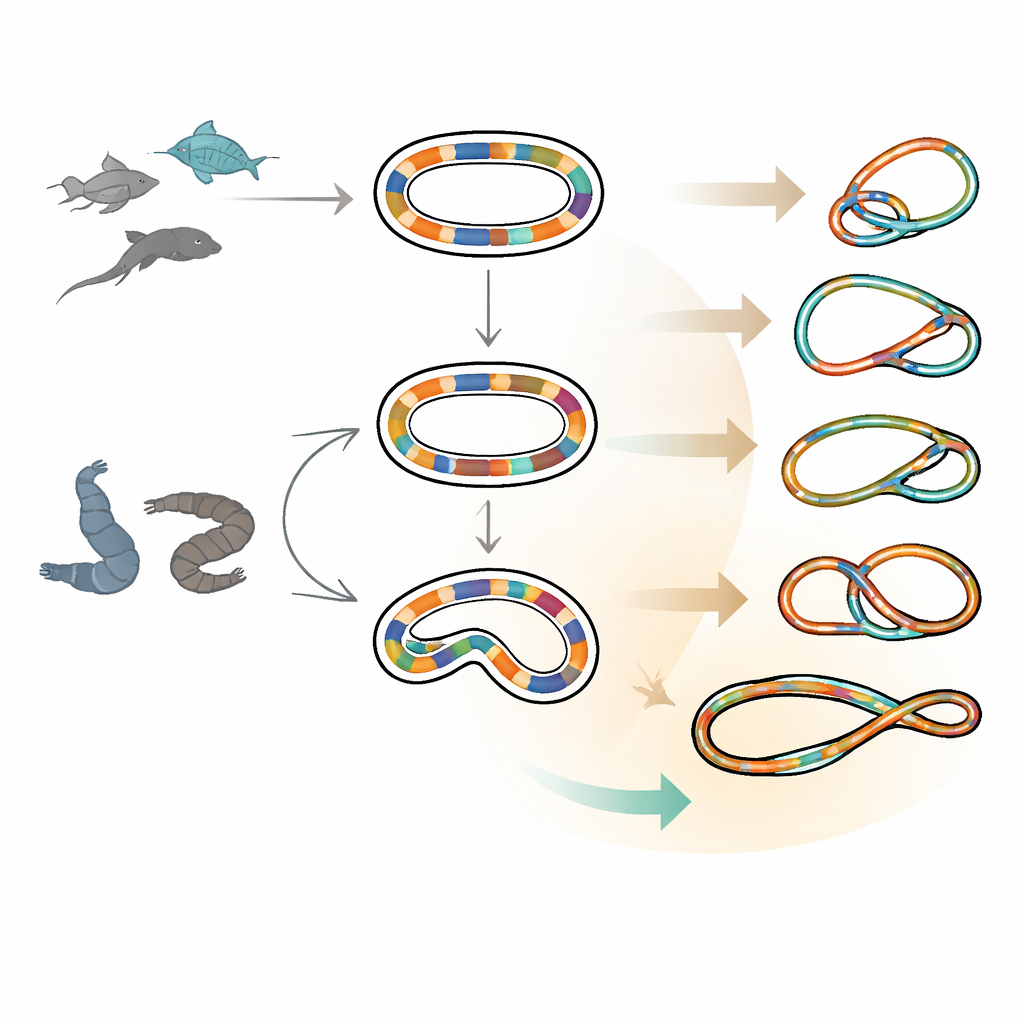
The researchers first reconstructed what the very first bilaterian’s mitochondrial genome probably looked like. Despite today’s wide diversity, their analyses point to a layout much like that seen in humans and many other vertebrates, with genes split between the two DNA strands of the mitochondrial circle. This “double‑stranded” arrangement appears to be ancestral not only for Bilateria as a whole, but also for most major subgroups. Over evolutionary time, at least twenty separate lineages shifted to a more radical state in which nearly all genes sit on a single strand. Such “single‑stranded” designs turned up repeatedly, especially in certain worms, molluscs, and rotifers, and in some cases even flipped back again—rare reversals that challenge earlier ideas that this transition was effectively one‑way.
Slow movers and parasites loosen the rules
Next, the team asked what kinds of animals tend to show the most scrambled mitochondrial layouts. They quantified how far each species’ gene order had drifted from the inferred ancestral pattern, and compared that to how quickly the underlying DNA sequence had changed. Across the tree of life, these two measures climbed together: species whose gene order is heavily rearranged also tend to have fast‑evolving sequences. Crucially, high levels of shuffling were concentrated in animals that either move very little or live as parasites inside other hosts. Internal parasites displayed the most extreme rearrangements, followed by external parasites, while free‑living, actively swimming or walking animals showed the most conservative genomes. This supports a unifying idea: when an animal’s lifestyle demands less constant, high‑powered energy output, natural selection relaxes its grip on the fine‑tuned workings of mitochondria, allowing both mutations and architectural experiments to accumulate.
Strand flips, chemical imbalances, and genome size
Single‑stranded mitochondrial genomes were not just structurally unusual; they also tended to evolve faster and to show stronger chemical asymmetries between strands, a feature measured as GC skew. These skew patterns, which reflect biases in the mutational process, were especially prone to flipping direction in parasitic and slow‑moving lineages, suggesting widespread past upheavals in how their mitochondrial DNA is copied and read. Surprisingly, another obvious suspect—effective population size, an estimate of how many individuals pass genes to the next generation—showed little relationship to any of the evolutionary measures. Equally counter‑intuitive, species with the most jumbled, rapidly changing mitochondrial genomes usually had smaller mitochondrial DNA circles, whereas large, stable genomes were typical of active, warm‑blooded vertebrates such as birds and mammals.
Warm‑ and cold‑blooded animals break expectations
The study also revisited a long‑standing debate about whether warm‑blooded animals, with their high metabolic rates, accumulate mitochondrial mutations faster than cold‑blooded ones. When the authors looked across all Bilateria, endotherms (warm‑blooded species) actually showed slower mitochondrial change and more conservative gene order than ectotherms, despite their higher energy turnover. Within vertebrates alone, however, earlier patterns re‑emerged, underscoring that broad rules drawn from one group do not always hold across the animal kingdom. Overall, traits linked directly to everyday energy use—how strongly an animal must power its own motion, and whether it relies on a host for many functions—were more informative than body temperature alone.
What this means for life’s energy systems
By tying together movement, lifestyle, and microscopic DNA architecture, this work shows that the “wiring diagram” of mitochondria is not merely drifting at random. In animals that must constantly generate bursts of energy, natural selection strongly protects tried‑and‑tested genome designs. In creatures that move little or outsource many needs to a host, that protection weakens, and mitochondrial genomes are freer to shrink, shuffle, and even switch how their strands are used. The authors conclude that variation in the strength of purifying selection—largely shaped by locomotory demands and ecology—is a primary driver of how mitochondrial genomes are built and rebuilt across animals, even though additional molecular and historical factors are needed to explain all the quirks and exceptions.
Citation: Jakovlić, I., Ma, YW., Ye, T. et al. Patterns and determinants of mitogenomic evolution in Bilateria. Nat Commun 17, 3849 (2026). https://doi.org/10.1038/s41467-026-70576-z
Keywords: mitochondrial genome evolution, parasitism, locomotory capacity, gene order rearrangement, Bilateria