Clear Sky Science · en
Solvation sheath reorganization enables fast ion transfer kinetics in lithium-ion battery
Why Colder, Faster Batteries Matter
Lithium-ion batteries power our phones, cars, and even aircraft prototypes, but they struggle when asked to charge very quickly or work in bitter cold. In everyday terms, the liquid inside the battery that ferries lithium ions back and forth becomes thick and slow, and the ions get bogged down. This article explores a new way to redesign that liquid so lithium ions can move rapidly, even at temperatures as low as −50 °C, opening doors for electric vehicles and other devices that must perform reliably in winter climates and under fast‑charging conditions.
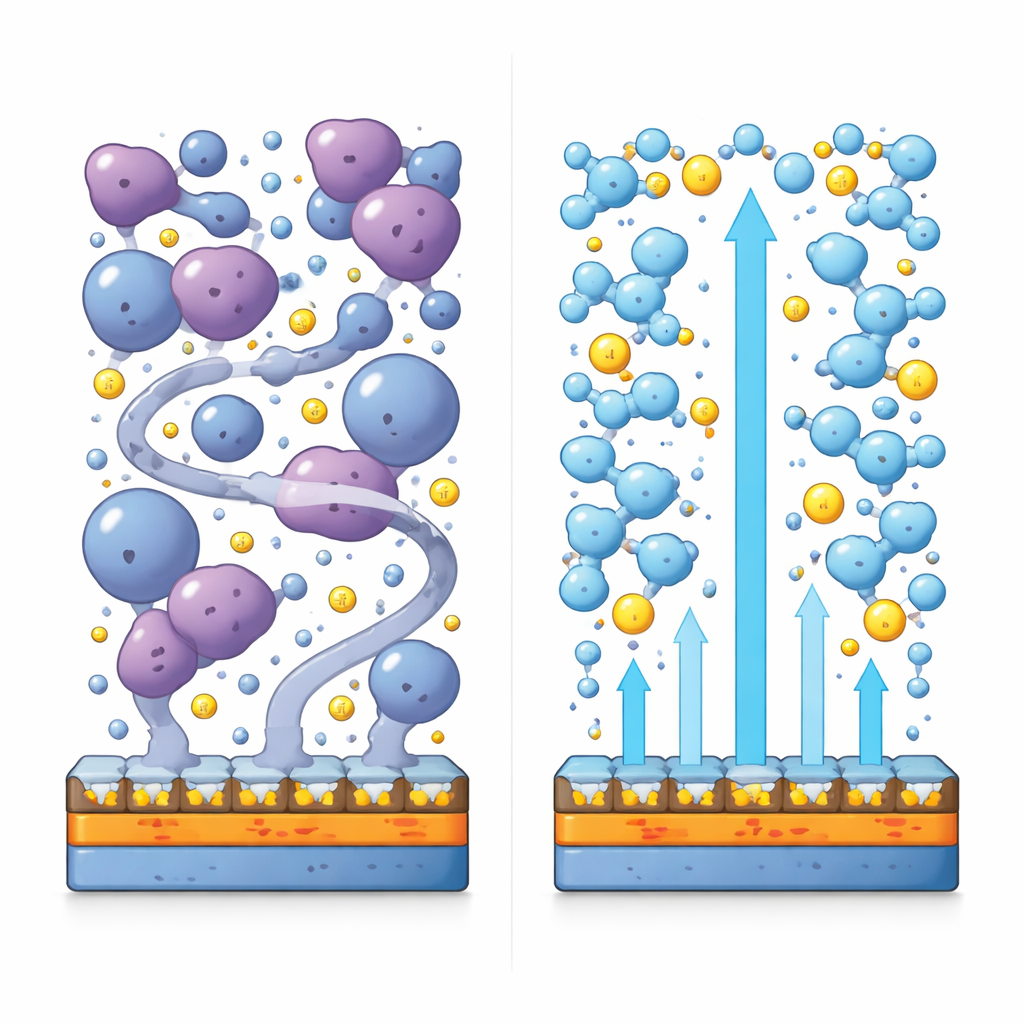
How the Inner Liquid Holds Batteries Back
Inside a lithium‑ion battery, charged lithium atoms drift through a liquid called the electrolyte. In most commercial batteries, this liquid is based on carbonate solvents that wrap lithium ions in bulky shells of molecules. These large shells help keep the battery stable, but they also slow lithium down by forcing it to drag a heavy entourage wherever it goes. Other advanced designs try to strengthen the protective layers on the battery electrodes by packing ions and solvent into dense clusters. That improves long‑term stability but further reduces the number of free, mobile ions and limits how quickly current can flow, especially at low temperatures where the liquid partially solidifies.
A New Ingredient That Loosens the Crowd
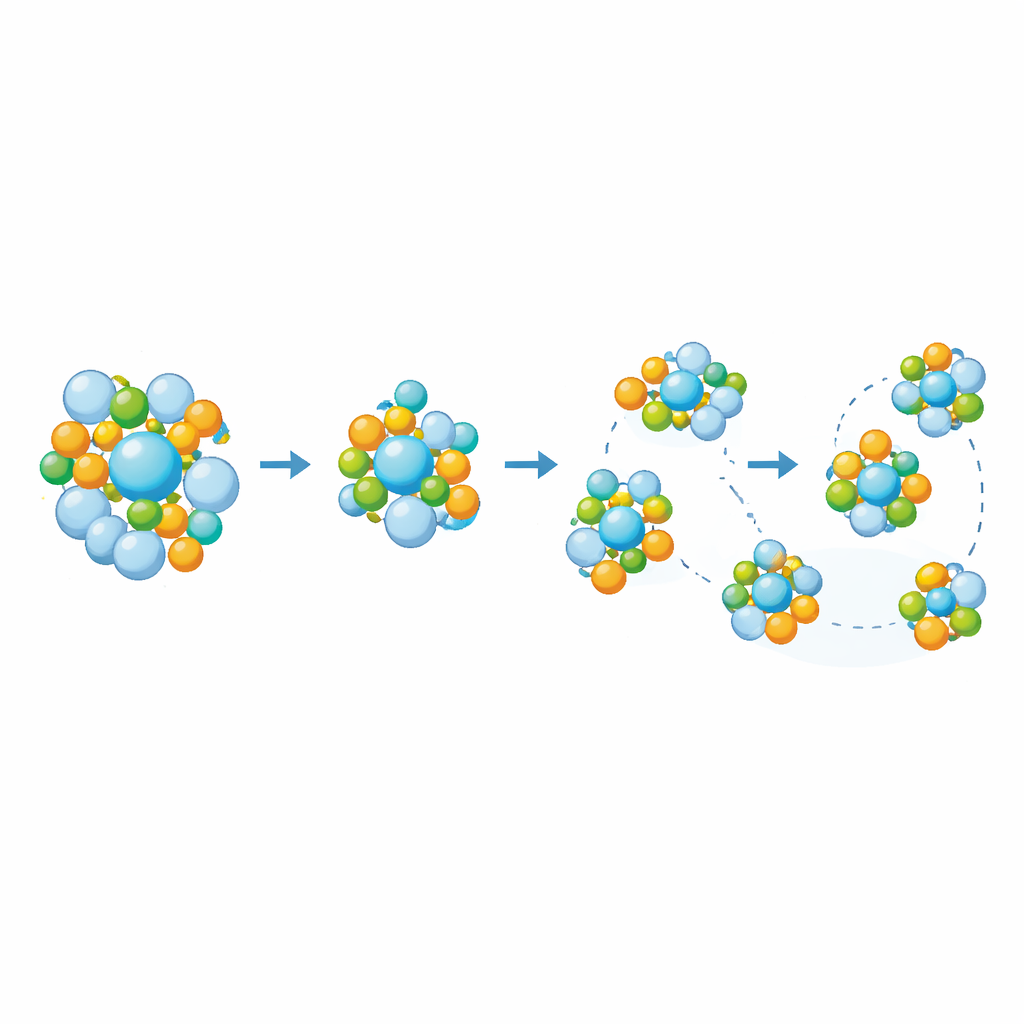
The researchers propose a different strategy: add a small, weakly polar “moderator” molecule that slips into the crowded environment around lithium and gently breaks up oversized clusters. They describe this action using a simple parameter, D, which depends only on two basic properties—how strongly the molecule interacts electrically and how big it is. A higher D means the moderator is better at breaking large clusters into compact, mobile units. Guided by this rule, they identify dichloromethane as a particularly effective choice. When mixed with a standard salt and acetonitrile solvent, it reorganizes the liquid so that lithium ions are mostly paired with single counter‑ions in tight, uniform groups rather than trapped in sprawling aggregates.
Making Ions Hop Instead of Trudge
Computer simulations show that in the new liquid, lithium ions do not drag their entire solvent shell as they move. Instead, the ions hop quickly from one local environment to the next, spending far less time stuck to any given neighbor. This hopping style turns out to be much faster than the “vehicular” motion seen in conventional electrolytes. The new mixture supports high ionic conductivity across a broad temperature range, retains a high fraction of charge carried specifically by lithium, and stays in a single liquid phase down to about −100 °C. In contrast, standard carbonate‑based liquids may conduct slightly better at room temperature but freeze or thicken badly around −40 °C, choking off ion motion.
From Laboratory Cells to Practical Pouch Batteries
When tested in battery cells built with graphite negative electrodes and high‑energy NMC811 positive electrodes, the redesigned liquid enabled both rapid charging and excellent low‑temperature operation. Graphite cells cycled at very high current maintained most of their capacity over hundreds to thousands of cycles, indicating that the usual bottleneck—getting lithium out of its solvent shell and into the graphite—had been eased. Full‑size pouch cells rated at 1.0 ampere‑hour delivered 0.87 ampere‑hours at −40 °C and still more than half their nominal capacity at −50 °C, while similar cells using commercial electrolytes produced little or no usable energy under the same conditions.
Building a Better Skin on Battery Electrodes
The team also examined how the new liquid changes the thin films that grow on electrode surfaces and largely determine battery lifetime. Using advanced microscopy and spectroscopy, they found that the dichloromethane‑based mixture forms very thin, tightly packed, inorganic‑rich layers on both graphite and NMC811. These layers conduct lithium ions well and resist mechanical damage, unlike the thicker, more organic films formed by standard carbonate liquids, which tend to be porous and resist ion flow. The cleaner, more uniform films help sustain the fast ion transfer seen in performance tests and reduce energy losses during cycling.
What This Work Means for Future Batteries
In simple terms, this study shows that carefully chosen small molecules can reorganize the battery’s inner liquid so lithium ions move by nimble hops instead of slow trudging, even in severe cold. While the specific additive used here, dichloromethane, has drawbacks such as toxicity and volatility, it serves as a proof‑of‑concept that the D parameter can guide the search for safer, equally effective molecules. The broader message is that by tuning how the liquid surrounds and releases lithium ions, engineers can unlock faster charging and reliable low‑temperature performance in next‑generation lithium‑ion batteries.
Citation: Li, M., Lu, D., Wang, J. et al. Solvation sheath reorganization enables fast ion transfer kinetics in lithium-ion battery. Nat Commun 17, 3953 (2026). https://doi.org/10.1038/s41467-026-70570-5
Keywords: lithium-ion batteries, electrolyte design, low-temperature performance, fast charging, ion transport