Clear Sky Science · en
Periplasmic gatekeeping of phage DNA entry by an rSAM enzyme matured effector with HxS repeats
How Bacteria Can Slam the Door on Viral DNA
Viruses that attack bacteria, called phages, are everywhere—from oceans to our own gut. They help shape ecosystems and are being explored as living antibiotics to fight drug-resistant infections. This study uncovers a previously unknown way that some bacteria stop phages at the very first step of infection: they block the virus’s DNA at the doorway between the cell surface and interior. Understanding this early “gatekeeping” strategy could influence how we design phage therapies and how we think about the constant arms race between microbes and their viruses.
A New Type of Bacterial Security System
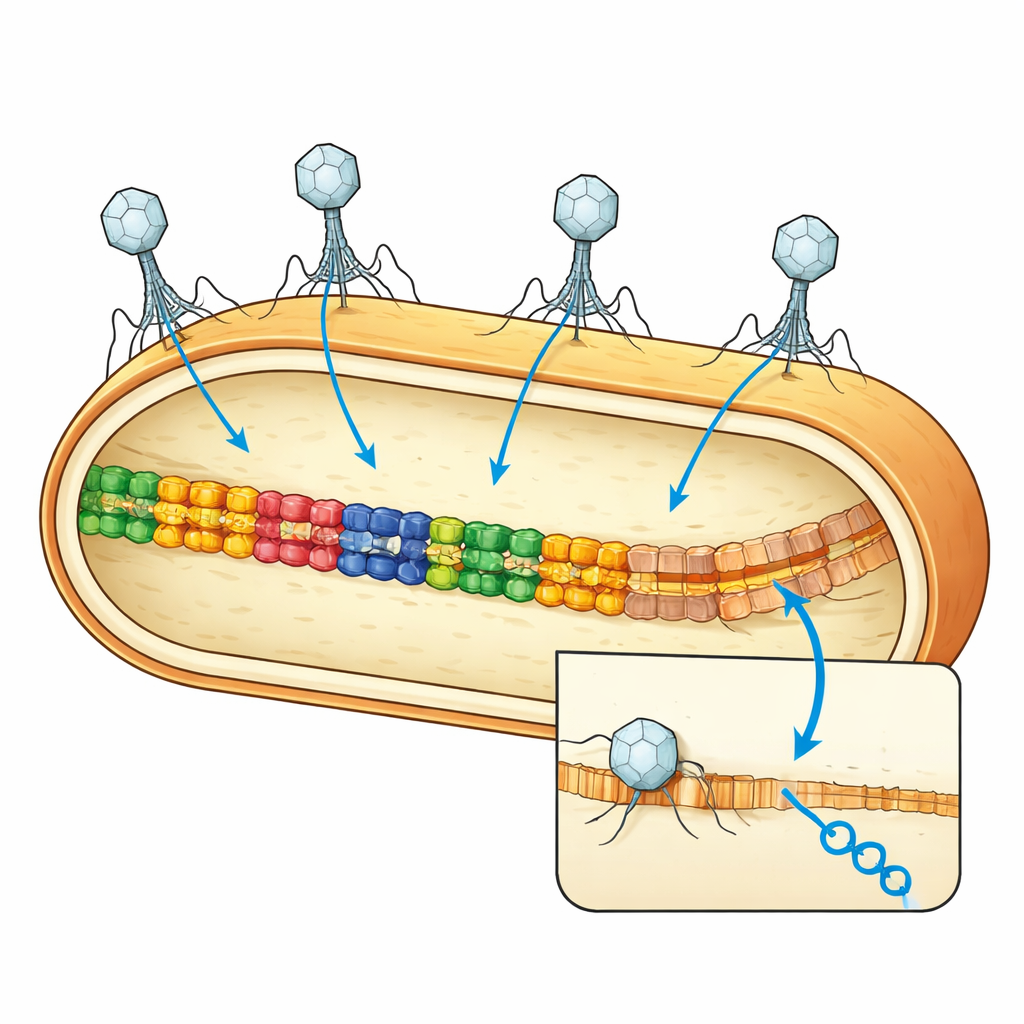
The researchers describe a four-part bacterial defense system they call HXS. It was first noticed in Escherichia coli while searching for relatives of viperin, a well-known antiviral protein in animals. When the team moved one HXS gene cluster into a lab strain of E. coli, the bacteria suddenly became highly resistant to an exceptionally broad range of phages: 110 out of 113 tested viruses were strongly blocked. Unlike many known defenses, HXS did not kill the host cell as a sacrifice; infected bacteria remained alive and growing, and the system did not interfere with phage binding to the cell surface. This pointed to a very specific block somewhere after the virus attached but before it could take over the cell’s machinery.
Stopping Viral Genomes at the Threshold
To pinpoint where HXS acts, the team focused on phage T7, a classic workhorse of molecular biology. By repeatedly growing T7 on HXS-protected bacteria, they evolved “escape” phages that could break through the defense. All key mutations clustered in two phage proteins that form a tunnel for DNA to cross the bacterial envelope, strongly suggesting that HXS targets the DNA-entry step. A biochemical assay that times how fast viral DNA moves into the cell confirmed this: in normal cells, T7 DNA finished entering in about 10–12 minutes, but in HXS-expressing cells, entry was delayed three- to fivefold. Electron microscopy, which distinguishes full from emptied viral shells, showed the same effect: phage particles remained full of DNA much longer when HXS was present. Similar delays were seen with a very different phage family, implying that HXS blocks a general DNA-delivery process rather than any one virus.
A Specialized Guard Protein in the Cell Wall Space
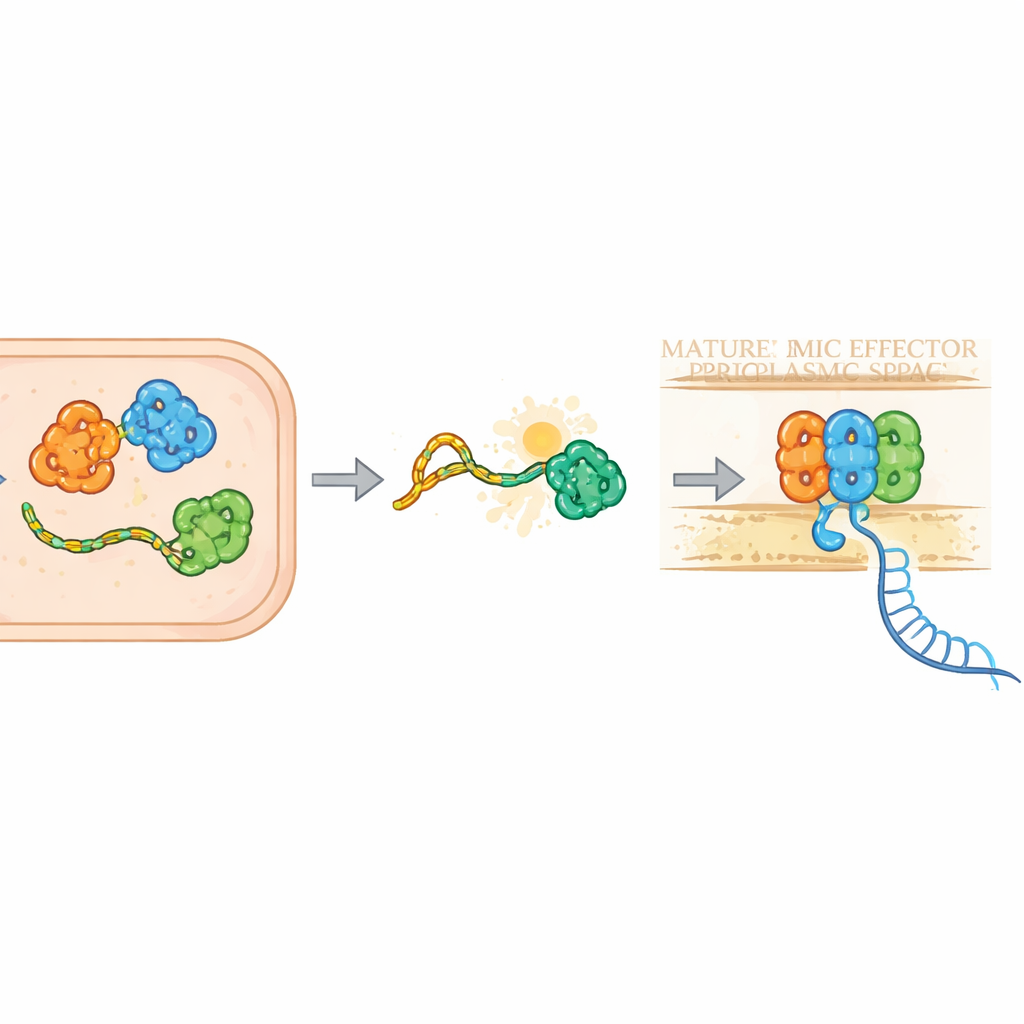
HXS is built from four proteins, but one called HxsA emerged as the front-line “effector.” HxsA carries a signal that sends it to the periplasm—the thin compartment between the inner and outer membranes of Gram-negative bacteria—and a region that can latch onto the rigid cell wall. When researchers disrupted either the targeting signal or the wall-binding region, phage protection vanished. Western blot experiments showed that HxsA is not used in its original form: it is cut and trimmed inside the cell, and only this shorter version accumulates in the periplasm. If any of the three partner proteins—HxsB, HxsC, or HxsD—were deleted or their key motifs altered, HxsA was no longer correctly processed or delivered, and the defense failed. Together, these results reveal a specialized assembly line that prepares and positions HxsA right where phage DNA must pass.
Chemical Fine-Tuning and DNA Snaring Repeats
Digging deeper, the authors used high-resolution mass spectrometry to map the precise changes made to HxsA. They found that a short segment of the protein carries an unusual chemical modification that adds eight units of mass, likely installed by the radical SAM enzyme activities of HxsB and HxsC working with HxsD. Altering individual amino acids within this tiny motif completely destroyed protection, underlining its importance. HxsA also contains five repeats of a short sequence rich in positively charged building blocks. Replacing any one repeat with neutral residues eliminated defense, and purified HxsA from the periplasm bound strongly to DNA in test-tube assays. These clues support a model in which matured HxsA proteins, anchored along the cell wall, use repeated positive patches to grab the negatively charged viral DNA as it tries to thread through the phage-made tunnel, physically stalling genome entry.
Why This Discovery Matters Beyond the Lab
By cataloging where HXS-like gene clusters appear across thousands of bacterial genomes, the study shows that this system is especially common in Gammaproteobacteria, including medically important genera such as Klebsiella, Escherichia, and Pseudomonas. That prevalence hints that HXS may play a major role in how these bacteria survive in phage-rich environments. More broadly, HXS is the first known example of a radical SAM enzyme that chemically matures a protein specifically to block phage DNA entry in the periplasm. This work expands the known playbook of bacterial immunity and suggests new ways to engineer phage-resistant production strains—or to anticipate resistance when phages are used as drugs—by understanding and perhaps reprogramming this molecular gatekeeping system.
Citation: Li, M., Sun, E., Wang, S. et al. Periplasmic gatekeeping of phage DNA entry by an rSAM enzyme matured effector with HxS repeats. Nat Commun 17, 3910 (2026). https://doi.org/10.1038/s41467-026-70567-0
Keywords: bacteriophage defense, bacterial immunity, phage DNA entry, radical SAM enzyme, HxsA gatekeeper