Clear Sky Science · en
Spatiotemporal visualization of long-range anisotropic plasmon polaritons in hyperbolic MoOCl2
Light Waves on a Tiny Highway
Modern technologies from faster computers to ultra-secure communication all hinge on one question: how can we guide light the way we guide electricity in a wire, but without wasting energy? This study shows that a little-known crystal, molybdenum oxydichloride (MoOCl₂), can carry special ripples of light called plasmons over surprisingly long distances, along preferred directions, and at speeds close to that of light in vacuum—all on a scale much smaller than the width of a human hair. 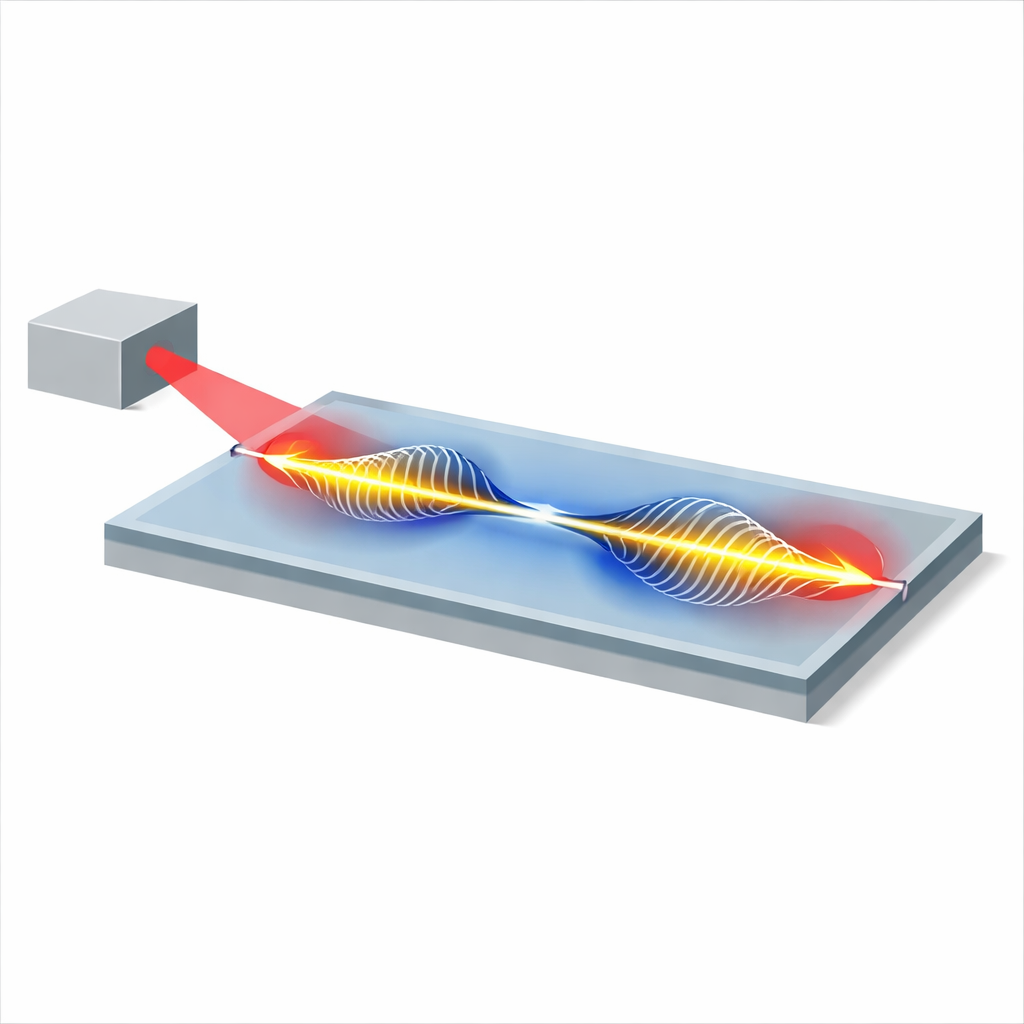
A New Kind of Light Traffic
In ordinary materials, light spreads out in all directions, which is not ideal if you want to route signals cleanly around a chip. Some crystals, however, respond differently to light depending on the direction it travels—an effect known as anisotropy. MoOCl₂ is one of these crystals, and it is also “hyperbolic,” meaning that for certain colors of light its internal electronic response forces waves to take very unusual paths. Instead of simply shining through, the light couples to collective electron motions at the material’s surface, forming plasmon polaritons: hybrid waves that cling to the crystal like ripples on a pond. The authors show that, in thin flakes of MoOCl₂, there is a special, previously overlooked plasmon mode that can travel long distances while remaining strongly directional.
Watching Ultrafast Ripples in Real Time
To find and study these long-range waves, the team used an advanced imaging method called time-resolved photoemission electron microscopy. They hit a tiny MoOCl₂ flake with extremely short laser pulses lasting only about 30 femtoseconds—a few dozen quadrillionths of a second. Where the light and the surface waves overlap, electrons are kicked out of the material. By collecting these electrons to form an image, the researchers could watch how the plasmon ripples spread, shift, and bounce off the flake’s edges. Crucially, they controlled the timing between two laser pulses with better than one-femtosecond precision, allowing them to see how the ripples evolved both in space and within a single oscillation of the light wave.
Directional Waves That Go the Distance
The experiments revealed plasmon waves that strongly prefer to travel along one crystal axis—the direction where MoOCl₂ behaves more like a metal. When the laser polarization was aligned with this axis, clear interference fringes appeared; when it was turned perpendicular, the fringes nearly vanished, confirming that the material steers the waves like a built-in set of rails. By analyzing the changing fringe patterns at different colors of light, the team mapped out how the plasmon’s energy depends on its wavelength and identified two related modes: a short-range, more strongly confined plasmon and a long-range anisotropic plasmon polariton (LRAPP). The LRAPP mode showed propagation lengths greater than 10 micrometers—over 100 times the thickness of many flakes—and traveled with a group velocity around two-thirds the speed of light and a phase velocity even closer to light speed.
Bouncing Waves and Hidden Losses
Because the imaging captured entire regions of the flake at once, the researchers could track how the LRAPPs launched from opposite edges, crossed in the middle to form standing-wave patterns, and then reflected back from the far edges. The waves completed multiple passes across an 11-micrometer-wide flake, implying a total travel distance exceeding 33 micrometers before decaying significantly. Comparing these measurements with theoretical models, the team found that the long-range mode suffers less intrinsic loss than its short-range counterpart, meaning it wastes less energy as heat. They also ruled out other exotic wave types predicted for anisotropic crystals—so-called “ghost modes”—because those would die out much faster and live deeper inside the bulk, beyond the reach of their surface-sensitive technique. 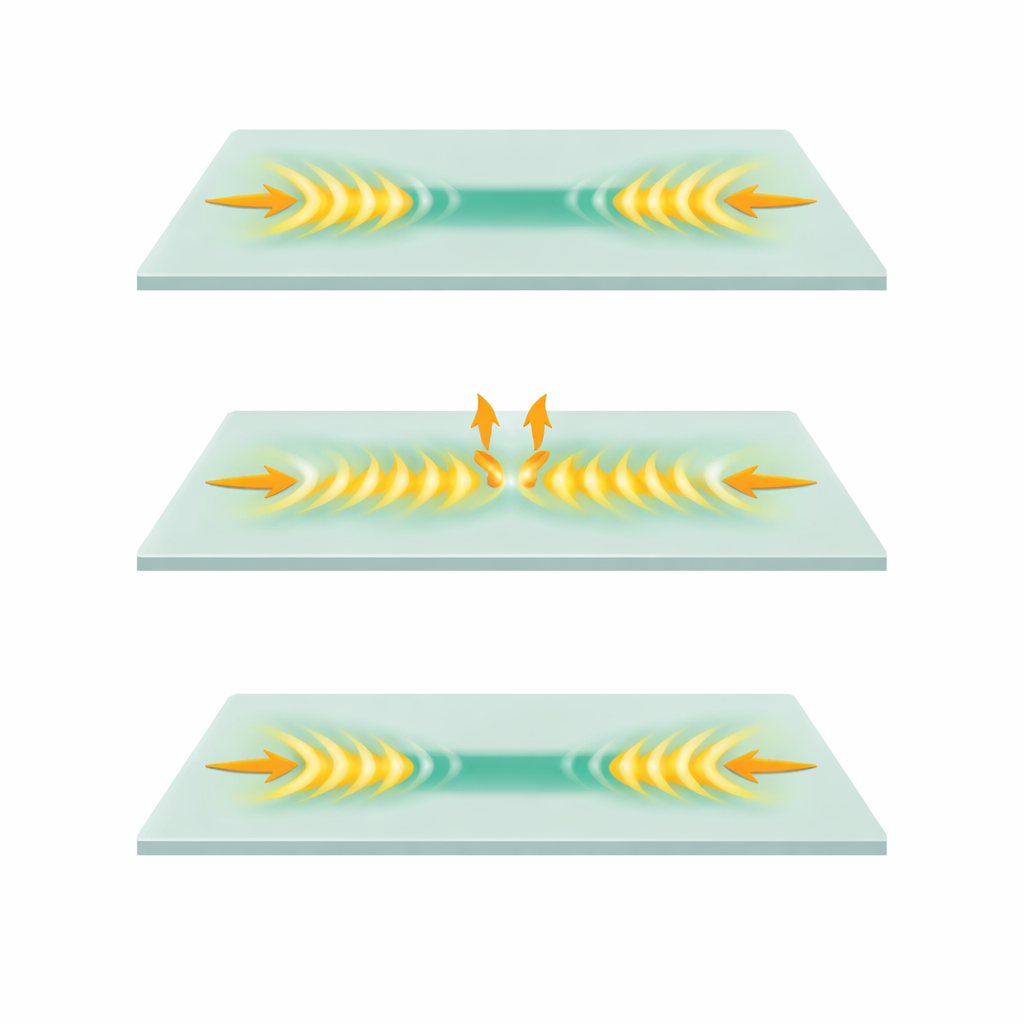
From Fundamental Ripples to Future Devices
In everyday terms, this work shows that a naturally occurring crystal can act as a tiny, directional light highway that moves energy quickly and efficiently along chosen paths, while also supporting more tightly confined modes for local control. Being able to see these waves in both space and time gives engineers a powerful new tool to design on-chip optical circuits, waveguides, and sensors that use light instead of electrons to carry information. Because MoOCl₂ works at visible wavelengths, is stable in air, and can be prepared by simple exfoliation, it offers a practical route toward nanophotonic devices that are faster, more energy-efficient, and capable of probing the quantum behavior of light and matter on ultrafast timescales.
Citation: Ghosh, A., Raab, C., Spellberg, J.L. et al. Spatiotemporal visualization of long-range anisotropic plasmon polaritons in hyperbolic MoOCl2. Nat Commun 17, 3884 (2026). https://doi.org/10.1038/s41467-026-70565-2
Keywords: nanophotonics, plasmon polaritons, hyperbolic materials, time-resolved microscopy, molybdenum oxydichloride