Clear Sky Science · en
A two-mode thermomechanically squeezed phonon laser
Turning Gentle Vibrations into a New Kind of Laser
Lasers usually make us think of beams of light, but at a deeper level they are about organizing chaos: taking jittery motion and turning it into a clean, steady wave. In this work, researchers show that you can build a laser not from light, but from the tiny vibrations of matter itself—and, crucially, that this laser can also quieten certain kinds of noise in those vibrations. That combination could one day help scientists measure forces more precisely, explore the boundary between classical and quantum physics, and design new sensors based on tiny moving particles.
Why Vibrations Matter as Much as Light
Traditional lasers shine because trillions of light particles march in step, giving a beam with a single color and a well-defined phase. Yet standard laser light is still noisy in important ways, and it does not naturally carry special resources like "squeezing" and "entanglement" that are vital for ultrasensitive measurements and quantum information. Creating squeezed light—where noise is reduced in one property at the expense of another—normally relies on weak optical nonlinearities, so the resulting beams are dim. The authors instead turn to mechanical motion: the tiny jiggling of a nanoparticle held in an optical trap. Mechanical systems can show much stronger nonlinear effects, raising the possibility of a device that is both bright, like a laser, and noise-reduced, like a squeezed source.
Building a Laser from a Levitated Nanoparticle
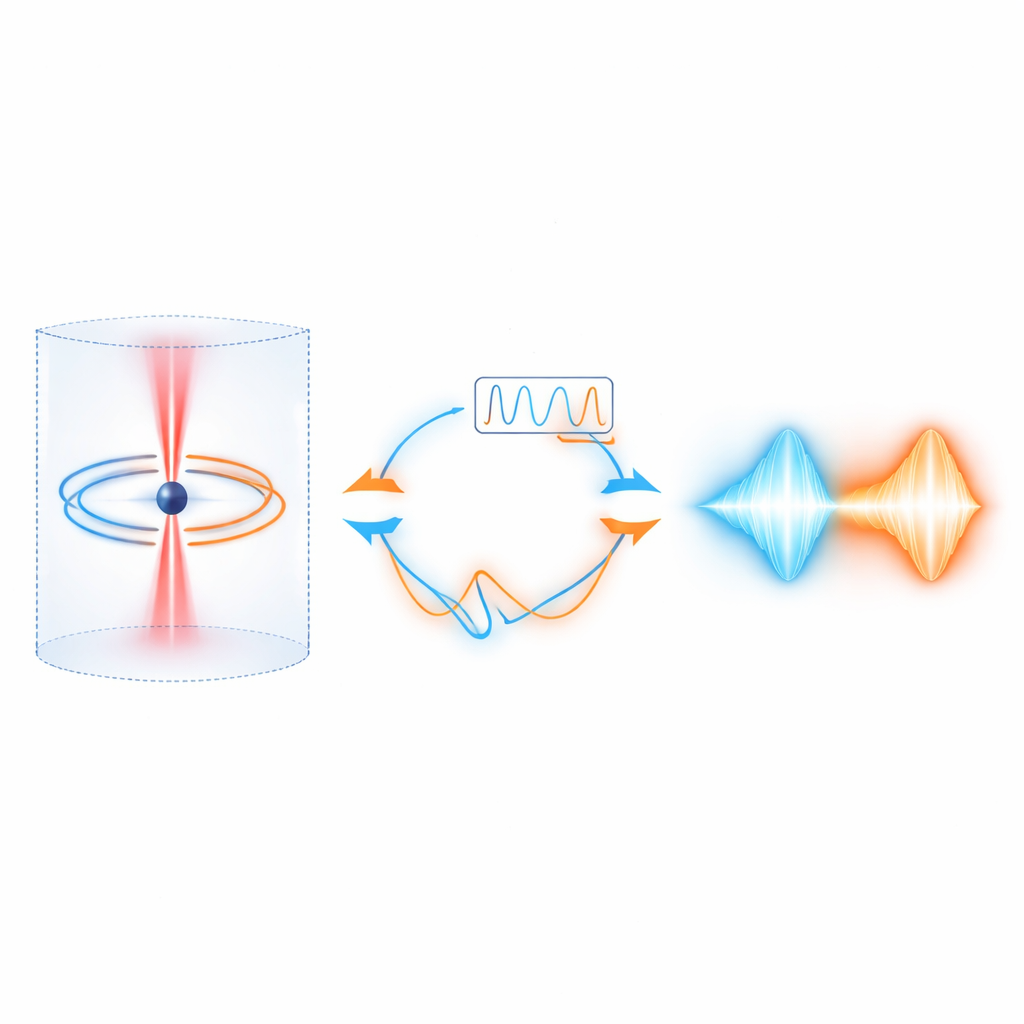
The experiment centers on a silica sphere only about 100 nanometers across, held aloft in a vacuum by a tightly focused infrared laser beam. This optical "tweezer" creates a three-dimensional potential well that confines the particle, allowing it to oscillate around the trap center. Because the trapping beam is linearly polarized, the restoring forces in two sideways directions are slightly different, giving two distinct vibration modes with their own natural frequencies. By periodically and very slightly rotating the direction of the light’s polarization, the team rhythmically twists the shape of the trapping well. This motion couples the two sideways vibrations and drives a special kind of process—nondegenerate parametric amplification—that converts energy from the drive into pairs of mechanical quanta (phonons) shared between the two modes.
From Brownian Motion to Coherent Mechanical Waves
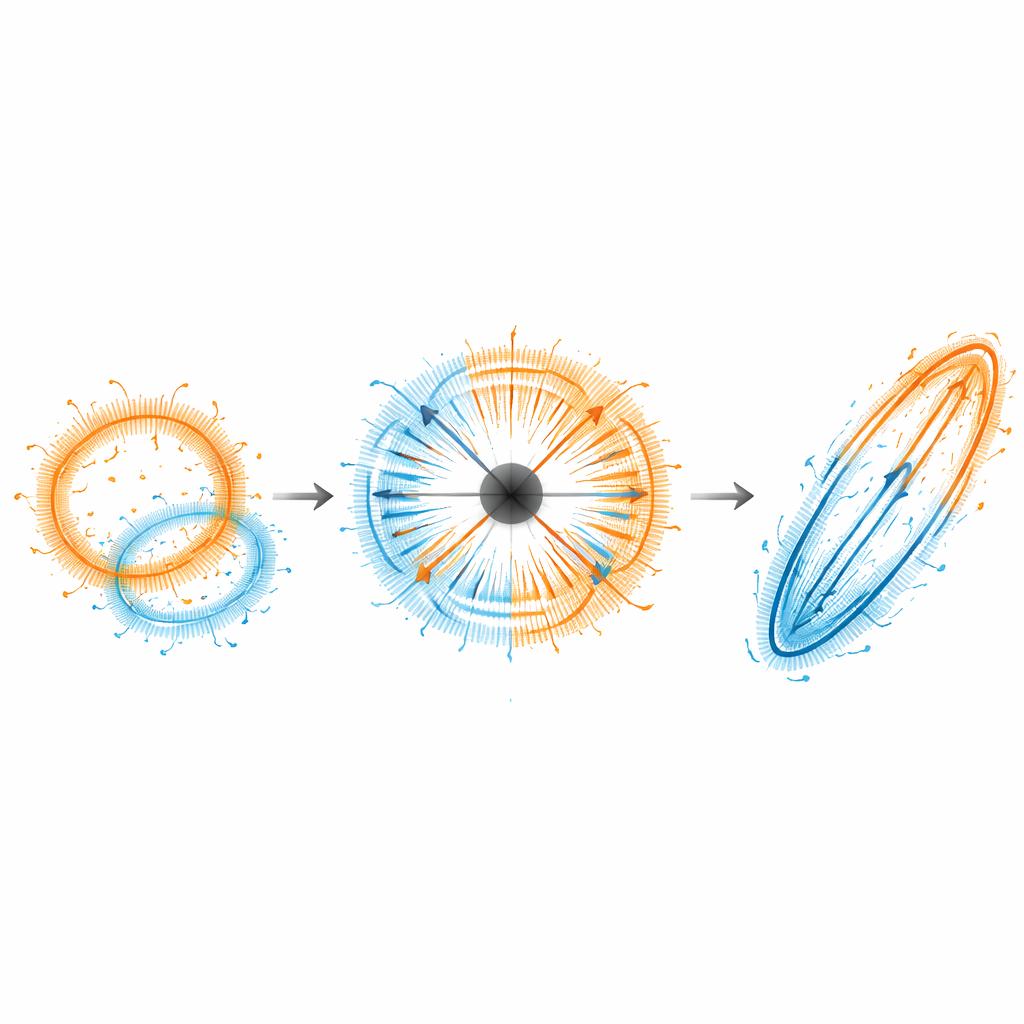
Left alone, each vibration mode behaves like a tiny Brownian particle: its position and momentum wander in a circular cloud in phase space, reflecting a thermal state full of random motion. When the coupling drive is turned on and increased, the researchers see a sharp threshold. Below this point, the motion remains thermal. Above it, both modes abruptly settle into sustained, nearly sinusoidal oscillations with narrow spectral lines and a photon-like coherence measure close to one—hallmarks of lasing, but now in mechanical vibrations. To prevent the particle from flying out of the trap under the strong drive, the team deliberately adds nonlinear damping, a form of parametric cooling that becomes stronger for larger amplitudes. This cooling counters the runaway amplification, stabilizing the oscillations at high intensity and effectively turning the device into a two-mode phonon laser.
Quiet Correlations Between Two Tiny Motions
Beyond simply making the nanoparticle’s motion coherent, the same coupling and damping combination reshapes the noise in a subtle way. By examining the sum and difference of the vibration amplitudes in the two directions, the authors find that fluctuations in one joint combination are reduced below the level expected for a thermal state, while fluctuations in the complementary combination are enhanced. This pattern—squeezing in one collective variable and anti-squeezing in the other—reveals strong classical correlations between the modes, known as two-mode thermomechanical squeezing. Remarkably, the strongest squeezing appears around the same threshold where lasing sets in, and above threshold the device continues to act as both a bright laser of phonons and a low-noise, correlated source. Detailed theoretical modeling, based on quantum master equations and Langevin dynamics, matches the observed transition in energy, coherence, and noise distributions.
A Step Toward Quieter Measurements and Quantum Devices
In simple terms, this work shows that it is possible to have the best of both worlds in a single mechanical platform: a strong, steady stream of mechanical vibrations, and reduced noise in the way two of those vibrations move together. Such a two-mode thermomechanically squeezed phonon laser could improve force sensing and other precision measurements that rely on tiny displacements. It also extends the rapidly growing toolkit of optical tweezer experiments, where levitated nanoparticles serve as model systems for nonequilibrium physics. Looking ahead, the same concepts could be adapted and cooled further to reach genuinely quantum versions of these states, in which correlations between the vibration modes would no longer be merely classical but fully quantum mechanical.
Citation: Zhang, K., Xiao, K., Bhattacharya, M. et al. A two-mode thermomechanically squeezed phonon laser. Nat Commun 17, 2882 (2026). https://doi.org/10.1038/s41467-026-70564-3
Keywords: phonon laser, levitated nanoparticle, two-mode squeezing, optomechanics, mechanical vibrations