Clear Sky Science · en
Template-free synthesis of colloidal quantum dot assemblies with molecule-like architectures
Building Tiny Lego Sets from Light-Emitting Particles
Many of today’s most exciting technologies rely on controlling matter at ever smaller scales, from the chips in our phones to detectors for medical scans. This study shows how scientists can make “molecules” out of ultra-small crystals called quantum dots in a simple, one-pot process. By learning to snap these dots together in precise shapes, researchers open the door to brighter displays, more sensitive sensors, and components for future quantum devices.
From Artificial Atoms to Artificial Molecules
Quantum dots are nanometer-sized crystals that behave a bit like artificial atoms: they absorb and emit light at specific colors, which can be tuned by changing their size and composition. For years, researchers have been able to make individual dots very well, but assembling them into stable, molecule-like units with strong internal communication has usually required complicated, expensive fabrication in high-end facilities. Alternatively, gentler “glues” such as DNA or polymers can connect dots, but those soft links tend to block the flow of electrons and energy between them, limiting their usefulness for advanced electronics and quantum optics.
A One-Pot Recipe for Quantum Dot Molecules
In this work, the team develops a straightforward chemical recipe to fuse two, three, or four zinc selenide/zinc sulfide (ZnSe@ZnS) quantum dots into compact clusters in a single reaction vessel. They rely on a pair of common oil-like molecules, oleic acid and oleylamine, which cling to the surfaces of the dots and subtly steer how the particles grow and merge. By changing how much of each molecule is present, the researchers dial how easily neighboring dots lose their protective coating and attach face-to-face. With modest amounts of oleylamine, pairs of dots link into dimers; with more, the reaction medium thickens, motion slows, and multistep attachment gives rise to trimers and tetramers that form spontaneously. 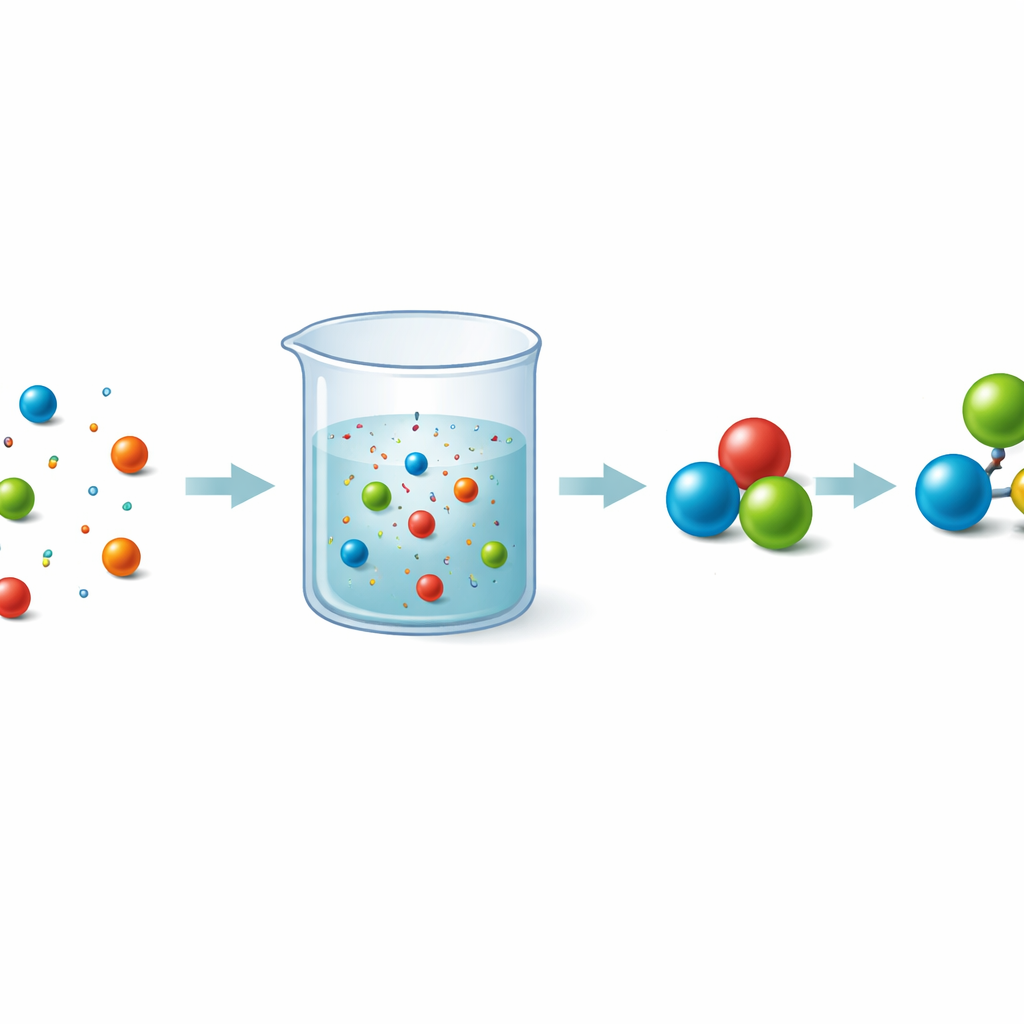
Shapes that Echo Classic Chemical Bonds
Using high-resolution electron microscopes, the authors show that these fused clusters are not random lumps but follow familiar patterns from basic chemistry. Dimers line up roughly in a straight, rod-like fashion, echoing the linear arrangement associated with so-called sp bonding. Trimers bend into triangular motifs resembling sp² patterns, while tetramers form three-dimensional tetrahedral shapes similar to sp³ bonding in carbon-based molecules like methane. On the atomic scale, the boundary between original dots almost disappears, revealing a continuous crystal lattice where electrons can roam across the entire cluster. In effect, the fused dots carve out a shared “potential well” for electrons and holes, much like orbitals shared in real molecules.
How Fusing Changes the Light
The researchers next probe how these new architectures handle light and energy. Compared with single dots, the fused dimers, trimers, and tetramers absorb and emit light at slightly lower energies, shifting their color in a way that signals stronger electronic coupling between the building blocks. Calculations support the idea that the electron wave patterns spread and mix across the cluster, much as electron clouds combine in conventional molecules. Time-resolved measurements show that excitons—bound electron–hole pairs created by light—recombine faster in the fused assemblies, consistent with new pathways created by shared structures and occasional defects. Yet, when the team zooms in to single particles, they find that individual clusters still behave as high-quality light sources, emitting single photons and biexcitons with lifetimes and brightness suitable for quantum optics experiments.
Turning Quantum Dot Molecules into X-Ray Screens
To test a practical application, the authors dope their quantum dots with manganese or copper atoms and form similar fused clusters. These “impurity-tuned” structures emit light at longer wavelengths and exhibit very fast charge separation, both useful traits for X-ray scintillators—the glowing screens that convert invisible X-rays into visible images. When embedded in plastic films and exposed to X-rays, the manganese-doped dimers produce clearer, brighter images of test patterns than single dots, thanks to their large separation between absorption and emission colors, which suppresses self-absorption. A simple physical picture emerges: X-rays create cascades of energetic charges inside the nanocrystals, which then funnel energy efficiently to the dopant atoms, where it is finally released as visible light. 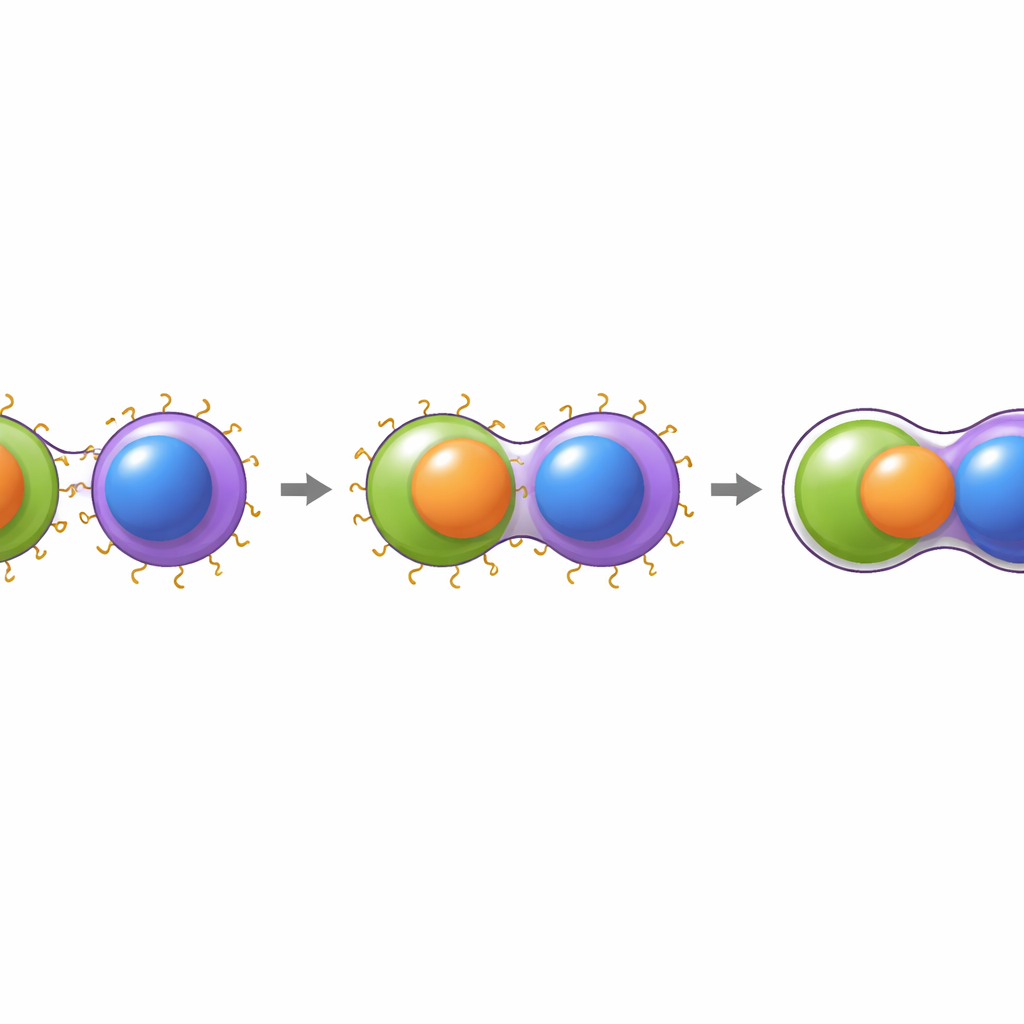
Why This Matters for Future Technologies
Overall, the study delivers a simple, scalable way to grow “artificial molecules” directly from solution, without relying on templates or complex nanofabrication. By tuning only the balance of common surface molecules, the team can choose whether dots remain isolated or fuse into dimers, trimers, or tetramers with well-defined geometries and strongly coupled electronic states. These building blocks could be mixed and matched in future work to create custom materials for displays, lasers, sensors, and quantum photonic devices, much as chemists now combine atoms into molecules and materials with tailored properties.
Citation: Fan, J., Ying, Z., Ma, J. et al. Template-free synthesis of colloidal quantum dot assemblies with molecule-like architectures. Nat Commun 17, 3898 (2026). https://doi.org/10.1038/s41467-026-70555-4
Keywords: quantum dots, nanocrystal assemblies, optoelectronics, X-ray scintillators, quantum photonics