Clear Sky Science · en
Advanced physiological maturation of human iPSC-derived cardiomyocytes using an algorithm-directed optimization of defined media components
Making Lab-Grown Heart Cells More Like the Real Thing
Lab-grown heart cells are becoming vital tools for understanding heart disease and testing new drugs, but they usually behave more like newborn heart cells than adult ones. This study describes a new way to “age” these cells in a dish so that they look and act much more like the working muscle in an adult human heart, potentially making lab tests safer and more reliable.
Why Heart Cells in a Dish Need to Grow Up
Heart disease is the leading cause of death in developed countries, and many promising drugs fail late in development because their harmful effects on the heart were missed in earlier tests. Human induced pluripotent stem cell-derived cardiomyocytes, or hiPSC heart cells, offer a human-based system for studying disease and screening medicines. However, most of these cells stay “stuck” in an immature state. They beat on their own like fetal cells, produce relatively weak force, and rely on less efficient ways of making energy. To truly stand in for adult heart muscle, they must be coaxed into a more grown-up form, and changing the liquid food that bathes them is one of the most powerful ways to do this.
Letting an Algorithm Design the Cells’ Diet
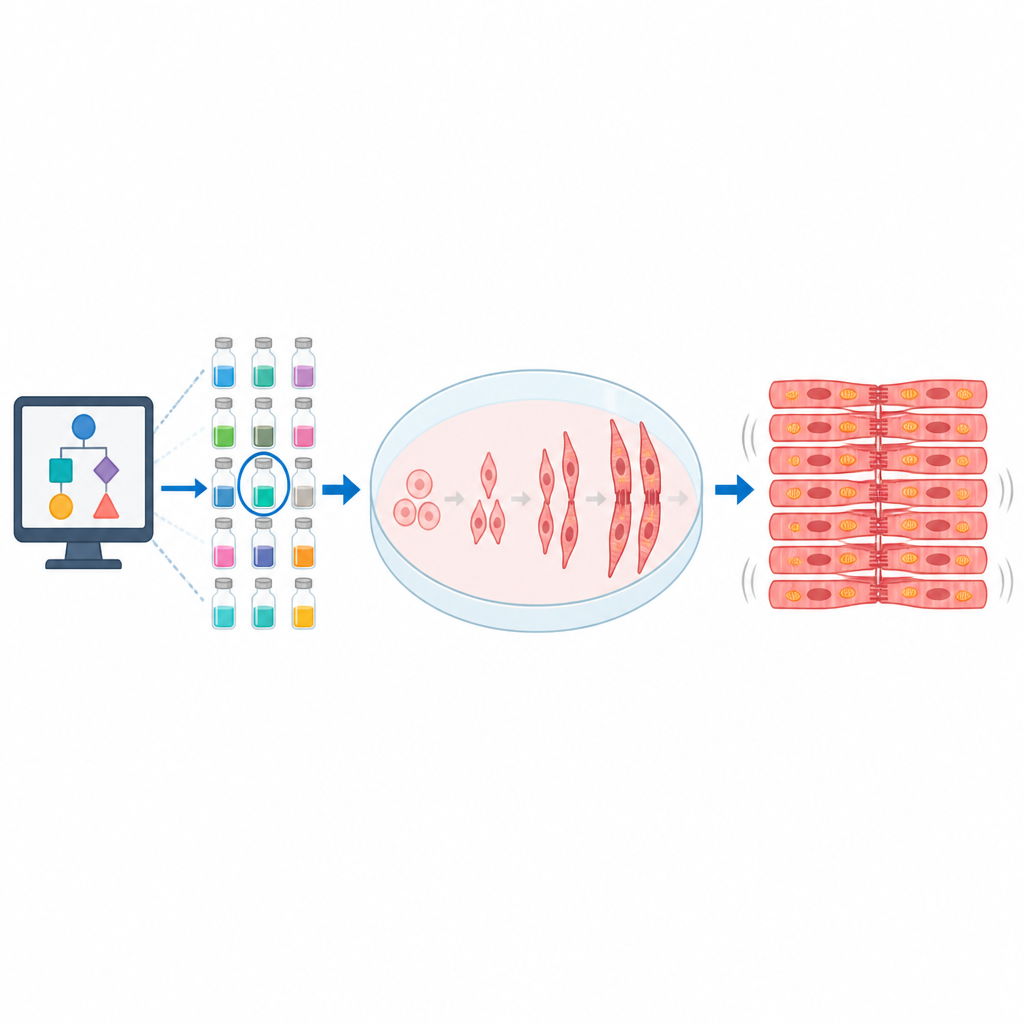
Instead of tweaking one ingredient at a time, the researchers turned to a computer-guided search strategy to design a better culture medium. They built a large menu of 17 soluble components, including energy sources like fatty acids and galactose, hormones such as thyroid hormone and growth factors, and small helper molecules and cofactors. These choices were inspired by the mix of signals that heart muscle encounters around birth and early childhood, when it naturally shifts toward a highly efficient, oxygen-driven metabolism. A “high-dimensional differential evolution” algorithm tested and refined combinations over four rounds, judging each mix by how well it boosted the cells’ ability to use oxygen in a self-normalizing stress test. Out of roughly 763 billion possible recipes, only 169 had to be tried in practice, leading to a 16-component formula the authors call C16.
Heart Cells Start to Look and Act Adult
When hiPSC heart cells were grown in the C16 medium, their structure and behavior changed dramatically compared with several leading commercial and published media. Under the microscope, cells in C16 became larger, more elongated, and better aligned, with sharply striped contractile fibers and improved connections between neighboring cells. Their internal plumbing, including tube-like membrane folds and dense clusters of mitochondria, became more prominent. Functionally, C16-treated cells shortened and relaxed more quickly, handled calcium signals in a more adult pattern, and relied more heavily on oxygen-based energy pathways instead of quick sugar breakdown. In engineered heart tissue strips, the same medium produced several-fold higher contractile stress and a healthier response when pacing frequency increased.
Switching Off Spontaneous Beating
A defining feature of working heart muscle in the body is that it does not fire on its own; instead, it waits for signals from the heart’s natural pacemaker. C16-treated cell layers largely lost spontaneous beating and settled at deeper resting voltages that closely matched adult human values. Detailed electrical recordings showed that this quiescence was tied to a strong inward rectifier potassium current, a key stabilizing current that has been hard to achieve in unmodified stem-cell-derived heart cells. Blocking this current unmasked spontaneous activity again, confirming its role. These electrical shifts, together with faster calcium cycling and stronger force, suggest that C16 pushes multiple aspects of the cells’ physiology toward an adult-like state.
Reading the Cells’ Molecular Signatures
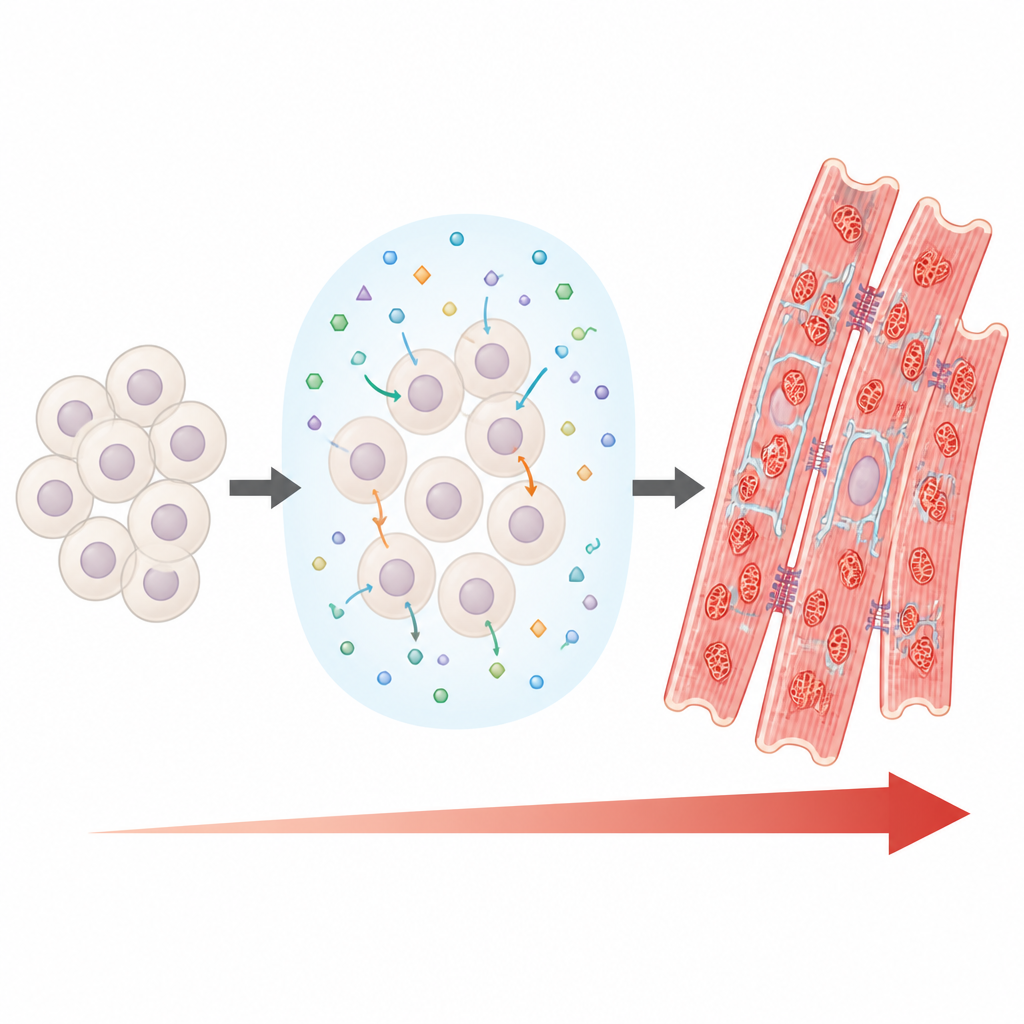
To see whether these changes were reflected in the cells’ inner wiring, the team performed broad surveys of RNA and proteins. In C16-treated cells, gene activity related to contraction, electrical signaling, cell-to-cell adhesion, and oxidative metabolism was boosted, while programs tied to growth, movement, and anaerobic metabolism were damped down. Protein measurements echoed many of these trends and highlighted increases in structural and metabolic components needed for robust pumping. At the same time, some classic “maturity markers” at the RNA level did not perfectly match their protein levels or functional behavior, underscoring that no single molecular readout can capture how adult-like these cells truly are.
What This Means for Future Heart Research
By combining an intelligent search algorithm with careful functional testing, the authors created a defined medium that moves lab-grown human heart cells noticeably closer to the behavior of adult tissue. This more mature state, especially the stable electrical properties and stronger, more energy-efficient contractions, could improve in vitro models used for studying disease mechanisms, predicting drug-induced heart problems, and designing cell-based therapies. The work also shows that optimizing many medium components at once, rather than one by one, can unlock complex biological improvements that are difficult to foresee, offering a general strategy for refining other stem-cell-derived tissues in the lab.
Citation: Callaghan, N.I., Durland, L.J., Chen, W. et al. Advanced physiological maturation of human iPSC-derived cardiomyocytes using an algorithm-directed optimization of defined media components. Nat Commun 17, 4625 (2026). https://doi.org/10.1038/s41467-026-70550-9
Keywords: cardiomyocyte maturation, stem cell heart models, culture medium optimization, cardiotoxicity testing, cardiac tissue engineering