Clear Sky Science · en
Embryonic zeolite-mediated suture synthesis of thin and scalable zeolite membranes for tailored gas separation
Cleaner Gas with Smarter Filters
From cooking fuel to electricity, methane-rich gas powers much of modern life—but it rarely comes pure. It typically arrives mixed with carbon dioxide, water vapor, and corrosive hydrogen sulfide. Stripping out these unwanted components is vital for climate, safety, and efficiency, yet today’s cleanup technologies are energy-hungry and rely heavily on bulky chemical plants. This study introduces a new way to build ultra-thin, robust mineral filters that can clean up gas streams more efficiently and at industrial scale, pointing toward cheaper and greener biogas and natural gas upgrading.
Why Today’s Gas Filters Fall Short
Most commercial gas-separation membranes are made from polymers—essentially high-tech plastics. They are inexpensive and easy to make into large modules, but they have an Achilles’ heel: under high pressures and in the presence of gases like carbon dioxide and hydrogen sulfide, they can soften and deform, losing their ability to discriminate between molecules. Inorganic alternatives such as zeolite membranes are far more rigid and chemically stable. Zeolites are crystalline materials riddled with precisely sized pores that can let small molecules pass while blocking larger ones. However, two major obstacles have kept zeolite membranes from wider use: they are typically too thick, which limits how fast gas can flow through, and they have been difficult to manufacture uniformly over large areas.
A New Way to Stitch Crystals Together
The authors tackle these problems with what they call an “embryonic zeolite-mediated suture” (EZMS) strategy. Instead of growing a crystal layer in the usual way—where crystals thicken outward and can leave defects—they begin with a very thin layer of tiny zeolite seed particles on a ceramic support. Separately, they prepare a liquid mixture of the raw building blocks of zeolites and allow it to partially organize into small, short-range ordered structures, which they describe as embryonic zeolites. When the seeded support is exposed to this reactive mixture under heat, these embryonic structures act like a glue that chemically “stitches” the scattered seed particles together into a continuous film. Crucially, this suturing process fills gaps without allowing unchecked thickening, so the final membrane ends up almost exactly as thin as the initial seed layer. 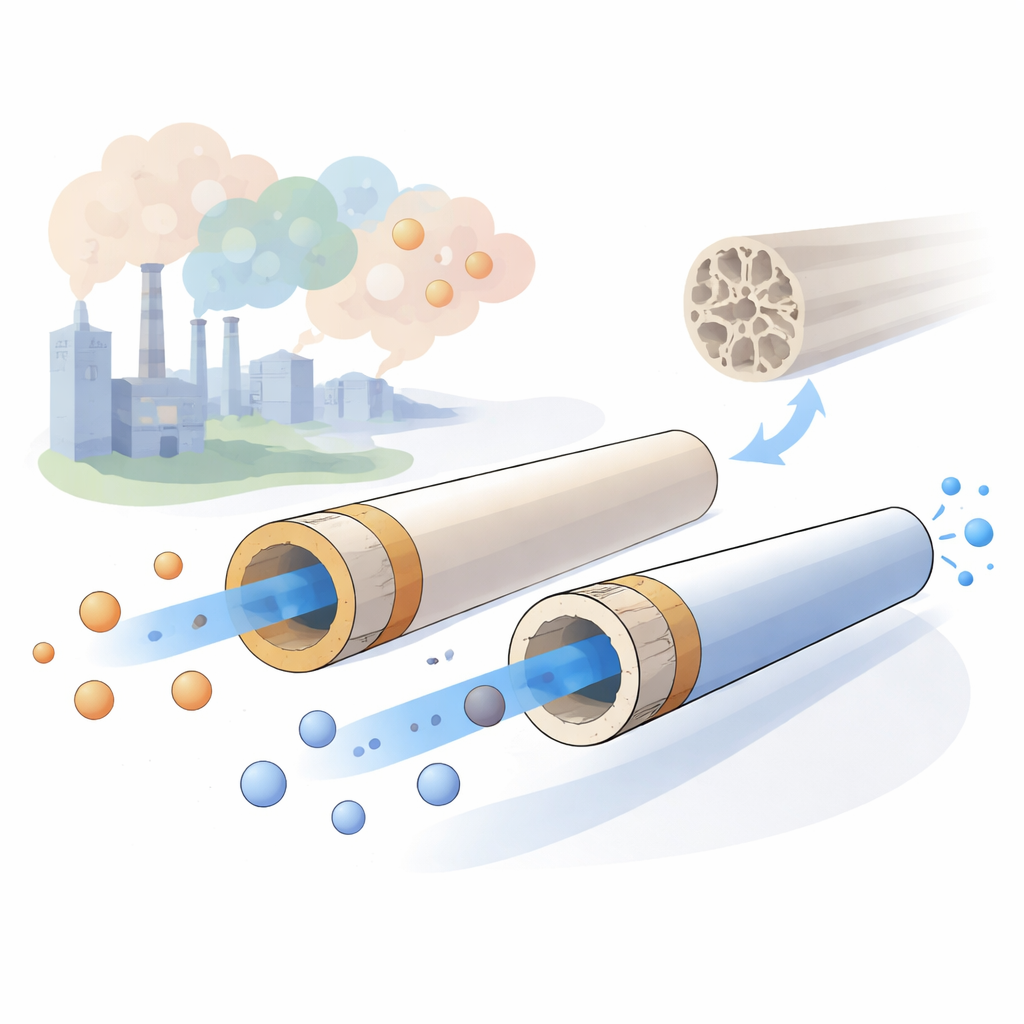
Thin, Tough, and Tailored for Different Gases
Using EZMS, the team fabricated three kinds of zeolite membranes with different internal pore architectures, each tuned for a specific gas separation task: helium from methane, carbon dioxide from methane, and straight-chain from branched butane molecules. Microscopy and structural analyses showed that the films were continuous, free of obvious defects, and retained a thickness essentially identical to the seed layers over a wide range. For a particularly important zeolite type known as SSZ-13, the researchers shrank the membrane thickness by a factor of five compared with earlier work, down to about half a micrometer—less than one hundredth the thickness of a human hair. This enabled very high carbon dioxide flow rates while still sharply rejecting methane, setting performance benchmarks that outstrip many existing membranes.
From Single Fibers to Industrial Modules
Beyond making good membranes, scaling them up is key. The group demonstrated that their method works not only on short test pieces, but also on 40-centimeter-long hollow ceramic fibers and on bundles containing up to 102 such fibers, each bundle offering an effective membrane area of about half a square meter. Remarkably, the separation performance remained uniform along the full length of these fibers and across many replicated bundles, indicating reliable manufacturing. When tested with real biogas containing carbon dioxide, methane, water vapor, and hydrogen sulfide, the membrane bundles could simultaneously remove carbon dioxide, dry the gas, and cut hydrogen sulfide levels by nearly an order of magnitude. They withstood pressures up to 4 megapascals and maintained stable performance over more than 220 days of operation, enduring repeated pressurization cycles without mechanical failure. 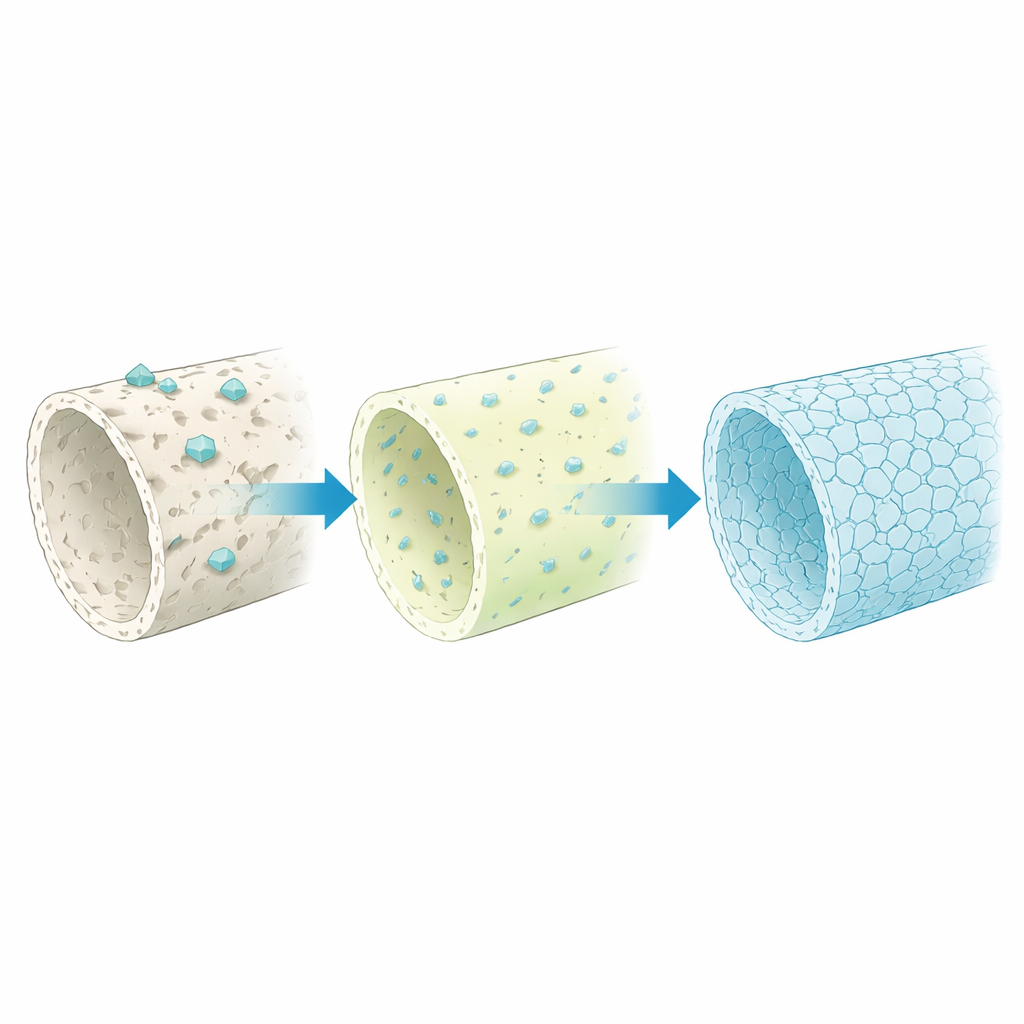
What This Means for Future Energy Systems
At its heart, this work shows that by carefully controlling how early-stage zeolite structures form and interact with pre-deposited crystal seeds, it is possible to make gas-separation membranes that are both very thin and reliably scalable. For non-specialists, the takeaway is that we may soon have filters that behave more like precision mineral sieves than plastics, yet can be manufactured in large modules suitable for real industrial plants. These membranes could upgrade biogas directly from farms and waste facilities, delivering cleaner methane fuel while reducing the need for multiple pretreatment steps and harsh chemical solvents. If adopted widely, such technology could lower the cost and environmental impact of capturing and purifying gases that underpin modern energy and chemical production.
Citation: You, L., Jin, Y., Zhu, Z. et al. Embryonic zeolite-mediated suture synthesis of thin and scalable zeolite membranes for tailored gas separation. Nat Commun 17, 3906 (2026). https://doi.org/10.1038/s41467-026-70549-2
Keywords: zeolite membranes, gas separation, biogas upgrading, carbon dioxide removal, hollow fiber modules