Clear Sky Science · en
Ultrasmall oral Saccharibacteria modulate gingival immunoactivation through type IV pili and TLR2-dependent endocytosis
How tiny mouth dwellers may help calm sore gums
Our mouths are home to countless microbes, most of them harmless partners in everyday life. Among them are ultra small bacteria called Saccharibacteria that tend to show up where gums are inflamed, such as in gingivitis and periodontitis. This study asks a surprising question a layperson might care about: could some of these hard to see microbes actually help quiet inflammation in the tissues that keep our teeth in place, instead of making things worse?
Tiny hitchhikers that live on other bacteria
Saccharibacteria are so small that several could sit side by side across the width of a typical germ. They cannot grow on their own and instead cling to larger host bacteria, often types of Actinobacteria that commonly live on teeth and gums. While Saccharibacteria are frequently found in diseased gum sites, earlier work in animals hinted they might sometimes reduce inflammation. To untangle this puzzle, the researchers focused on one strain, Nanosynbacter lyticus TM7x, and its host, Schaalia odontolytica, and asked how they interact with human gum lining cells grown in the lab.
When helpers of troublemakers soften the blow
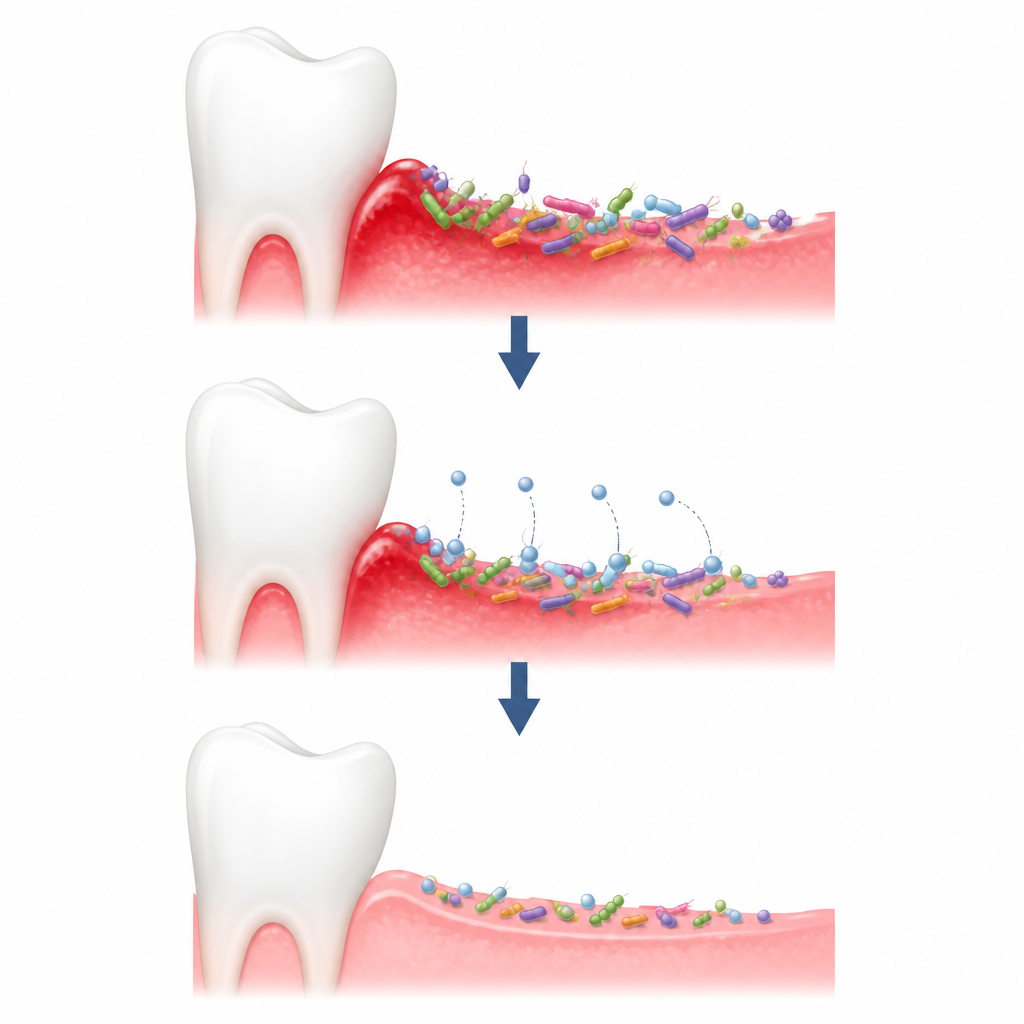
Gingival epithelial cells form the first living barrier between the mouth’s biofilms and the bloodstream, and they alert the immune system by releasing chemical signals called cytokines. In this study, host bacteria like S. odontolytica strongly activated these cells, prompting high levels of signals that draw in white blood cells linked to inflammation. In contrast, Saccharibacteria alone triggered very little response and did not kill the gum cells. When both microbes were present together, or when gum cells were briefly exposed to TM7x before seeing the host bacteria, the inflammatory signals dropped markedly. This taming effect depended on live Saccharibacteria; killed or heavily damaged cells lost the ability to calm the response.
How the tiny cells grab on and get swallowed
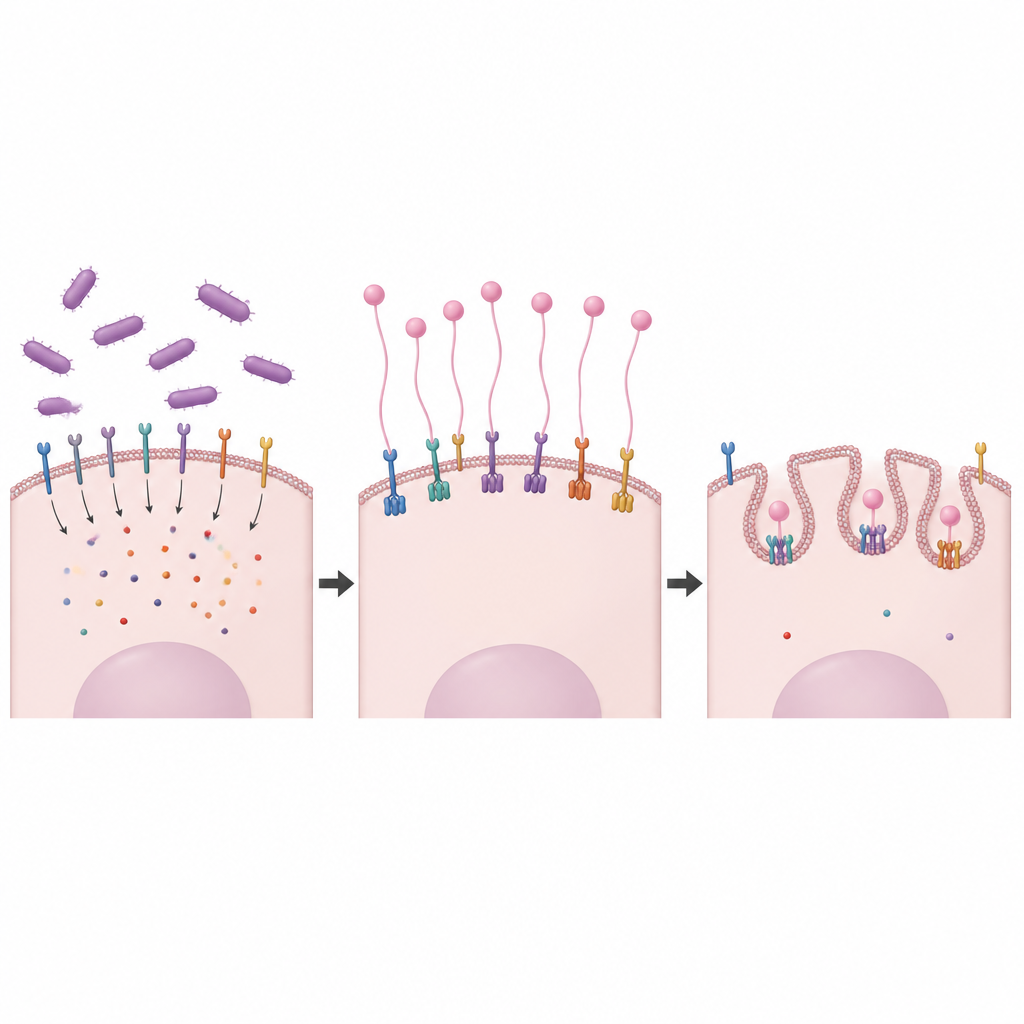
To learn how TM7x contacts gum cells, the team used fluorescent dyes, flow cytometry, and high resolution microscopes. TM7x bound rapidly and specifically to oral epithelial cells, much more than similarly sized inert particles. The binding required intact surface proteins and a set of hair like filaments known as type IV pili. Mutant Saccharibacteria lacking key pilus building blocks barely attached and could no longer dampen inflammation. The pili appeared to grab a receptor called TLR2 on the gum cell surface, pulling multiple receptors together. Advanced imaging showed that TM7x and TLR2 clustered side by side and were then drawn into the cell in small membrane pockets, a process that relied mainly on a pathway known as caveolin dependent endocytosis.
Hijacking a key alarm switch inside gum cells
TLR2 is one of the gum cell’s main alarm switches for sensing bacterial lipoproteins, especially those from Actinobacteria. The researchers showed that when they blocked TLR2 or reduced it with genetic tools, the strong cytokine response to host bacteria nearly vanished. At the same time, TM7x still attached and continued to lessen any remaining response, indicating that its calming effect runs through this same switch. Broad surveys of gene activity in the gum cells confirmed that host bacteria strongly turned on TLR2 related immune pathways, whereas TM7x shifted the cells toward changes in membrane traffic and vesicle handling. Once inside, many Saccharibacteria ended up in endosomes and then lysosomes, compartments that digest foreign material. Yet a fraction survived for days, protected from antibiotics, and could later escape when the host cells were broken open, going on to reinfect their preferred bacterial partners.
What this could mean for gum health
To a lay reader, the main message is that not all microbes enriched in diseased gums act in the same way. This work suggests that certain ultrasmall bacteria, despite their association with problem sites, can actually shield gum tissue from overactive inflammation by binding a key receptor, clustering it, and carrying it inside the cell. Most of these tiny guests are eventually destroyed, but some persist just long enough to ride out stressful conditions and return to their bacterial hosts. In everyday terms, Saccharibacteria may behave less like simple villains and more like shrewd negotiators between our immune system and the larger microbes living at the gumline, potentially helping to keep the peace in a crowded and sensitive environment.
Citation: Chouhan, D., Grossman, A.S., Kerns, K.A. et al. Ultrasmall oral Saccharibacteria modulate gingival immunoactivation through type IV pili and TLR2-dependent endocytosis. Nat Commun 17, 4574 (2026). https://doi.org/10.1038/s41467-026-70546-5
Keywords: oral microbiome, gum inflammation, Saccharibacteria, gingival epithelial cells, TLR2 signaling
See more on the researcher's website: http://www.borlab.org/