Clear Sky Science · en
Condensin accelerates long-range intra-chromosomal interactions
How DNA Finds Its Partners Inside the Cell
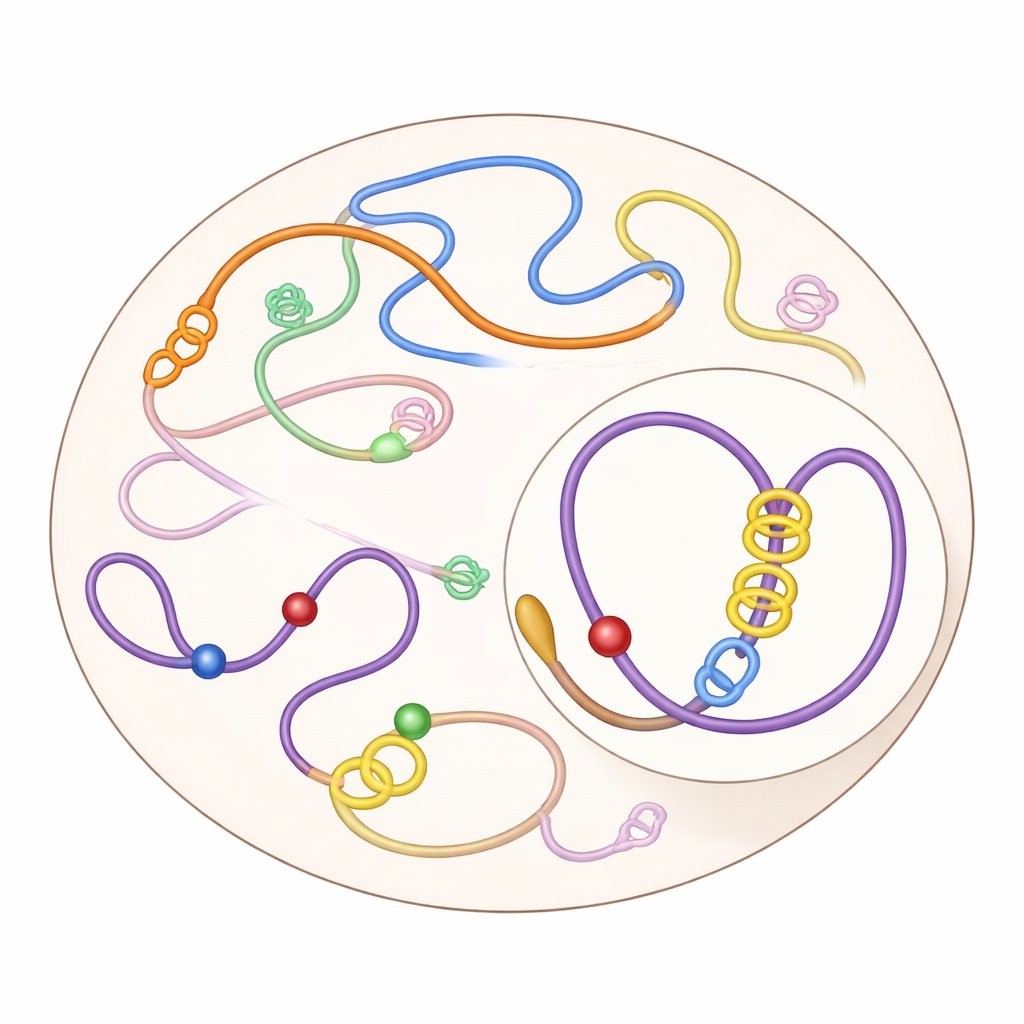
Inside every cell nucleus, long strands of DNA are constantly moving, bending, and colliding. For vital tasks like turning genes on, repairing breaks, or reshuffling genetic information, distant stretches of DNA must find and touch each other in three-dimensional space. This study shows that a protein machine called condensin helps speed up these long-distance meetings along the same chromosome in yeast, revealing a hidden layer of control in how the genome is organized and how quickly DNA regions can find one another.
Why DNA Encounters Matter
Many genetic processes depend not just on whether two DNA regions can interact, but on how fast they can find each other. For example, an enhancer that boosts a gene’s activity must physically meet its target, and a broken DNA end must locate a matching sequence to guide repair. Traditional methods like Hi-C and FISH have mapped where DNA contacts tend to occur, but mostly from fixed, dead cells, giving static pictures rather than movies. What has been missing is a way to measure the “encounter time” between DNA sites in living cells: how long it actually takes for two specific points on the genome to come together for the first time.
A Chemical Switch to Catch DNA Meetings
The researchers used a clever strategy called Chemically Induced Chromosomal Interaction (CICI) to turn fleeting DNA encounters into stable, easily spotted events. They engineered budding yeast so that two chosen spots on different parts of the genome each carry a tag that glows under the microscope—one green, one red—and can be snapped together by a drug. When the drug rapamycin is added, special proteins on each tagged site lock together if, and only if, the two DNA regions have come close enough in space. Once linked, the red and green dots stay co-localized, acting as a long-lasting record that an encounter occurred. By filming thousands of cells over time and measuring how long it takes for the dots to “click” together, the team could quantify encounter times for multiple pairs of loci across the yeast genome.
Same Motion Everywhere, But Faster Meetings on the Same Chromosome
First, the authors confirmed that the motion of chromosomal segments in yeast behaves as expected for a flexible polymer—a random-walk model known as the Rouse model. Different DNA sites moved with similar diffusion properties, meaning that overall wiggle and speed were fairly uniform across the genome. However, when they compared how fast different pairs of loci met, a striking pattern emerged. Pairs of sites on the same chromosome arm found each other much more quickly than pairs on different chromosomes, even when their average three-dimensional separation was the same. Pairs on opposite arms of the same chromosome showed intermediate behavior. Pure diffusion of free-floating segments cannot explain this gap; something must specifically help DNA regions on the same chromosome come together more rapidly over long distances.
A Loop-Making Machine Speeds Up Intra-Chromosome Encounters
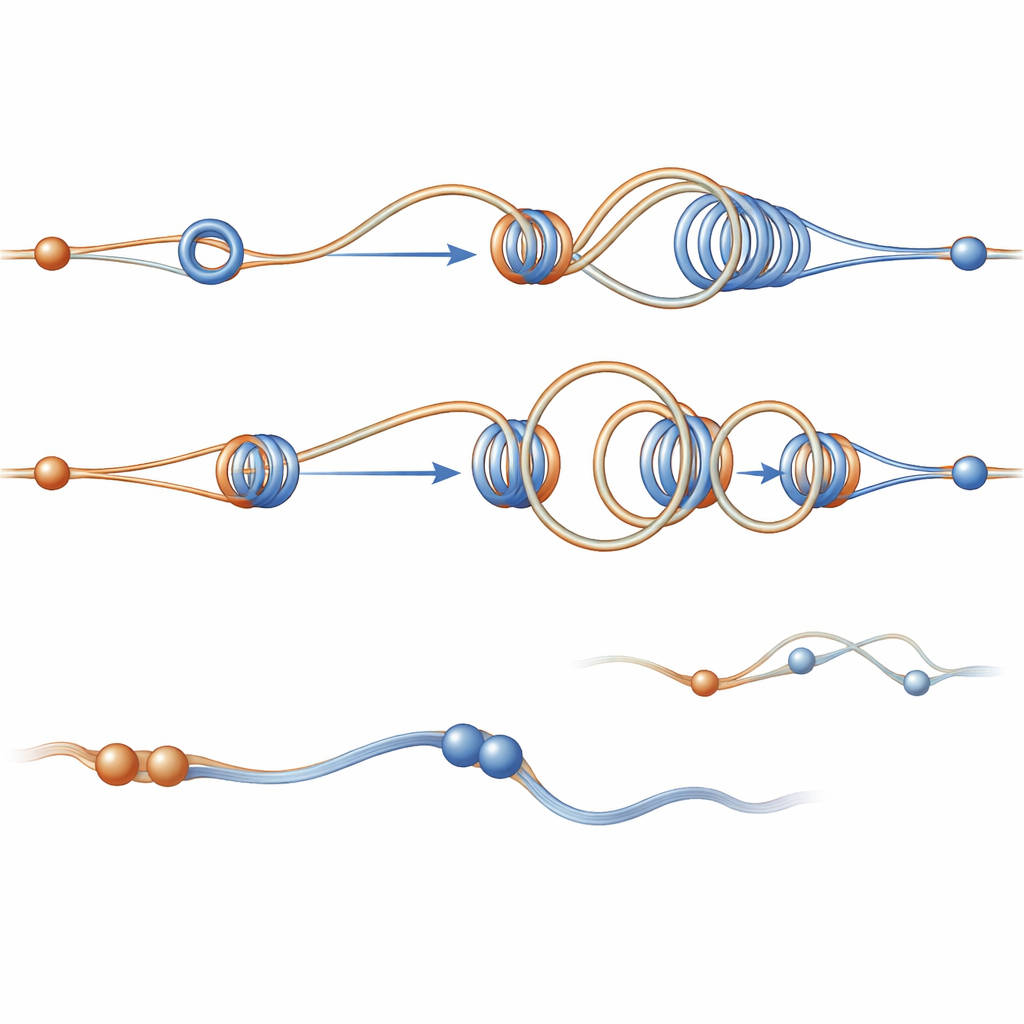
The team next asked whether known DNA-organizing complexes might be behind this effect. Two major candidates are cohesin and condensin, both of which can grab DNA and form loops. Using a rapid “degron” system, the authors selectively depleted either cohesin or condensin in G1-phase cells and repeated their CICI measurements. Removing cohesin had little impact: DNA motion and encounter times were largely unchanged. In contrast, reducing condensin consistently slowed the encounters between distant sites on the same chromosome arm, while leaving inter-chromosomal encounters mostly unaffected. Genome-wide contact maps from Hi-C experiments supported this view: when condensin was depleted, long-distance contacts along individual chromosomes decreased, whereas contacts between different chromosomes stayed nearly the same. Polymer simulations that added rare, fast condensin-driven loop extrusion events could reproduce both the modest change in average distances and the much larger speed-up in encounter times, suggesting that condensin extrudes loops at about 2 kilobases per second, with sparse but highly effective activity.
What This Means for Genome Organization
To a layperson, the key message is that DNA inside the nucleus does not rely solely on random motion to bring important regions together. In budding yeast, condensin acts like a small fleet of loop-making winches that occasionally reel in long segments of the same chromosome, briefly shrinking the distance between far-apart sites and giving them extra chances to meet. This mechanism speeds up crucial long-range interactions within chromosomes without dramatically reshaping the overall genome map. The work suggests that similar loop-extruding machines in other organisms could help distant regulatory elements find their target genes more efficiently, adding a dynamic, time-sensitive layer to how genomes are organized and how quickly they can respond.
Citation: Zou, F., Li, Y., Földes, T. et al. Condensin accelerates long-range intra-chromosomal interactions. Nat Commun 17, 4020 (2026). https://doi.org/10.1038/s41467-026-70538-5
Keywords: 3D genome organization, condensin, chromatin loops, yeast chromosomes, DNA encounter dynamics