Clear Sky Science · en
Cortical representation of multidimensional handwriting movement and implications for neuroprostheses
Why this matters for future communication
For people who are paralyzed and cannot move their hands, being able to “write” using only brain activity could restore a fast, natural way to communicate. This study explores how the human brain controls handwriting in far more detail than just the pen’s path on paper. By uncovering the extra hidden signals the brain uses—such as how hard we press, how we move in the air between strokes, and how muscles are recruited—the work points the way toward brain–computer interfaces that can turn imagined handwriting into text more accurately and reliably than before. 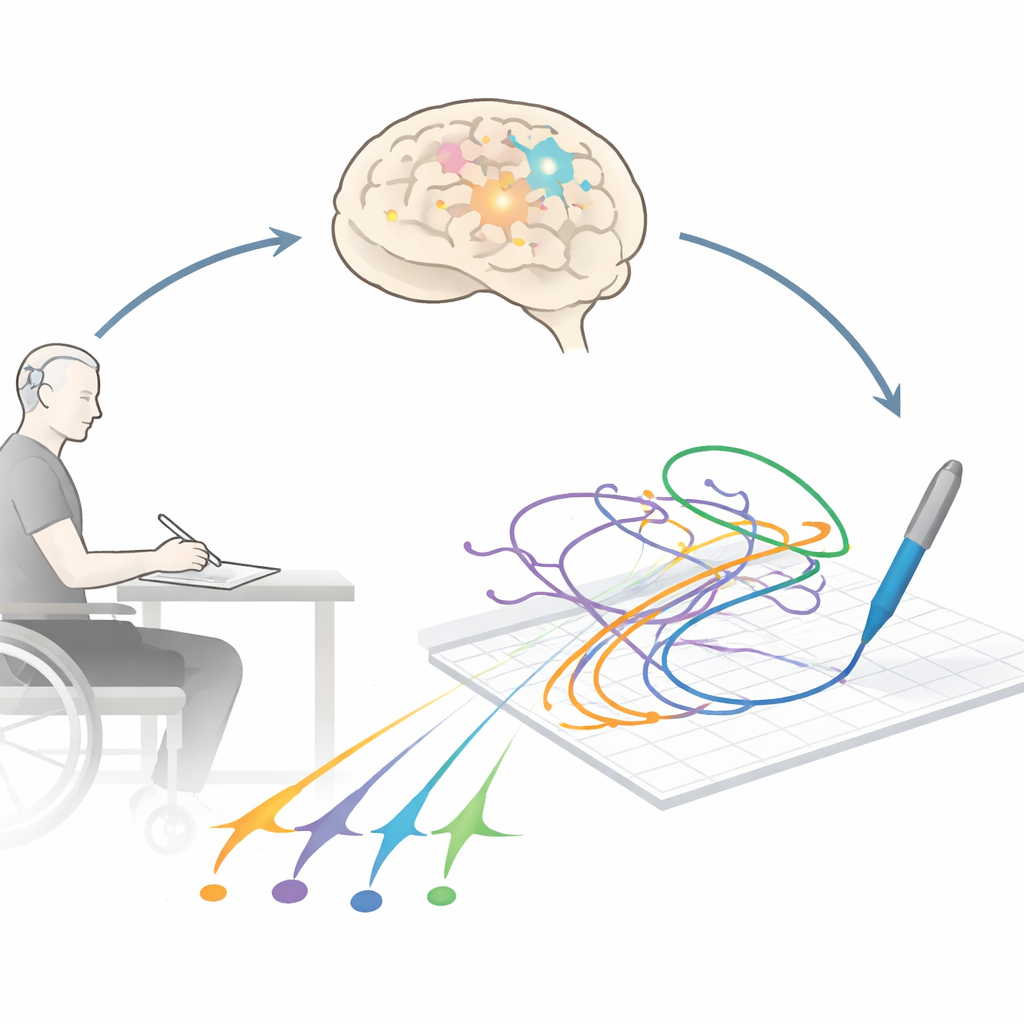
Handwriting as a window into the mind
Handwriting is one of the most practiced skills humans acquire, blending fine motion control, timing, and personal style. Researchers have long used handwriting to study brain disorders like Parkinson’s disease and to build computer systems that recognize writing. More recently, scientists have shown that brain–computer interfaces can decode imagined handwriting, allowing paralyzed people to “write” letters or draw trajectories in their minds and see them converted into text on a screen. However, most of these systems treat handwriting as a flat, two-dimensional motion across the page, ignoring the fact that real writing also includes pen lifts, changes in height, grip force, and subtle muscle activity.
Looking inside the brain during imagined writing
The authors recorded the activity of individual neurons from the motor region of the brain in a man with a high spinal cord injury who could no longer move his limbs. Tiny electrode arrays were implanted over the part of the cortex that normally controls the hand. While he watched videos showing how to write digits and Chinese characters, he tried to trace each stroke and pen lift in his mind. The researchers showed that neurons still followed classic rules seen in healthy movement: many cells preferred particular directions of motion, and these patterns were strong enough to let a computer decode single-trial digit shapes that were recognizable. Intriguingly, when they treated the whole character as simple 2D motion, decoding was much better for on-paper strokes than for the in-air movements between them, suggesting that something important was missing from the model.
Adding depth, force, and muscle activity
To fill in that missing information, the team collected detailed handwriting data from six healthy volunteers writing the same characters. They tracked the pen tip in three dimensions, measured how tightly the pen was gripped, how hard it pressed on the paper, and recorded electrical activity from forearm muscles. These recordings revealed that pen lifts are not just straight lines through the air: they arc upward and often overshoot before coming back down, and they involve ongoing grip and muscle changes even when the pen is off the page. Many of these features were highly stereotyped across people, meaning an average template could stand in for the movement the paralyzed participant was attempting to imagine.
How the brain blends many movement signals
By aligning the healthy volunteers’ multidimensional handwriting templates with the paralyzed participant’s neural activity, the researchers tested which features best explained the firing of each neuron. Models that included only flat 2D velocity left much of the neural variation unexplained. When they added pen height, vertical speed, grip force, pressure, and muscle-related signals, more of the neural patterns made sense. Different neurons carried mixtures of these ingredients: some were most sensitive to overall speed, others to muscle-like signals or vertical motion, and many combined two or three features at once. Crucially, including extra dimensions such as vertical movement and muscle activity improved how well the models described both strokes on the page and pen lifts in the air. 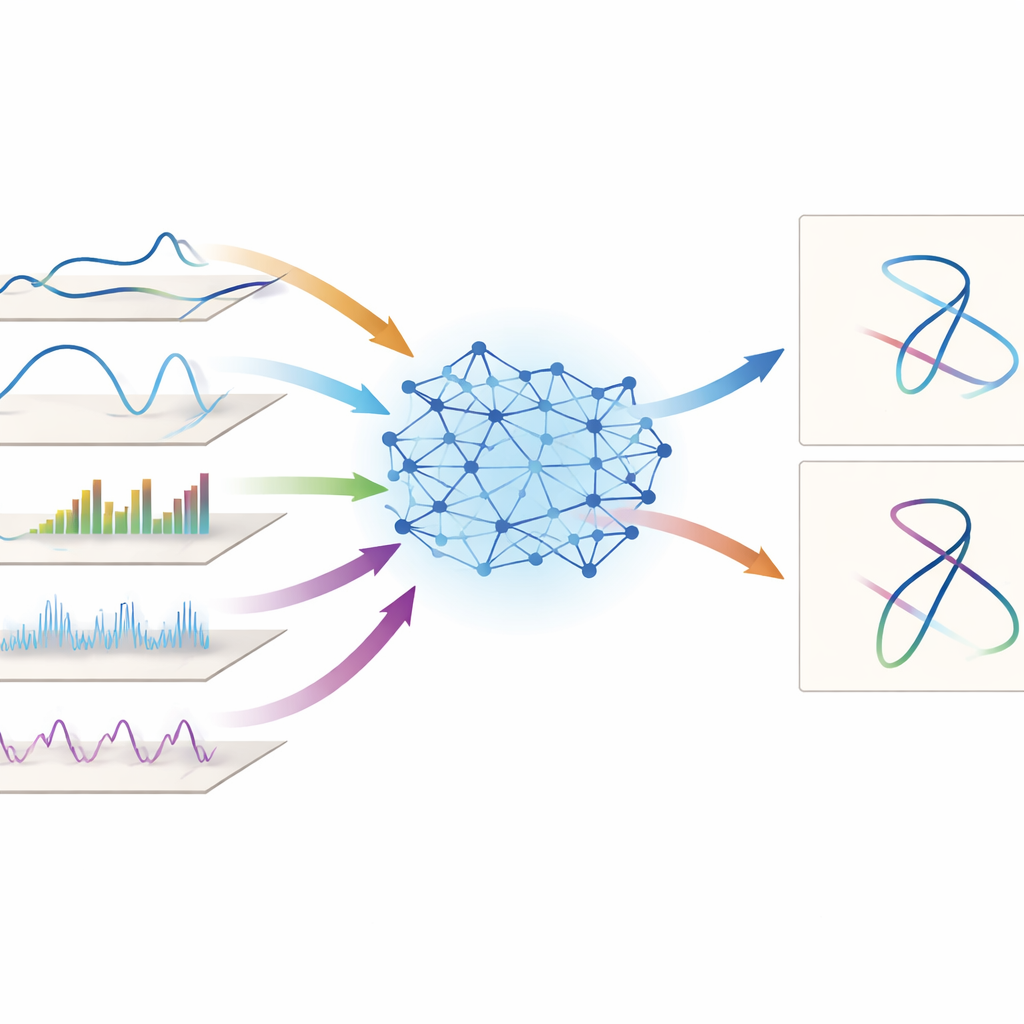
Turning richer brain signals into clearer writing
The team then asked whether decoding these extra dimensions could actually improve communication. Using a machine-learning model, they tried two strategies: one that decoded only 2D pen speed, and another that decoded a richer set including vertical motion, grip force, and pressure. To recognize which character was being written, they compared the decoded patterns to a library of reference characters from healthy writers, using a time-warping method that can align sequences even if they are written at different speeds. When only flat 2D motion was used, recognition worked some of the time. When the full multidimensional information was included, accuracy rose markedly, approaching half of the characters correctly identified, even though the user was completely paralyzed and only imagining the movements.
What this means for future neuroprostheses
This work shows that the motor cortex does not encode handwriting as simple lines on a page. Instead, it represents a rich, multidimensional action that includes pen strokes, pen lifts, depth, force, and muscle patterns all at once. For brain–computer interfaces, this means that decoders should aim to reconstruct a full, three-dimensional, force-aware version of handwriting rather than just tracing a flat path. Although the current system is not yet fast or accurate enough for everyday use, combining such multidimensional decoding with advanced language models could greatly improve brain-to-text communication, bringing us closer to restoring natural writing abilities to people who cannot move their hands.
Citation: Wang, Z., Xu, G., Yu, B. et al. Cortical representation of multidimensional handwriting movement and implications for neuroprostheses. Nat Commun 17, 3966 (2026). https://doi.org/10.1038/s41467-026-70536-7
Keywords: handwriting brain-computer interface, motor cortex, neuroprosthetic communication, multidimensional movement, paralysis