Clear Sky Science · en
Sub-second spin and lifetime-limited optical coherences in 171Yb3+:CaWO4
Why long-lived quantum states matter
Quantum computers and ultra-secure communication networks promise to transform how we process and share information, but they depend on fragile quantum states that usually disappear in fractions of a second. This study explores a new solid crystal material that can host quantum states which last remarkably long and can be controlled using light. By keeping these states stable for much longer than usual, the work takes an important step toward practical quantum memories, interfaces, and sensors.
A new home for fragile quantum bits
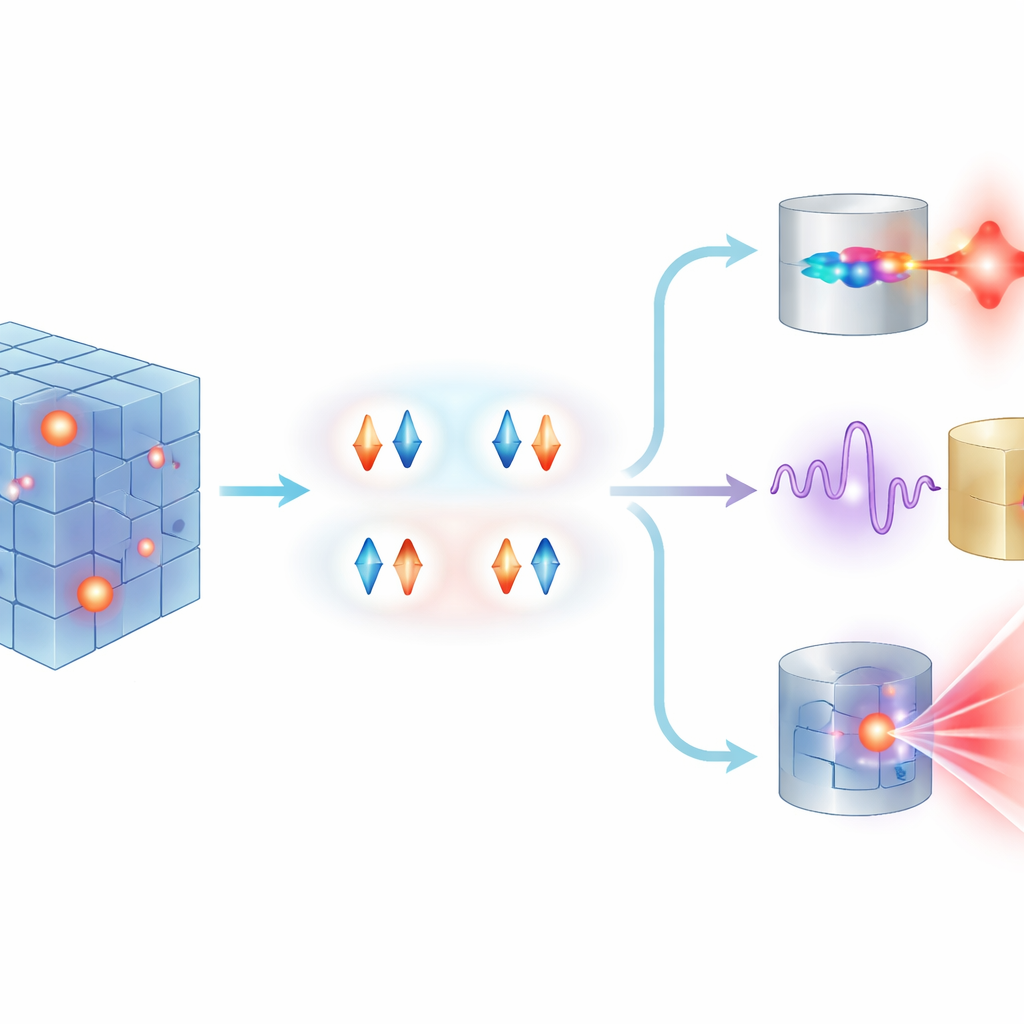
The researchers focus on a crystal called calcium tungstate (CaWO4) that is sprinkled with a small number of ytterbium ions of a specific type, known as 171Yb3+. Each of these ions behaves like a tiny quantum magnet with both an electron and a nucleus contributing to its magnetic character. Because the crystal contains very few other magnetic atoms, the environment around each ytterbium ion is unusually quiet. This low level of background noise is essential: it allows the quantum states of the ions to survive for a long time instead of being quickly scrambled by random magnetic disturbances in the solid.
Probing the hidden structure with light and magnets
To understand and control these quantum states, the team first had to map out in detail how the energy levels of the ions are arranged. They cooled the crystal to just a few degrees above absolute zero and shone highly stable laser light through it while applying carefully controlled magnetic fields. By measuring how the crystal absorbed light at slightly different colors and polarizations, they could determine how the electron and nuclear spins interact inside both the lower-energy (ground) and higher-energy (excited) states of the ion. The observed absorption peaks were extremely sharp, meaning that the ions see nearly identical surroundings in the crystal, a key requirement for precise optical control of large ensembles of ions.
Creating long-lived spin memories
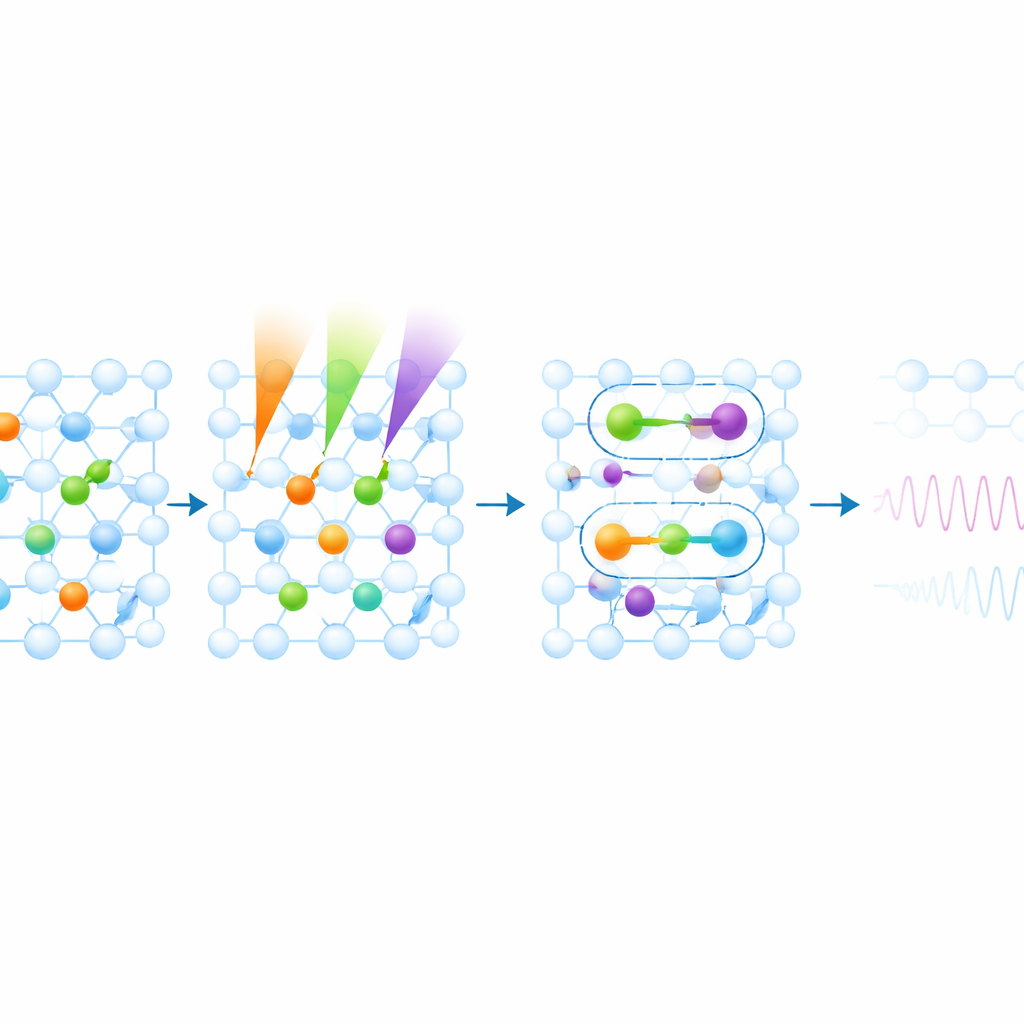
Armed with this level diagram, the researchers used pairs of laser beams to manipulate the spin states of the ions in a fully optical way, without relying on microwaves. They designed a sequence of light pulses that first pushes almost all ions into a single, well-chosen spin state and then flips them into a special pair of states known as a "clock" transition. In this configuration, the two states respond almost identically to external magnetic fields, so fluctuations in the environment have very little effect on the energy gap between them. Spin echo measurements—where a series of pulses reveals how long the spins remain in step with one another—showed that the collective spin state could stay coherent for about 0.15 seconds at zero magnetic field, a record value for this kind of system under these conditions.
Light that remembers for almost its natural limit
The team also studied how long the optical transitions themselves remain well defined. Using a technique called a photon echo, they sent in two light pulses and observed the crystal emit a faint echo signal that reveals how quickly the optical phase information is lost. They found that when the spin population is carefully prepared so that disruptive spin-exchange processes are suppressed, the optical coherence time reaches about 0.75 milliseconds—almost exactly what is expected from the natural lifetime of the excited state. In other words, the main limit is no longer environmental noise but the basic rule that an excited ion must eventually emit a photon and relax. This is one of the best optical coherence performances ever reported for a paramagnetic solid-state emitter.
Toward practical quantum devices
These results show that 171Yb3+ in CaWO4 combines several highly desirable properties: sharply resolved optical lines that allow selective control, spin states that can be initialized and manipulated purely with light, and exceptionally long lifetimes for both spin and optical coherence, even without applying a strong magnetic field. The authors argue that by reducing the concentration of ytterbium ions or further engineering the material, these lifetimes could be extended even more. Because of this unique combination of traits, the material is a strong candidate for future quantum technologies, including light-based quantum memories, devices that convert signals between microwaves and light, and single-ion interfaces that link stationary quantum bits to photons traveling in optical networks.
Citation: Tiranov, A., Green, E., Hermans, S. et al. Sub-second spin and lifetime-limited optical coherences in 171Yb3+:CaWO4. Nat Commun 17, 4115 (2026). https://doi.org/10.1038/s41467-026-70534-9
Keywords: quantum memory, solid-state spins, rare-earth ions, optical coherence, quantum networking