Clear Sky Science · en
Lifestyle change accelerates epigenetic ageing in King penguins
Why Penguin Lifestyles Matter to Our Own
What happens to aging when a wild animal suddenly gets a life much like ours—steady meals, little exercise, and protection from danger? This study follows King penguins that move from the open Southern Ocean to carefully managed zoo enclosures, creating a powerful mirror of the human shift to a modern Western lifestyle. By tracking subtle chemical marks on their DNA that act as a “biological clock,” the researchers reveal how comfort can lengthen life yet quietly speed up the internal pace of aging, with lessons that reach far beyond penguins.
Two Very Different Ways to Be a Penguin
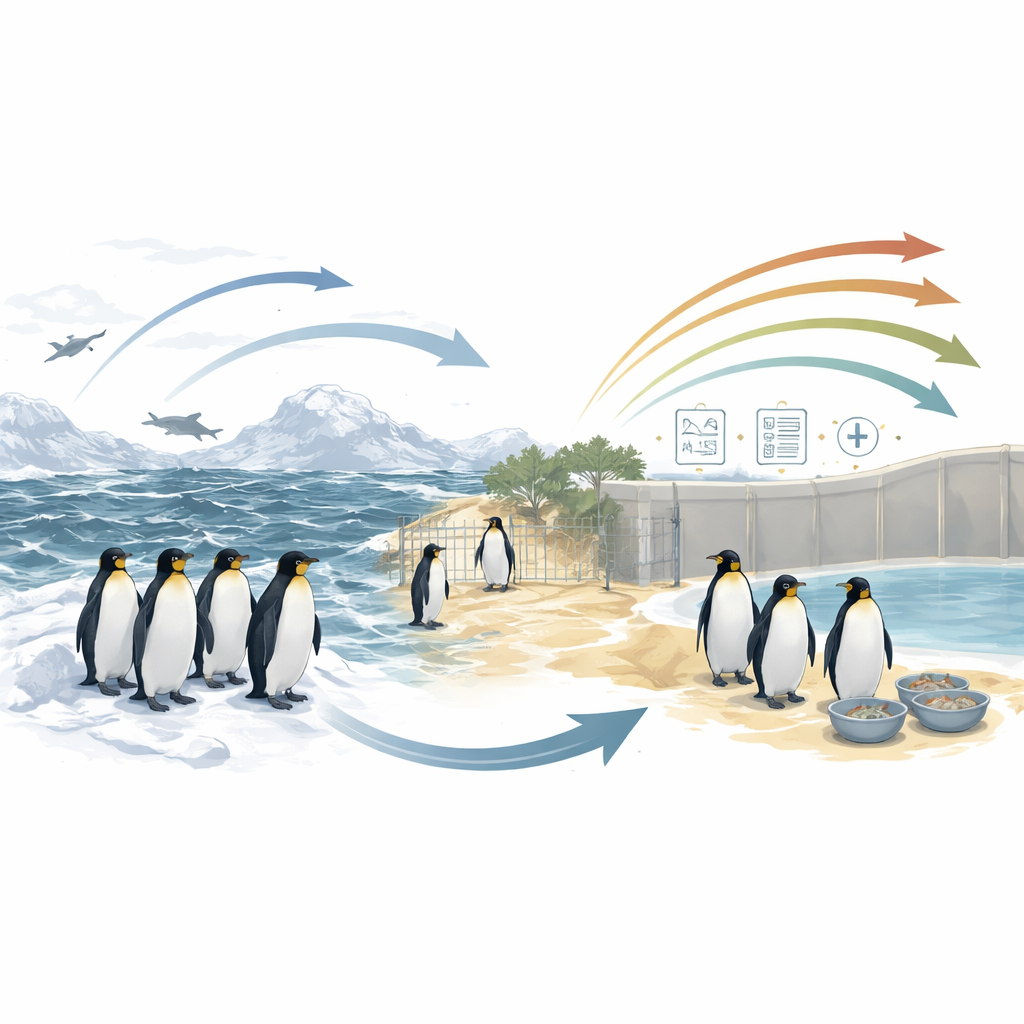
In the wild, King penguins live a demanding rhythm. They alternate between long ocean swims that can cover hundreds of kilometers in a few days and weeks-long fasts while they breed and incubate eggs. Food is uncertain, predators are real, and surviving to old age is far from guaranteed. In zoos, the same species experiences the opposite: safe conditions, regular high-quality meals, medical care, and much less room to roam. For these birds, the wild lifestyle—with intense activity and natural periods of going without food—acts as the “control,” while the zoo lifestyle stands in for a human-like, sedentary, well-fed existence.
Living Longer While Aging Faster Inside
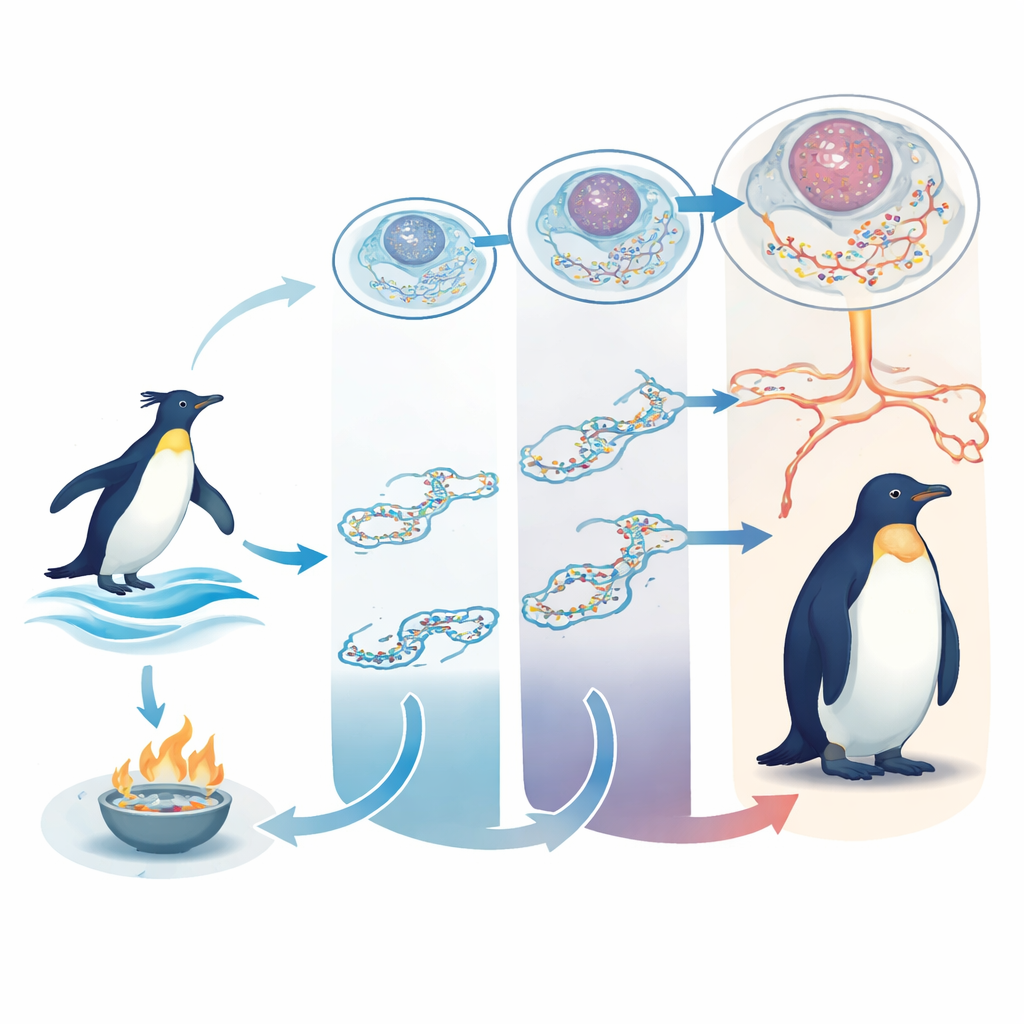
The scientists focused on epigenetic aging, measured through DNA methylation—tiny chemical tags on DNA that change in a predictable way as animals grow older. Using whole-genome data from blood samples of 64 male King penguins of known age, they built statistical models to estimate each bird’s “epigenetic age” and compared it with its calendar age. Penguins raised and kept in zoos showed significantly higher epigenetic age than wild birds of the same actual age. Depending on the method, their biological clock appeared to be ticking between roughly 3 and 6.5 years faster, a large gap for a species that can live about 40 years. To make sure this method was reliable, they ran the same style of analysis on human data where the effects of smoking on epigenetic aging are well known, and obtained consistent results.
Protected Lives, Hidden Frailty
Paradoxically, while their internal aging clock ran faster, zoo-housed King penguins lived longer overall than their wild counterparts. Survival records from nearly 1,900 wild birds and over 300 zoo birds showed that animals in zoos had a much higher chance of reaching advanced ages, for both males and females. In the wild, many penguins die young from predation, starvation, or harsh conditions at sea. Zoos largely remove these external threats through secure enclosures, dependable feeding, and veterinary care. The study did not find evidence that only the “toughest” birds survived in the wild in a way that could fake this signal. Instead, the findings suggest that zoo birds can survive for many years in a state of elevated internal wear-and-tear that would likely be fatal in nature—a situation that echoes how humans can now live longer while carrying more age-related disease.
How Comfort Changes the Body’s Inner Settings
To understand what might drive this faster biological aging, the team looked for regions of the genome where methylation differed between wild and zoo birds independent of age itself. They identified hundreds of such regions near genes involved in growth control, cell survival, and DNA repair—systems that help balance building up the body versus maintaining and repairing it. Many of these genes lie in major nutrient-sensing and growth pathways that biologists already suspect of tying diet and activity to aging, including networks analogous to the mTOR and PI3K/Akt systems in humans. Other affected genes were linked to handling rich diets, heart function, physical exercise, and the internal body clock that governs daily rhythms. Together, these changes paint a picture in which steady food, low activity, and indoor living shift the body toward continual growth and reduced repair, subtly rewiring metabolism and timing in ways that match the idea of a Western lifestyle mismatch.
What This Means for Human Health
The King penguin experiment shows that a move to a safe, sheltered, well-fed life can both extend lifespan and accelerate the biological processes of aging. In penguins, as in humans, comfort appears to come with a cost: more years lived, but with the body’s cellular “clock” running faster. Because the same types of nutrient and growth pathways are involved in people, this work strengthens the case that our own sedentary, food-abundant lifestyles are directly pushing our biological age ahead, even when medical care keeps us alive longer. The findings hint that combining the best of both worlds—ample protection and healthcare with more natural patterns of movement, feeding, and daily rhythms—could add years of healthier life, for us and for the animals in our care.
Citation: Cristofari, R., Davis, L.R., Bardon, G. et al. Lifestyle change accelerates epigenetic ageing in King penguins. Nat Commun 17, 3795 (2026). https://doi.org/10.1038/s41467-026-70527-8
Keywords: epigenetic aging, king penguins, sedentary lifestyle, zoo versus wild, nutrient sensing