Clear Sky Science · en
Microgravity-activated high-performance van der Waals InSe ferroelectric semiconductor
Growing Better Crystals in Space
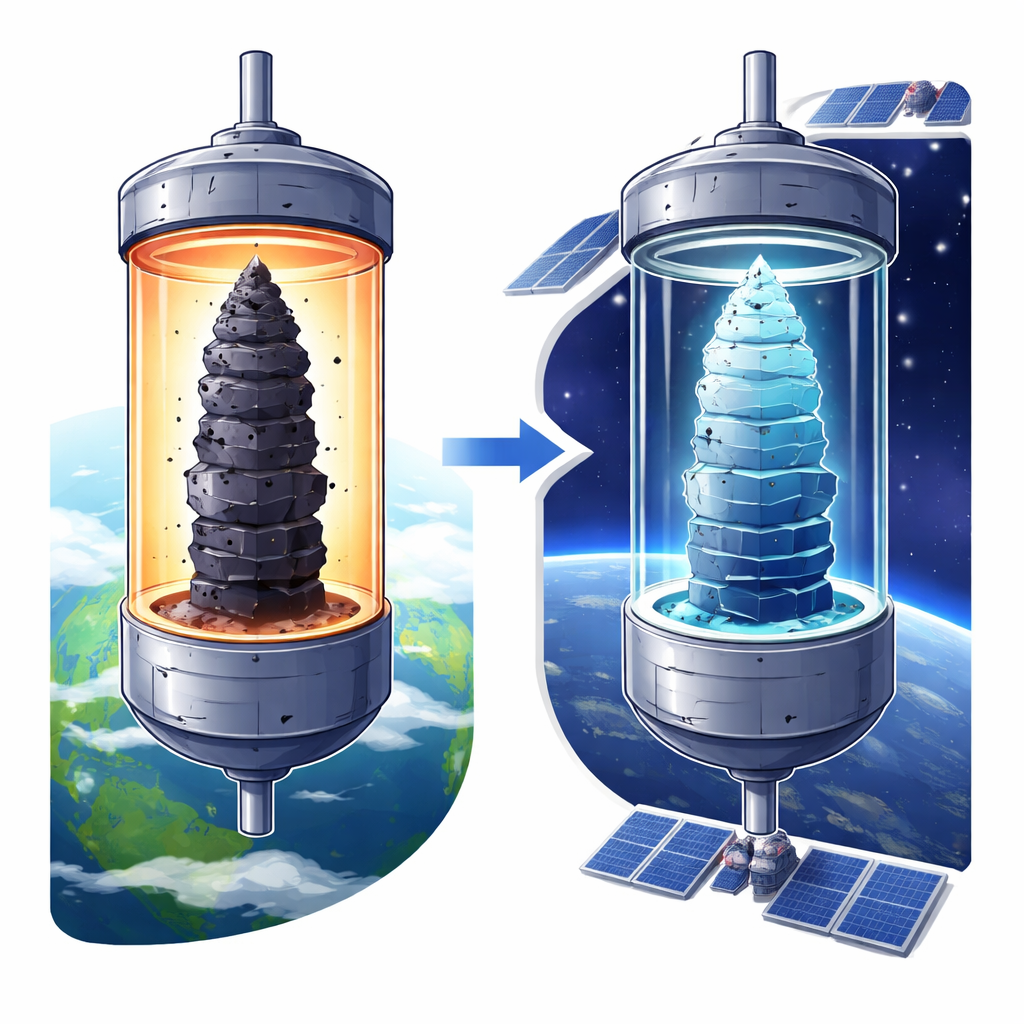
Imagine building the tiny electronic and light‑emitting parts inside future phones and supercomputers using crystals grown not on Earth, but in orbit. This study explores how the weightless environment of a space station can dramatically improve a promising semiconductor material called indium selenide, or InSe, making it better for memory, computing, and light‑based devices.
Why This Space Crystal Matters
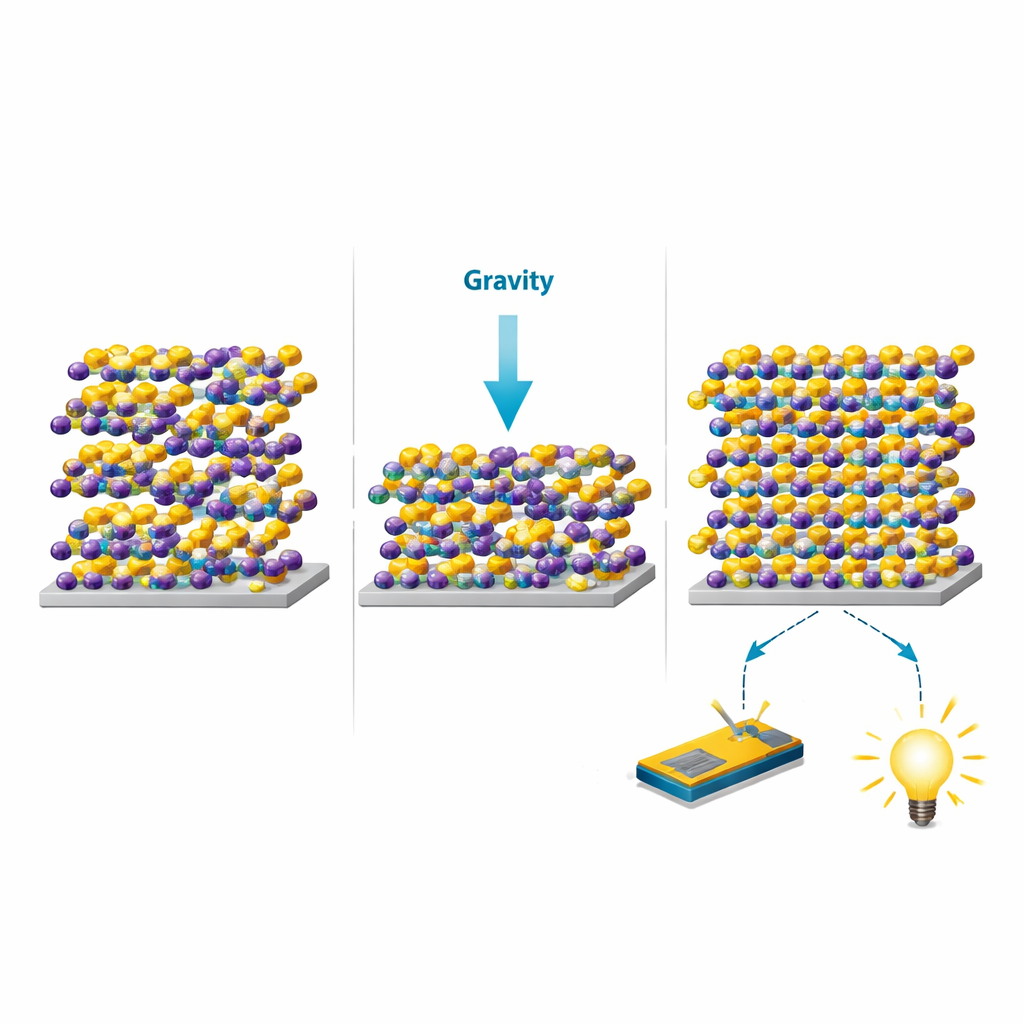
InSe is a layered material whose sheets are held together weakly, a bit like a stack of ultra‑thin cards that can slide past each other. It is non‑toxic, conducts electricity very well, and shines brightly in the near‑infrared, making it attractive for electronics and optical components. But when InSe is grown on Earth, many tiny structural flaws form where these layers stack incorrectly. These “stacking faults” and dislocations disrupt how charges and light move through the crystal, limiting the performance of advanced devices such as high‑speed transistors, energy‑efficient memory, and tiny lasers.
Using Weightlessness as a Tool
To tackle this, the researchers grew InSe crystals aboard China’s space station using a standard technique in which a melted mixture slowly solidifies inside a heated tube. They made two kinds of crystals under otherwise identical conditions: one grown in orbit under microgravity (called s‑InSe) and one grown on Earth (e‑InSe). Basic tests showed that both kept the same overall crystal structure and energy bandgap, meaning the essential identity of the material was unchanged. The big difference emerged when the team zoomed in at the atomic level and inspected how the layers stacked.
Smoother Stacks and Hidden Electric Order
High‑resolution electron microscopy revealed that the space‑grown crystals have far fewer stacking faults than their Earth‑grown counterparts; the layered structure is straighter and more regular. This cleaner stacking matters because InSe can host a special form of built‑in electric order that comes from layers sliding slightly relative to each other, a behavior known as sliding ferroelectricity. In ordinary samples, the many defects scramble this delicate effect. In the space‑grown InSe, the team could clearly see stable electric switching using a sensitive scanning probe. They wrote and erased tiny polarized regions, and the response remained robust even when they reduced the applied voltages, demonstrating that the material’s intrinsic ferroelectric behavior had been “activated” without extra chemical treatments or high‑temperature steps.
Better Memory and Brighter Light
Taking advantage of this built‑in electric order, the researchers built field‑effect transistors in which an ultra‑thin InSe flake serves both as a semiconductor channel and as a ferroelectric element. These devices showed a wide memory window—the electrical state remains clearly different after writing and erasing—and an on/off current ratio of around a million, together with very high carrier mobility. This combination is ideal for “in‑memory” computing, where data storage and processing are merged to save power and speed up operations. The optical behavior also improved: compared with Earth‑grown crystals, the space‑grown InSe emitted much more intense and cleaner light, with defect‑related glow strongly suppressed. Its main emission band increased superlinearly with excitation strength and reached this regime at nearly ten times lower excitation power, suggesting that compact, low‑threshold light sources or even tiny lasers could be built directly on the same chip as memory and logic.
What This Means for Future Technology
Together, these results show that the microgravity environment of space can act as a powerful “purifier” for layered crystals like InSe, eliminating structural faults that are hard to remove on Earth and revealing their full electrical and optical capabilities. By enabling durable, switchable electric polarization and efficient light emission in the same material, space‑grown InSe points toward compact chips that tightly integrate memory, sensing, and light‑based communication. More broadly, the work suggests that space stations could become important factories and laboratories for cultivating high‑quality layered semiconductors that underpin the next generation of electronics and photonics.
Citation: Jin, R., Sui, F., Yu, Y. et al. Microgravity-activated high-performance van der Waals InSe ferroelectric semiconductor. Nat Commun 17, 3851 (2026). https://doi.org/10.1038/s41467-026-70520-1
Keywords: microgravity materials, indium selenide, ferroelectric semiconductor, van der Waals crystals, optoelectronic devices