Clear Sky Science · en
Biosynthesis of pyomelanin from methanol with engineered Komagataella phaffii and its characterizations
Turning a Colorful Microbe into a Tiny Factory
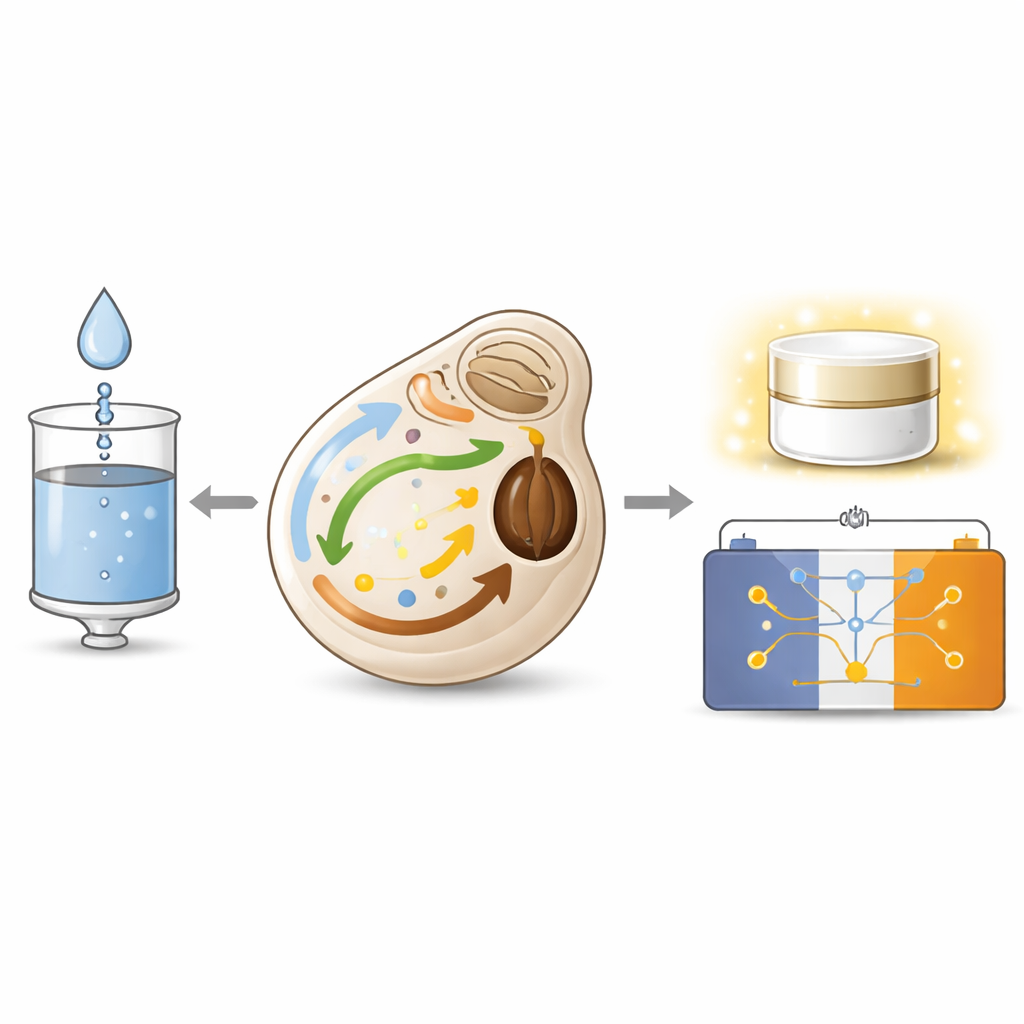
Dark pigments like freckles and hair color are all around us, but some microbes make related pigments with surprising powers: they can soak up sunlight, neutralize harmful molecules, and even store energy. This study shows how scientists reprogrammed a safe yeast to turn cheap, renewable methanol into large amounts of a brown‑black pigment called pyomelanin, then tested it as a cosmetic protector and as a material for next‑generation batteries. The work illustrates how biology can convert simple, climate‑friendly feedstocks into useful, high‑value products.
What Makes This Brown Pigment Special?
Pyomelanin is a member of the melanin family, the same broad class of pigments that help protect our skin and eyes. It forms when a small molecule called homogentisic acid, derived from the amino acid L‑tyrosine, oxidizes and links into long, dark polymers. Beyond its color, pyomelanin can absorb ultraviolet (UV) light, quench damaging reactive oxygen species, and interact with metals and electrons. That combination makes it attractive for cosmetics, medicine, and energy technologies. However, natural microbes normally produce only tiny amounts, and earlier attempts to boost supplies relied on feeding the cells expensive L‑tyrosine, limiting industrial use.
Rewiring Yeast to Drink Methanol and Make Pigment
The researchers chose the yeast Komagataella phaffii, already widely used to make proteins and considered safe for industry. This yeast can grow on methanol, a simple one‑carbon alcohol that can be produced from renewable sources and does not compete with food crops. The team split the overall pathway from methanol to pyomelanin into three linked modules: basic carbon metabolism, a route called the shikimate pathway that feeds aromatic building blocks, and the final steps that turn L‑tyrosine into homogentisic acid and then into pyomelanin. By methodically tuning each module, they pushed carbon from methanol toward pigment instead of toward normal cell components.
Fine‑Tuning Enzymes with Color as a Readout
To increase the supply of the key intermediate homogentisic acid, the team focused on two bottleneck enzymes. First, they created a color‑based screening system: since homogentisic acid slowly darkens as it turns into pyomelanin, cultures that became browner within a day likely made more intermediate. Using this visual cue, they evolved variants of DAHP synthase, an enzyme that controls flow into the aromatic pathway, identifying mutations that boosted pigment formation several‑fold. Second, they redesigned a downstream enzyme, hydroxyphenylpyruvate dioxygenase, using computer‑guided “semi‑rational” engineering. By modeling its 3D structure and testing selected mutations in the lab, they obtained a double‑mutant version that was both more active and more heat‑stable than the original, further raising production.
Balancing Metabolic Traffic and Converting It to Solid Pigment
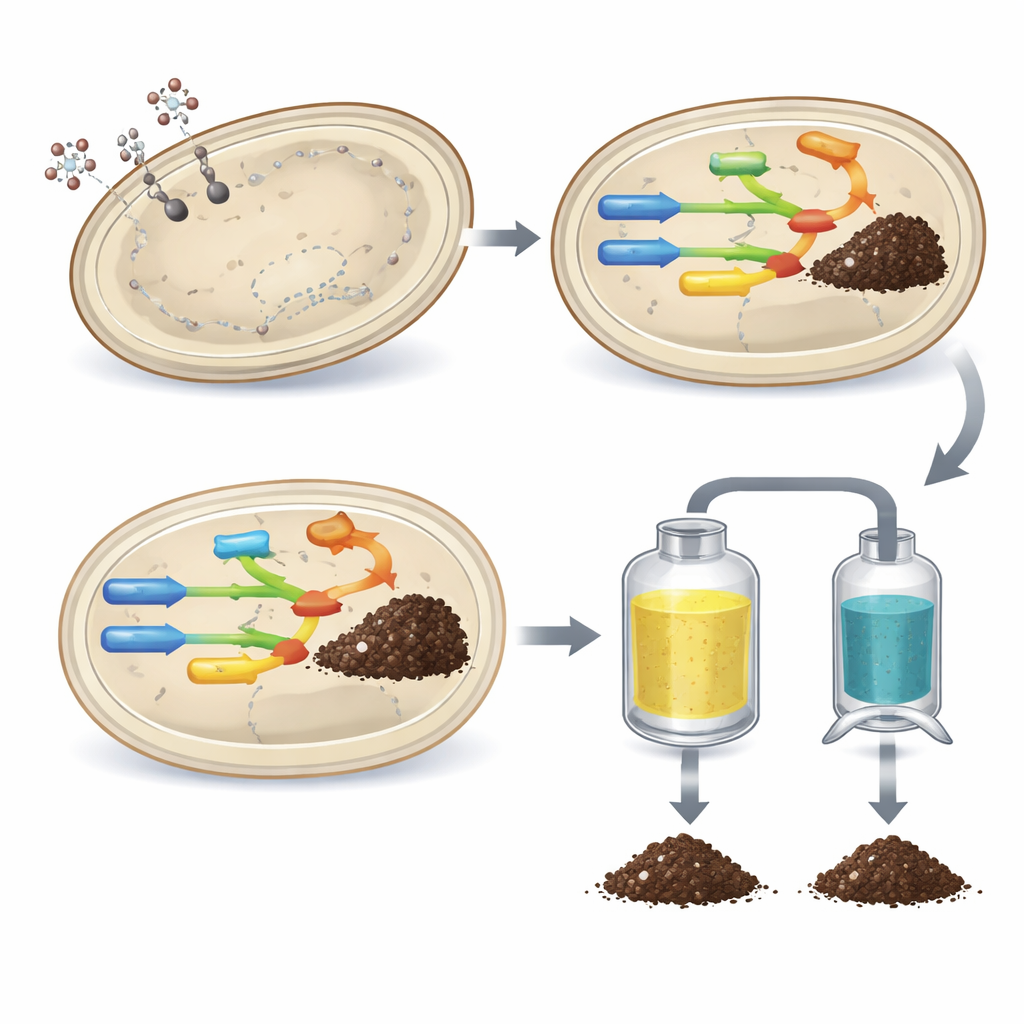
Beyond individual enzymes, the scientists reshaped the yeast’s internal traffic. They strengthened steps that generate key precursors, improved how the cells detoxify methanol by efficiently assimilating a poisonous intermediate, and deleted side routes that would otherwise siphon off valuable carbon into other amino acids or small alcohols. Altogether, they made more than 15 genetic changes, raising homogentisic acid levels about 66‑fold. The best strain, called Pyo29, was grown in a 5‑liter fermenter under tightly controlled feeding of glycerol and then methanol. During nearly a week of induction, the broth gradually turned from clear to jet black as homogentisic acid oxidized. When the researchers then deliberately drove this oxidation using either a strong alkali solution or the enzyme laccase, they converted essentially all of the intermediate into solid pyomelanin, reaching about 70.5 grams per liter—far above previous records.
Comparing Two Routes and Testing Real‑World Uses
The team purified pyomelanin made with alkali (Pyo‑NaOH) and with laccase (Pyo‑Lac) and compared their structures. Using infrared spectroscopy, elemental analysis, solid‑state nuclear magnetic resonance, and electron microscopy, they found that both materials were disordered, aromatic polymers with very similar chemical features, though they differed subtly in particle size and packing. Functionally, both types acted as strong antioxidants and helped human skin‑like cells survive UV exposure in culture, with the alkali‑derived pigment showing roughly twice the free‑radical scavenging power at the same dose. When the pigments were carbonized at high temperature, they yielded hard carbon materials suitable as negative electrodes in sodium‑ion batteries, with the alkali‑derived version again performing better, delivering stable capacities comparable to other biomass‑based carbons.
Why This Work Matters
For non‑specialists, the key message is that the authors turned an ordinary industrial yeast into a tiny, efficient factory that drinks a simple alcohol and makes a sophisticated, multifunctional pigment at industrially relevant levels. By dissecting the pathway into modules, evolving and redesigning critical enzymes, and then carefully characterizing the final product, they provide both a recipe and a reference standard for future pyomelanin research. The resulting pigment can help protect cells from oxidative stress and UV light and can be transformed into useful energy‑storage materials. More broadly, the study showcases how smart genetic engineering can connect renewable feedstocks like methanol to advanced materials that serve health, cosmetic, and clean‑energy applications.
Citation: Zhu, X., Lin, J., Liang, S. et al. Biosynthesis of pyomelanin from methanol with engineered Komagataella phaffii and its characterizations. Nat Commun 17, 4052 (2026). https://doi.org/10.1038/s41467-026-70512-1
Keywords: pyomelanin, metabolic engineering, Komagataella phaffii, methanol biomanufacturing, sodium ion battery materials