Clear Sky Science · en
In situ synchrotron X-ray scattering reveals organic-mediated scaling mechanisms on desalination membranes
Why mineral crust on filters matters
Turning seawater into drinking water is one of the most promising ways to ease global water stress, but the filters at the heart of desalination plants slowly clog with hard mineral crusts. These crusts make the systems use more energy and need more cleaning. This study looks closely at how invisible organic matter already present in water quietly changes the way mineral scale forms on desalination membranes, and how that knowledge could help us design filters that stay cleaner for longer.
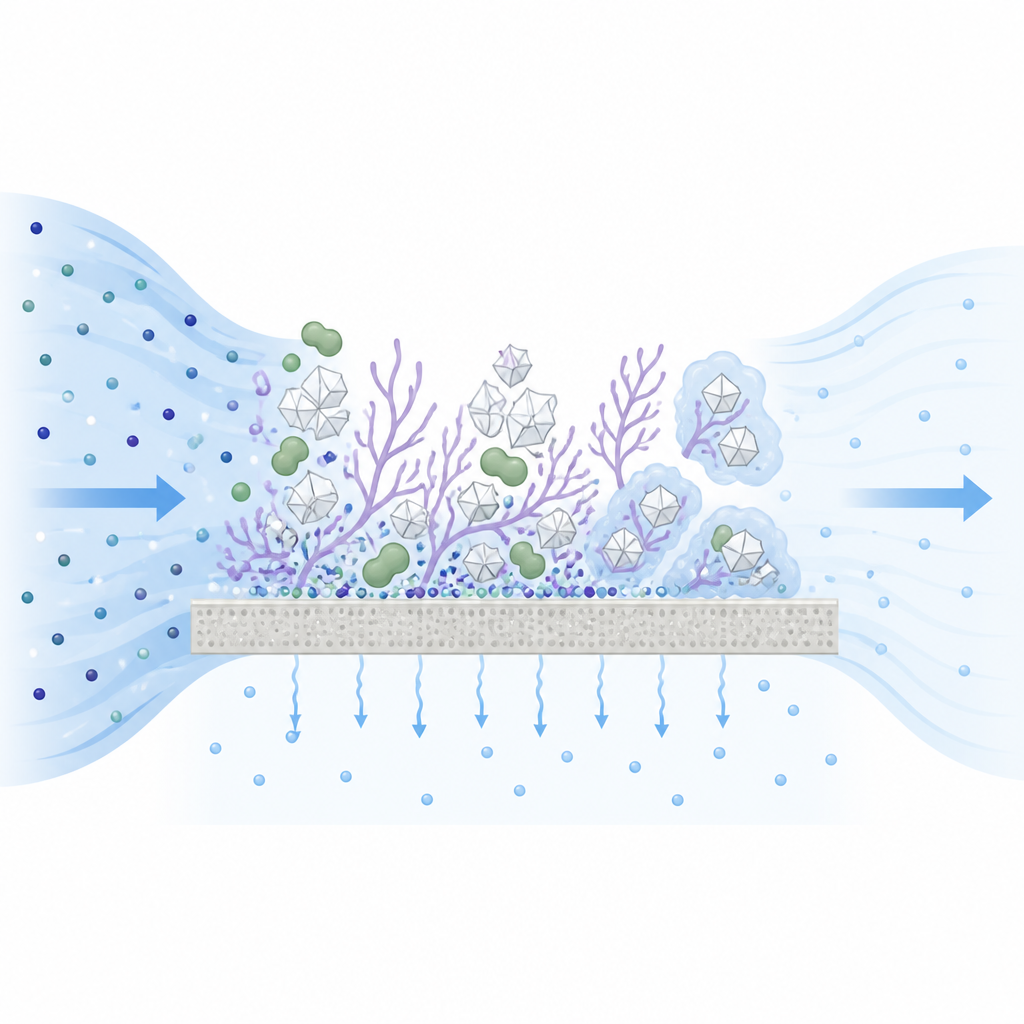
How salty water cakes up a membrane
In a reverse osmosis plant, seawater is pushed against a thin plastic membrane that lets water pass but holds back salts. Just above the membrane, salts build up in a thin “hot spot” layer where their concentration can be several times higher than in the bulk water. Under these conditions, calcium and sulfate ions join to form gypsum, a common mineral that crystallizes and sticks to the membrane, reducing water flow. Even a thin layer of this scale can sharply increase operating costs. Real seawater is not pure salt and water, though; it also carries proteins, natural brown-colored organics from decaying plants, and sticky sugars from algae and microbes. These organics mix with the forming mineral and can change how, where, and how fast gypsum builds up.
Watching crystals grow in real time
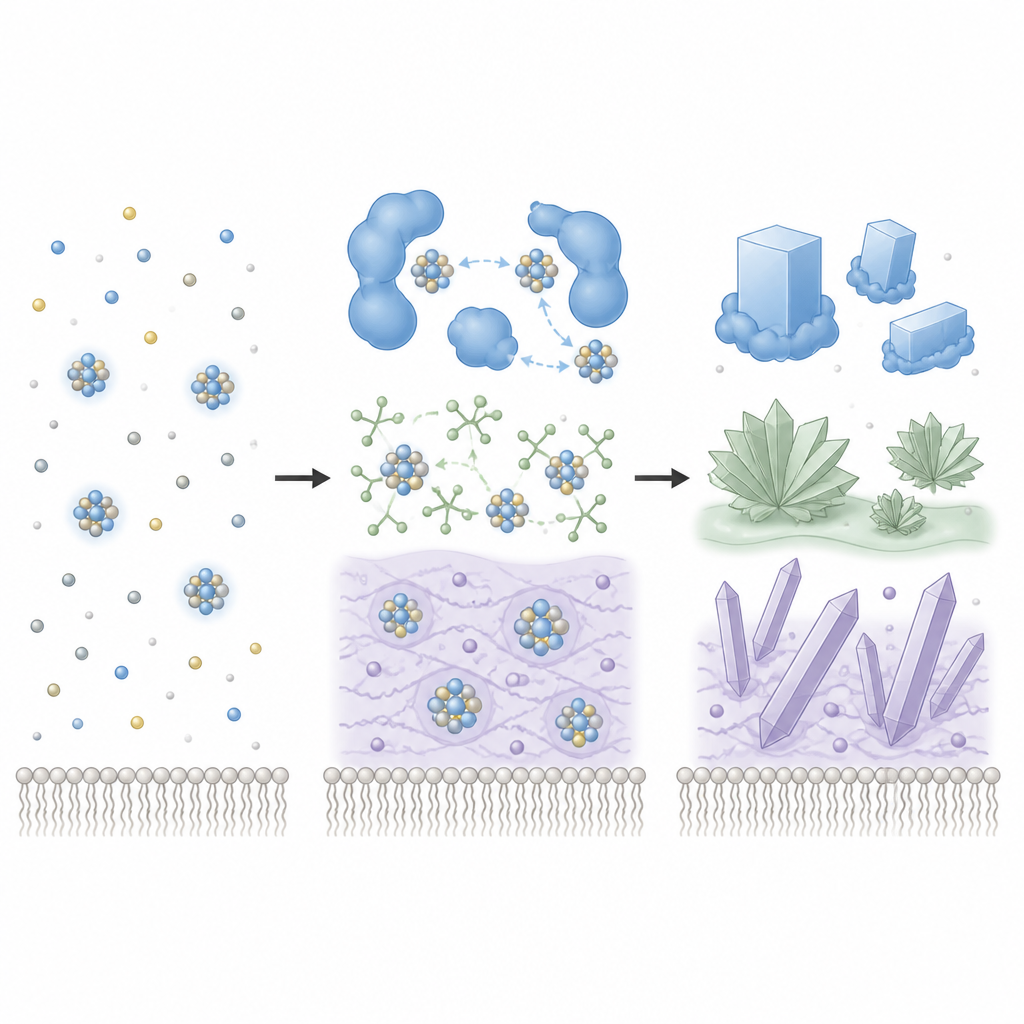
To see what actually happens in that thin hot spot, the researchers used intense X-rays from a synchrotron facility. They recreated the same high salt conditions found right at the membrane surface inside tiny glass tubes, then followed the process with two types of X-ray scattering. One detects very small, shapeless clusters only a few billionths of a meter across, while the other sees the ordered lattice of full-grown crystals. Together, they captured the journey from early, disordered “seed” clusters to mature gypsum crystals in real time. The measurements showed that, under desalination conditions, gypsum does not appear by simple one-ion-at-a-time assembly. Instead, many small, non-crystalline clusters first form, then bunch together and reorganize into ordered crystals, a so-called non-classical pathway.
Proteins, humic stains, and gels as crystal shapers
The team tested three common types of organic matter: a protein (bovine serum albumin), humic substances similar to those that give natural waters a tea-like color, and a sugar-rich polymer called alginate from algae. Each one changed gypsum formation in its own way. The protein reduced the effective driving force for crystal birth by surrounding tiny clusters and slowing their growth in the fluid layer. This led to fewer and smaller precursor clusters and much slower loss of water flow, with short, thick gypsum crystals forming on the membrane. Humic substances, by contrast, were less able to hold ions in solution, but they coated the membrane to form a thin “non-stick” layer. This layer made it harder for newly formed particles to attach, pushing the most intense gypsum build-up away from the membrane surface.
When a soft gel becomes a crystal nursery
Alginate behaved differently again. In the presence of calcium it formed a soft, gel-like network near the membrane. This gel temporarily trapped calcium, slowing the first steps of crystallization, but it also created many sites where crystals could later grow. As a result, gypsum nucleated more slowly, yet the final crystal layer was thick and highly ordered, with rosette-shaped crystals growing within the gel itself. Advanced imaging with infrared microscopy allowed the team to map, slice by slice, where organics and gypsum sat across the fouling layer, confirming that protein tended to avoid co-locating with crystals, while humic substances and alginate frequently overlapped with gypsum.
From better understanding to cleaner water
By combining real-time X-ray tracking, surface force calculations, and chemical mapping, the study shows that organic matter can act as a shield, a non-stick coating, or a gel scaffold for mineral scale, depending on its type. It also confirms that gypsum scale forms through an intermediate-cluster pathway rather than a simple direct jump from dissolved ions to crystals. For a lay reader, the takeaway is that not all “dirt” in water is equally bad for desalination membranes; some kinds can even soften or redirect scale formation. Understanding these subtle roles points the way toward smarter pretreatment, better membrane coatings, and operating conditions that keep minerals from locking into hard crusts, helping desalination deliver clean water more efficiently.
Citation: Feng, Z., Xu, S., Cao, J. et al. In situ synchrotron X-ray scattering reveals organic-mediated scaling mechanisms on desalination membranes. Nat Commun 17, 4157 (2026). https://doi.org/10.1038/s41467-026-70508-x
Keywords: gypsum scaling, desalination membranes, organic fouling, synchrotron X-ray scattering, crystallization pathways