Clear Sky Science · en
RHD6LA regulates root hair responses to both symbionts and commensals
How plant roots sort their many tiny guests
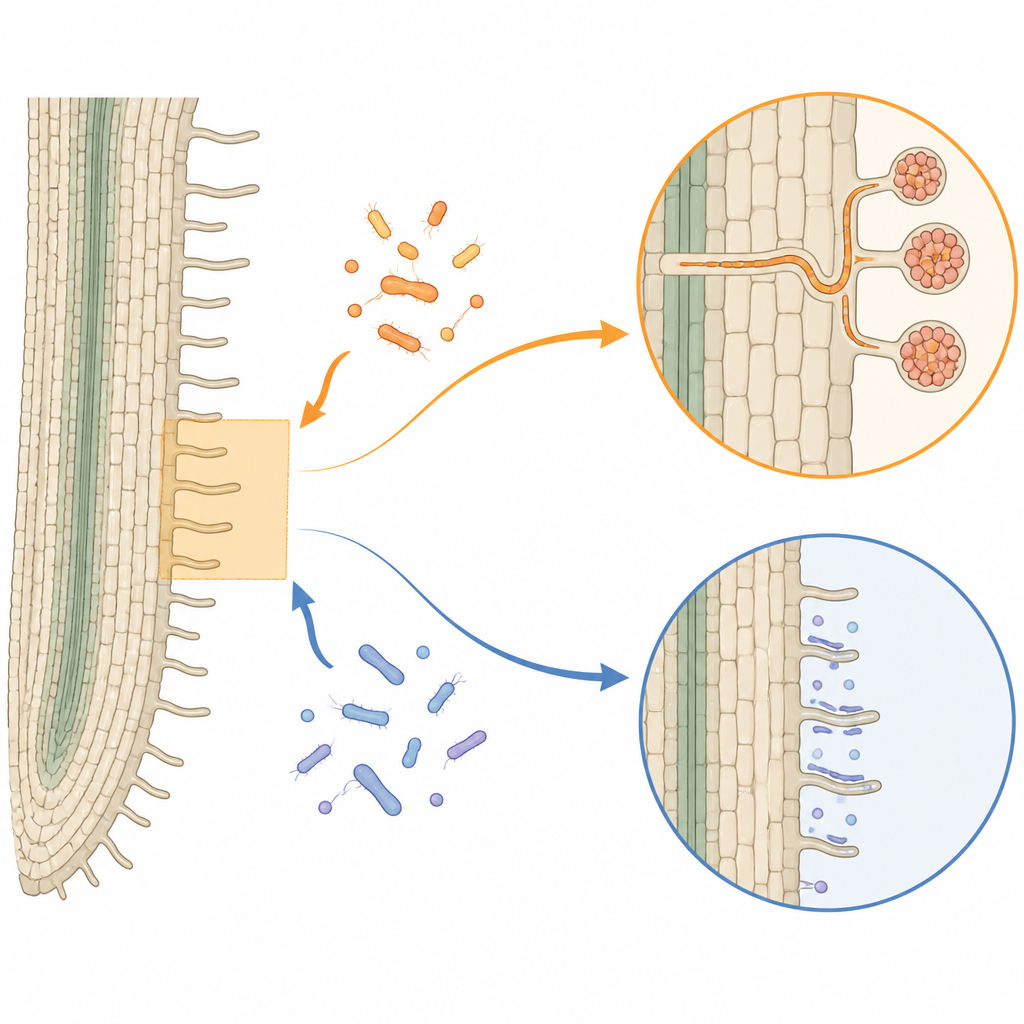
Soil around plant roots teems with countless bacteria, some that move into the plant as close partners and many others that simply live nearby. This study explores how the roots of a small legume, Lotus japonicus, tell these different bacterial neighbors apart using tiny hairs on their surface. Understanding this sorting process matters because helpful microbes can boost plant growth and reduce the need for fertilizer, while others must be kept at arm’s length.
Tiny root hairs as busy contact points
Roots are covered with fine hairs that greatly increase their contact with the soil. These root hairs are a first meeting point with bacteria that either become long-term helpers or remain casual visitors. For legumes, special partner bacteria called rhizobia enter root hairs and build nodules, where they convert nitrogen from the air into a form the plant can use. At the same time, many harmless bacteria live around the roots without moving inside. How one group gains access while the other does not has been a long-standing puzzle.
Watching thousands of root cells one by one
The researchers used single-cell RNA sequencing, a technique that reads which genes are active in thousands of individual cells, to map root responses at very high resolution. They exposed Lotus roots to a carefully built community of 19 harmless soil bacteria, to the symbiotic rhizobium Mesorhizobium loti, or to both. This allowed them to compare how different root cell types, including root hairs, react to these treatments. They confirmed that the harmless community does not trigger the classic symbiotic signal pathway used by rhizobia, which depends on special molecules called Nod factors.
A shared alarm in select root hairs
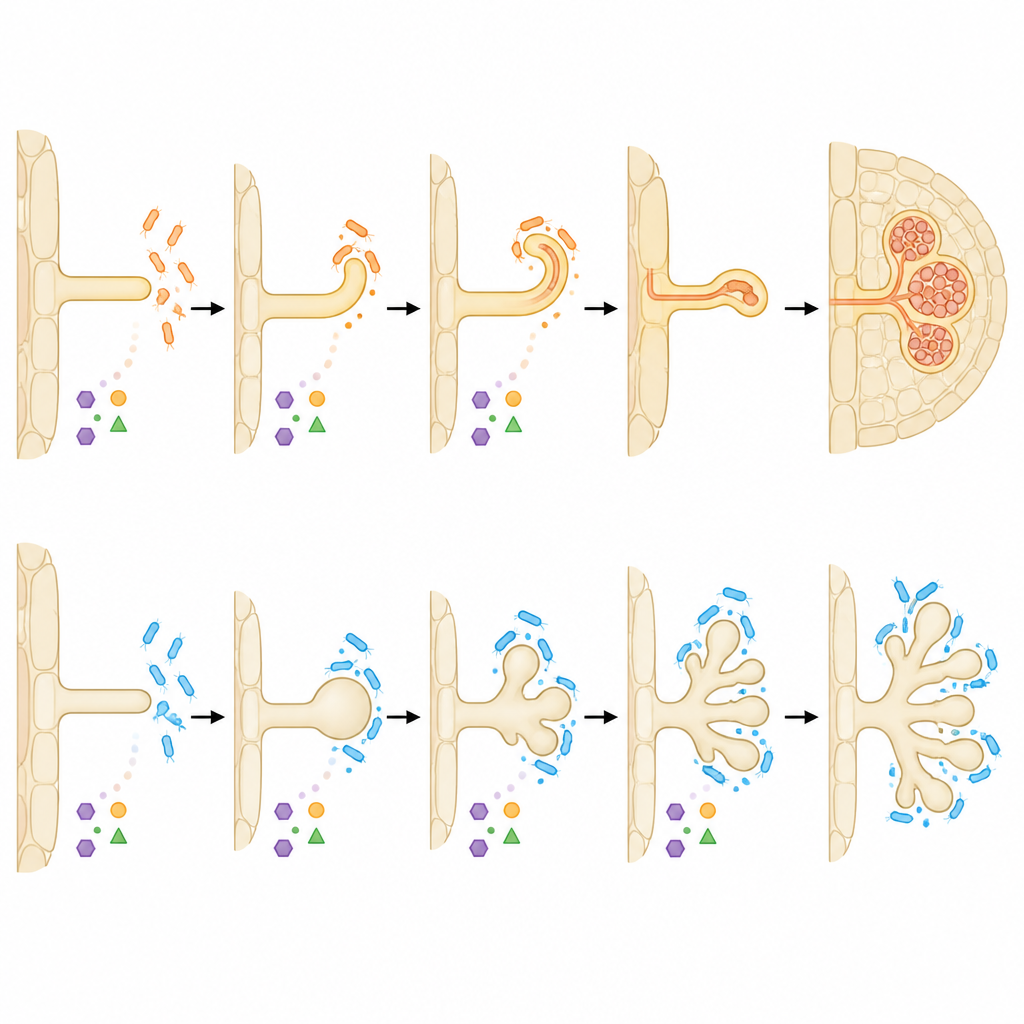
Despite lacking Nod factor signals, the harmless bacteria still switched on a strong gene response in a small group of root hairs. The pattern of active genes in these hairs overlapped with the response seen when mutant plants, which cannot complete normal infection, encounter rhizobia. This suggests a shared early sensing system for bacteria that does not rely on the usual symbiotic signals. Among the genes turned on in both cases was a transcription factor the authors named ROOT HAIR DEFECTIVE 6 LIKE A (RHD6LA) and another key symbiosis regulator called NSP2, hinting that these factors sit at a crossroads between general bacterial sensing and full symbiotic entry.
A single gene that keeps root hairs in balance
To uncover what RHD6LA actually does, the team studied plants in which this gene was disrupted. Without bacteria, mutant plants had normal root hairs. When exposed to the harmless community, however, their root hairs were more often swollen, split, or otherwise misshapen than those of normal plants. At the same time, when exposed to rhizobia, mutants formed fewer infection threads inside root hairs and developed fewer nodules. Tests with several individual harmless strains showed that this exaggerated deformation was a broad effect, not caused by a single bacterium, confirming that RHD6LA helps tame the physical response of root hairs to many commensal neighbors while supporting proper entry of true symbionts.
Balancing friendship and caution at the root surface
Together, the results reveal that certain root hairs use both a general bacterial sensing system and the classic symbiotic pathway to decide how to respond to microbes. RHD6LA sits in this shared control center, helping root hairs permit orderly invasion by friendly rhizobia while preventing overreaction to everyday soil residents. This layered control may have evolved to protect plants from being exploited by unhelpful bacteria while still allowing intimate partnerships that supply nutrients. Insights like these could guide future work to harness root microbiomes for more sustainable crop production.
Citation: Tedeschi, F., Quilbé, J., Fechete, L.I. et al. RHD6LA regulates root hair responses to both symbionts and commensals. Nat Commun 17, 4447 (2026). https://doi.org/10.1038/s41467-026-70504-1
Keywords: root microbiome, legume symbiosis, root hairs, plant microbe interactions, single cell RNA sequencing