Clear Sky Science · en
Multisite atomic-chlorine-passivation stabilizes perovskite interfaces for efficient H2O2 photosynthesis from seawater
Turning Sunlight and Seawater into a Useful Cleaner
Hydrogen peroxide is a workhorse of modern life, quietly disinfecting water, cleaning wounds, and driving greener chemical reactions. Yet most of it is still made in giant factories using an energy-hungry process that creates waste and requires shipping concentrated peroxide around the globe. This study explores a very different idea: using sunlight to make hydrogen peroxide directly from seawater and air, on site, with a new kind of light-harvesting material that can survive the harsh, salty environment.
Why Making Peroxide from Seawater Is Hard
On paper, sunlight, water, and oxygen are all you need to make hydrogen peroxide. In practice, seawater is a brutal place for most light-absorbing materials. Many promising "perovskite" semiconductors, which are excellent at capturing sunlight, quickly fall apart in water, and even faster in salty water. Simple protective coatings can keep them dry, but then oxygen and reaction products cannot reach or leave the active sites easily, choking off the chemistry. The challenge is to protect these sensitive light harvesters while still allowing gases and liquids to flow freely where the reactions happen.
A Protective Sponge for Fragile Light Harvesters
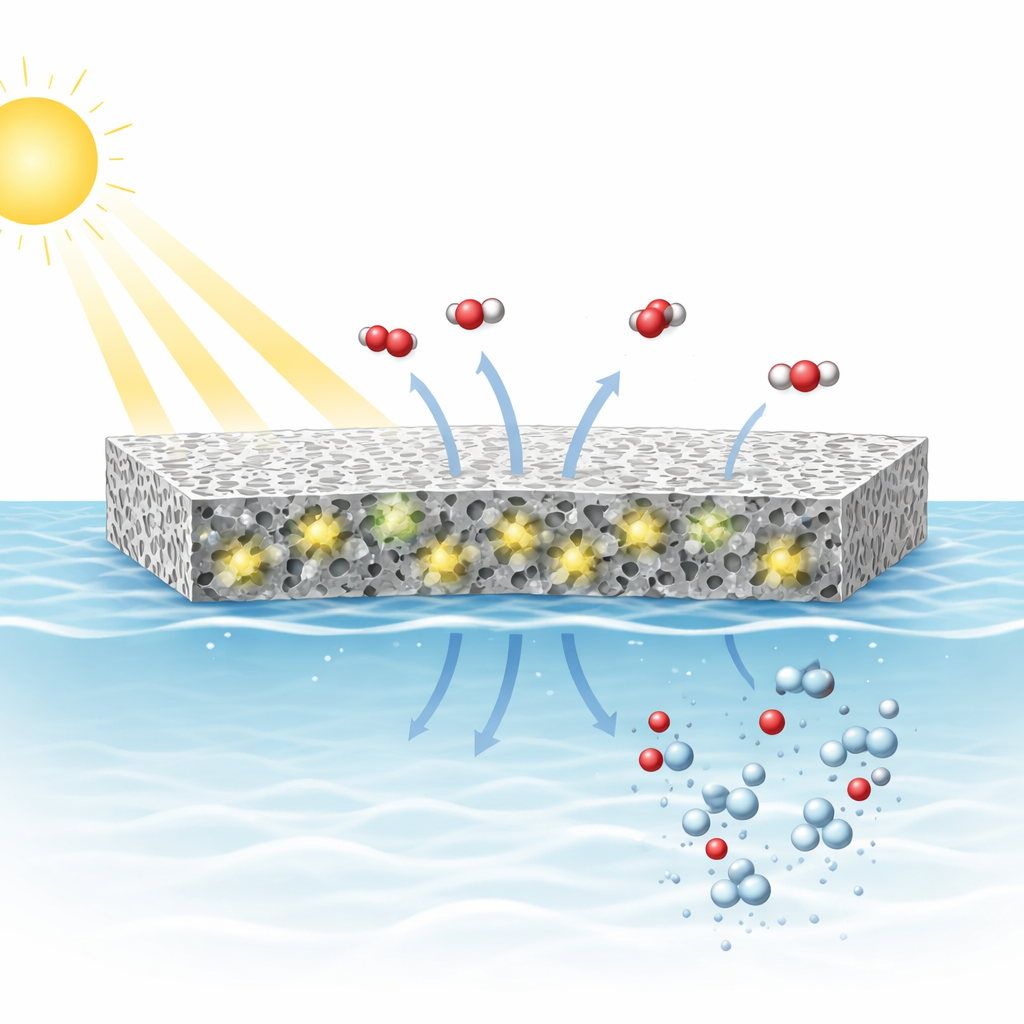
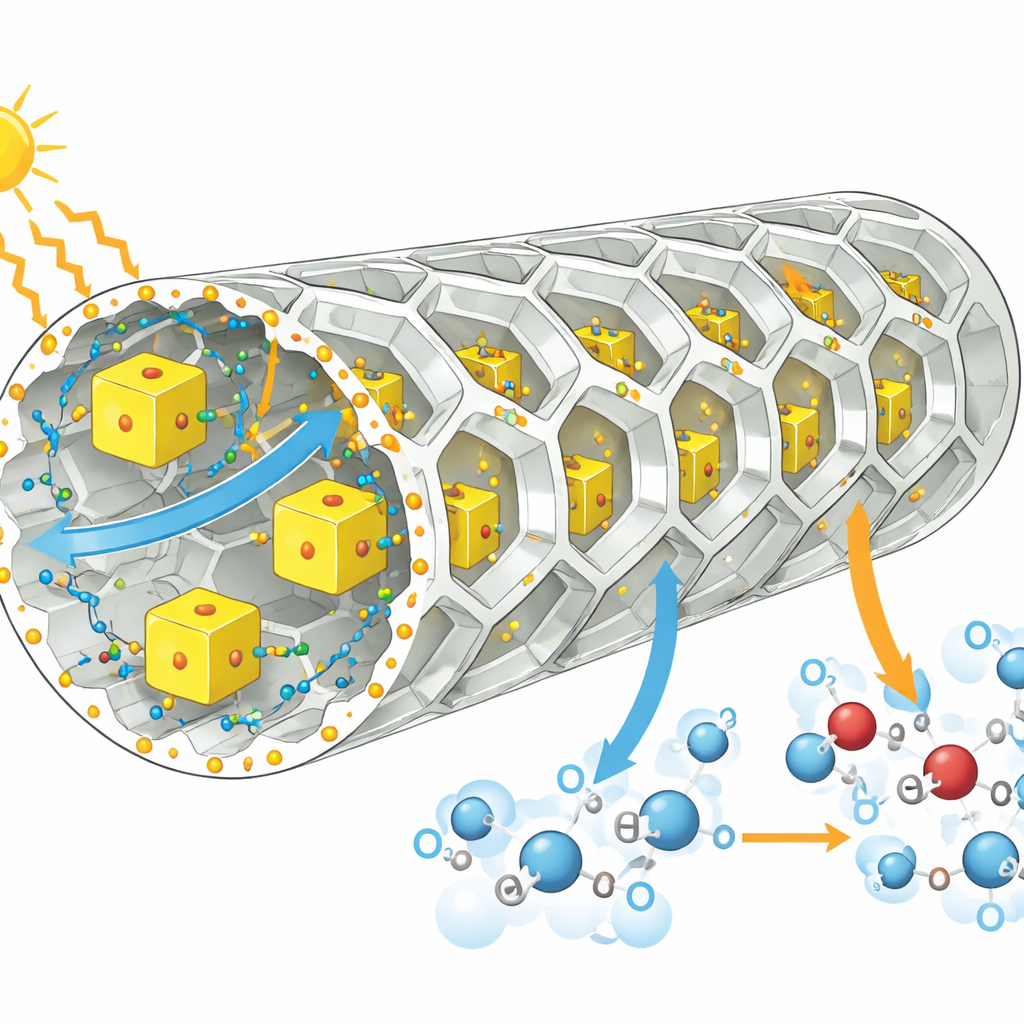
The researchers built a kind of molecular sponge, known as a covalent organic framework, whose walls are lined with chlorine atoms and whose interior is full of nanoscale channels. Inside these channels, they grew tiny crystals of a perovskite called CsPbI3, only a few billionths of a meter across. The chlorine atoms form multiple, tightly spaced links to the perovskite surface, grabbing both lead and iodine atoms. This atomic “Velcro” holds the crystals in place, blocks the sites where damaging reactions usually start, and makes it much harder for their ions to wander off and dissolve. At the same time, the outer surface of the sponge is water-repelling, so the whole composite floats and spreads over the water surface like a thin, porous raft.
A Three-Layer Zone Where Air Meets Water
Because the material is both light and water-hating, it naturally forms a gas–solid–liquid contact zone at the air–water boundary: air above, catalyst in the middle, seawater below. In this narrow region, oxygen from the air can slip straight into the pores, while water from below wets just enough of the surface to participate in the chemistry. Electrical measurements show that this three-phase contact greatly lowers resistance to charge and mass flow compared with a fully submerged catalyst. In simple terms, oxygen can reach the active sites more easily, and the charges created by sunlight can move where they are needed without getting stuck.
Guiding Light Energy into the Right Chemical Paths
The team also tuned how charges behave once light hits the composite. The perovskite crystals and the chlorine-lined framework form what is called an S-scheme junction, which naturally drives negative charges (electrons) to stay in the perovskite and positive charges (holes) to stay in the framework. At the floating interface, electrons on the perovskite side reduce oxygen to hydrogen peroxide through several short-lived oxygen species, while holes on the framework side oxidize water to peroxide without needing added helper chemicals. Experiments using light, magnetic probes, and isotopically labeled water show that both oxygen reduction and water oxidation contribute to the final peroxide, and theory calculations suggest that the interface is especially good at stabilizing the key reaction steps.
What This Could Mean for Clean Chemistry
In tests with real seawater and simulated sunlight, the new material produced hydrogen peroxide steadily for at least 20 hours, with high efficiency and very little loss of lead to the water. Outdoor trials under natural sunlight generated measurable peroxide levels over the course of a day, confirming that the concept works outside the lab. For a non-specialist, the key message is that the authors have created a floating, sunlight-powered "factory" that turns ordinary seawater and air into a useful oxidant, without extra chemicals and with built-in protection for a fragile but powerful light absorber. This approach points toward compact, local peroxide generators for water treatment and green manufacturing, using the ocean itself as both feedstock and reaction medium.
Citation: Meng, G., Wei, S., Li, N. et al. Multisite atomic-chlorine-passivation stabilizes perovskite interfaces for efficient H2O2 photosynthesis from seawater. Nat Commun 17, 3988 (2026). https://doi.org/10.1038/s41467-026-70503-2
Keywords: solar hydrogen peroxide, seawater photocatalysis, perovskite quantum dots, covalent organic frameworks, artificial photosynthesis