Clear Sky Science · en
Mesoporous ruthenium titanium oxide solid solution with efficient three phase reaction interface for water electrolysis
Turning Water into Fuel
Hydrogen is often touted as a clean fuel of the future, but producing it efficiently and affordably remains a major challenge. One of the most promising methods, proton exchange membrane water electrolysis, can generate very pure hydrogen using renewable electricity. However, the heart of this technology—the catalyst that helps split water into hydrogen and oxygen—tends to degrade under the harsh, acidic conditions needed for industrial operation. This study introduces a new ruthenium–titanium oxide material that keeps working reliably at high power for hundreds of hours, pointing toward more practical large-scale green hydrogen production. 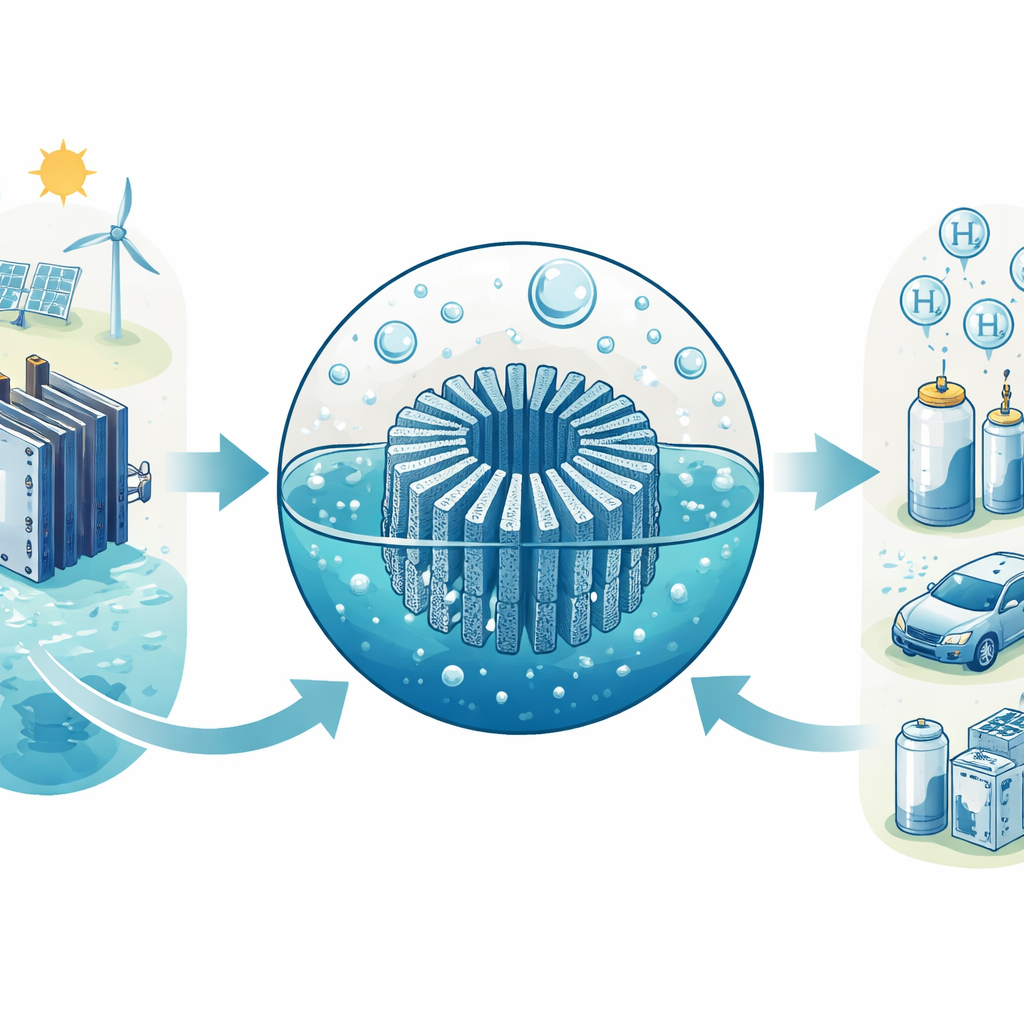
Why Current Catalysts Fall Short
In today’s best commercial systems, the oxygen-forming side of the reaction relies heavily on iridium, one of the rarest and most expensive metals on Earth. Ruthenium-based materials can, in principle, rival iridium’s performance, but they usually suffer from a fatal flaw: at the high voltages required for industrial current densities, ruthenium tends to over-oxidize, dissolve into the liquid, and lose its structure. At the same time, bubbles of oxygen crowd the catalyst surface and block fresh water from reaching active sites, further stressing and degrading the material. The authors argue that solving this problem requires not only tweaking the chemistry of the active atoms, but also engineering the interface where solid catalyst, liquid water, and oxygen gas all meet.
Building a Better Catalyst from the Bottom Up
To address both issues at once, the researchers designed a ruthenium–titanium oxide “solid solution” with a highly ordered, sponge-like architecture. Using a tailored self-assembly process, they created nanospheres made of radially aligned nanorod bundles riddled with uniform mesopores—tiny channels about nine nanometers wide. At the atomic level, ruthenium atoms are dispersed within a rutile titanium oxide lattice, forming continuous Ru–O–Ti linkages rather than separate ruthenium clusters. This arrangement turns the originally semiconducting titanium oxide into a conductive network, allowing electrons to move easily and helping to stabilize ruthenium against over-oxidation. 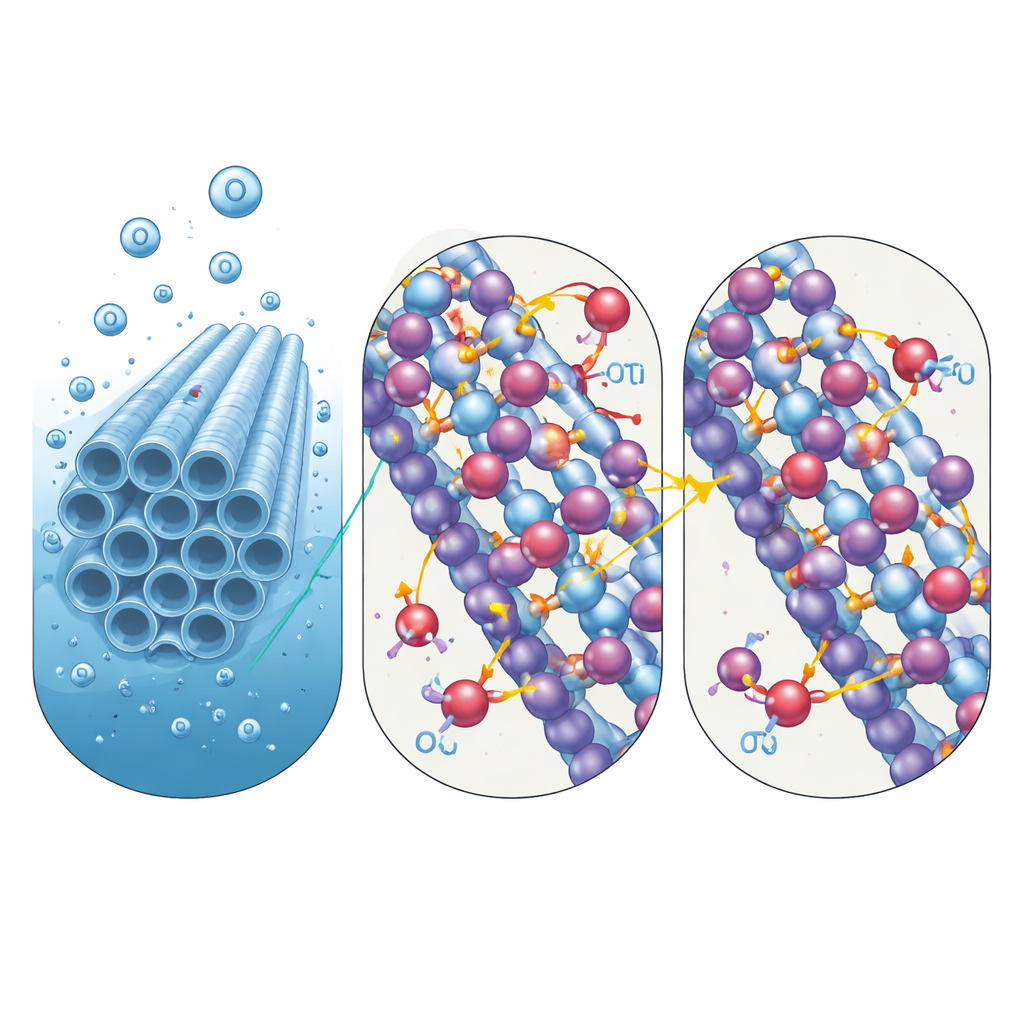
Making the Most of the Three-Phase Interface
The unusual shape of the particles is not just visually striking; it is central to how the material works. The radially aligned pores draw water in quickly and expose a large internal surface to the liquid. Measurements show that water spreads instantly across the catalyst, while oxygen bubbles barely stick and detach with almost no force. In other words, the surface is super-hydrophilic to water but strongly repels gas bubbles. This carefully tuned gas–liquid–solid interface keeps fresh reactants flowing and products leaving, even when the system is driven at very high current densities, which is crucial for industrial devices.
Guiding the Reaction Down a Gentler Path
Beyond structure, the team probed how the catalyst actually carries out the oxygen-forming reaction. Using advanced X-ray and mass spectrometry techniques under operating conditions, they tracked both the oxidation state of ruthenium and the source of the oxygen atoms in the released gas. They found that, even at high voltage, ruthenium’s valence state rises only modestly and then plateaus, instead of climbing into a range where it dissolves. Isotope labeling experiments revealed that most of the oxygen in the produced gas comes from the water, not from the crystal lattice itself, meaning that the catalyst avoids a more destructive “lattice oxygen” route. Calculations support a preferred reaction pathway in which oxygen atoms couple on the surface through Ru–O–Ti motifs, rather than pulling oxygen out of the solid framework.
From Lab Concept to Device Performance
When integrated into a full proton exchange membrane electrolyzer, the new mesoporous ruthenium–titanium oxide anode delivers industrially relevant performance: it sustains a current density of 1 ampere per square centimeter for more than 450 hours with very little voltage drift, and it does so with a relatively low loading of ruthenium. Compared with commercial ruthenium dioxide, it operates at lower voltages and shows much slower degradation. For a non-iridium catalyst in such harsh acidic conditions, this combination of efficiency and longevity is rare.
What This Means for Clean Hydrogen
In simple terms, the study shows that careful design across scales—from the way individual atoms share electrons to the way pores guide water and release bubbles—can transform a fragile metal oxide into a robust workhorse for splitting water. By blending ruthenium into a titanium oxide scaffold and sculpting it into a highly wettable, bubble-shedding architecture, the authors created a catalyst that produces oxygen efficiently without tearing itself apart. If such materials can be scaled economically, they could help reduce reliance on iridium, cut costs, and bring large-scale green hydrogen production closer to everyday reality.
Citation: Zhang, JY., Yue, K., Zhao, Y. et al. Mesoporous ruthenium titanium oxide solid solution with efficient three phase reaction interface for water electrolysis. Nat Commun 17, 3752 (2026). https://doi.org/10.1038/s41467-026-70502-3
Keywords: green hydrogen, water electrolysis, ruthenium catalysts, proton exchange membrane, oxygen evolution reaction