Clear Sky Science · en
Auto-crosslinking sporesilk fibers promote endospore and Cry toxin clustering
Sticky Threads That Make Green Pest Killers Stronger
Farmers and public health workers around the world already rely on the soil bacterium Bacillus thuringiensis (Bt) as a “green” insect killer that spares people, wildlife, and pollinators. This study reveals that one important Bt strain hides an extra trick up its sleeve: it spins an ultra-tough protein “sporesilk” that ties together its hardy spores and toxin crystals into infectious clumps. Understanding these natural glue fibers could help us design safer, more effective biopesticides and reduce the need for harsh chemical sprays.
A Natural Insect Killer in Need of Better Packaging
Bt kills insect larvae such as mosquito and moth caterpillars by producing two key ingredients during its life cycle: rugged spores that survive in the environment, and crystalline toxin packets known as parasporal bodies. When a larva swallows both together, the crystals dissolve in its gut, punch holes in the intestinal wall, and allow the bacteria to invade, leading to sepsis and death. However, spores and toxin crystals are separate particles floating outside the cell, so in principle they could drift apart in water or soil. For efficient infection, the bacterium needs a way to keep the infectious spore and its toxic payload traveling together. This puzzle is especially acute for the mosquito-targeting strain B. thuringiensis subsp. israelensis (Bti), whose hosts live in dilute aquatic habitats.
Discovery of a Hidden Fiber Net Around Spores
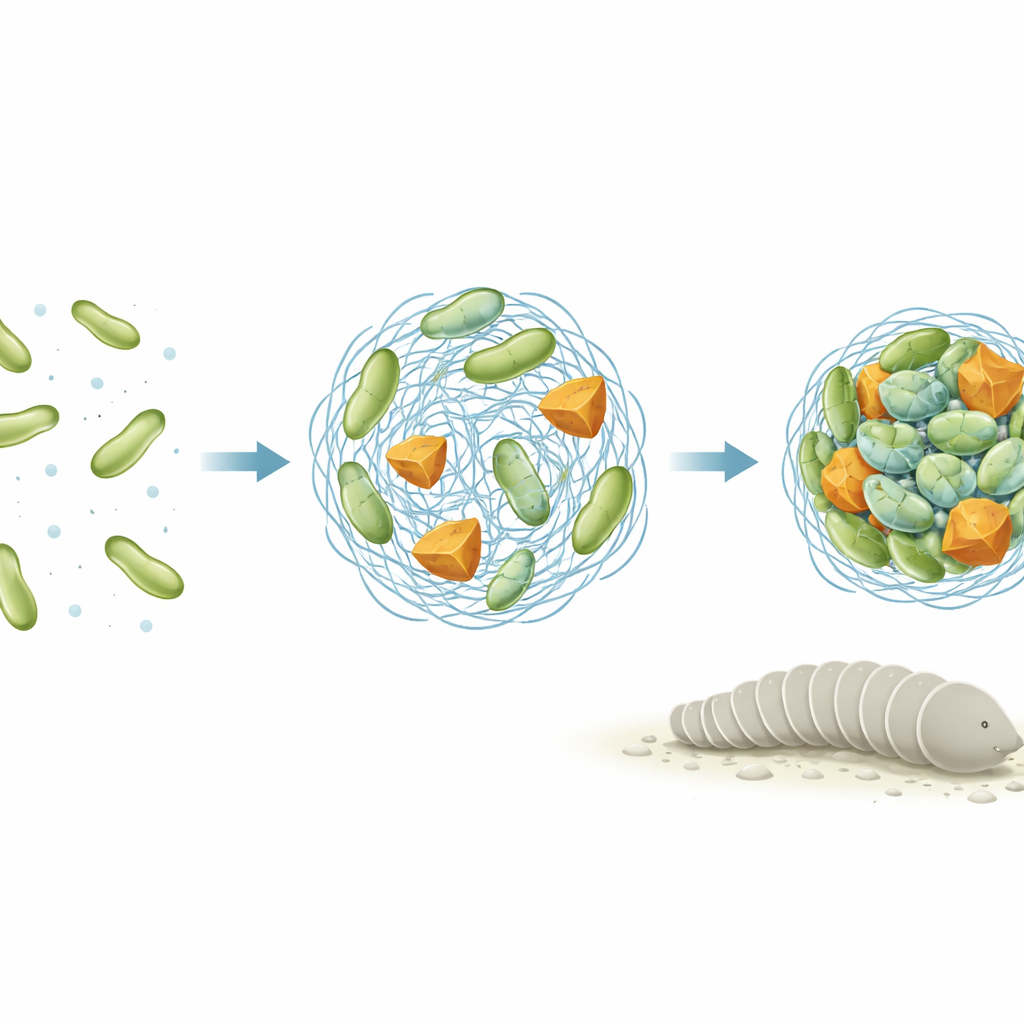
The authors examined Bti spore preparations with light and electron microscopes and noticed that spores and toxin crystals were not scattered individually. Instead, they clustered in dense microcolonies wrapped in a delicate-looking but pervasive mesh of fine fibers. Closer imaging showed that these fibers, only about 8 nanometers thick, extend from the surfaces of both spores and toxin sacks, weaving them into three-dimensional clumps. Even under very alkaline conditions that dissolve the toxin crystals, the empty toxin sacks remained entangled in this mesh. This suggested that the fibers act as tethers, holding the toxic cargo close to the spores so that both are taken up together during infection.
Spinning an Ultra-Tough Molecular Rope
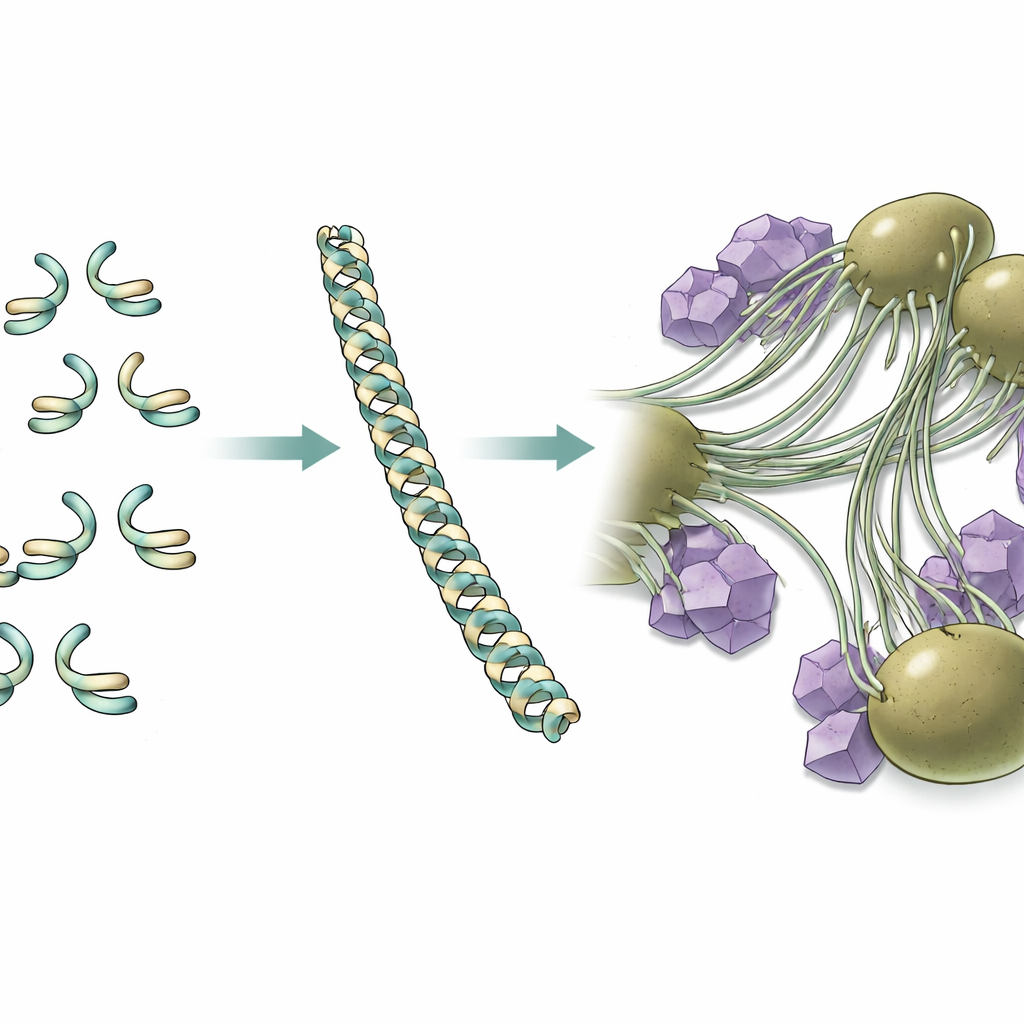
Using high-resolution cryo-electron microscopy, the team solved the three-dimensional structure of the fibers and traced them back to a small protein they named A-ENA. Many copies of A-ENA stack into parallel helices that twist together into a double-stranded rope. At the atomic level, each protein subunit forms up to ten covalent links, called isopeptide bonds, to its neighbors. These internal crosslinks effectively weld the entire fiber into a continuous chain of peptide bonds, making it remarkably resistant to heat, strong acids, strong bases, and detergents. Strikingly, when the A-ENA protein was produced in ordinary E. coli bacteria, it spontaneously assembled into the same fibers without any helper enzymes, showing that its self-organizing and self-crosslinking behavior is hard-wired into its sequence.
From Fiber Net to Stronger Biopesticides
The researchers then asked what these sporesilk fibers do for the bacterium. By knocking out the A-ENA gene in Bti, they created a strain whose spores lacked the fiber matrix. Without A-ENA, spores and toxin crystals no longer formed fluffy, low-density clumps but instead separated as heavier individual particles. Larval midges exposed to this mutant strain survived longer than those exposed to normal Bti, indicating reduced killing power. Next, the team turned to a widely used crop biopesticide strain, B. thuringiensis subsp. kurstaki (Btk), which naturally lacks A-ENA. When they either engineered Btk to produce A-ENA or simply mixed in purified A-ENA fibers made in the lab, spores and toxin crystals suddenly clustered together, and the preparation became significantly more lethal to cabbage looper caterpillars. Importantly, the fibers alone, without spores and toxins, were not toxic to the insects.
How Widespread Are These Glue Fibers?
By scanning thousands of bacterial genomes, the authors found A-ENA-like proteins scattered across many species in the broader Bacillus and Clostridium group, with a strong enrichment in strains that also carry insecticidal toxin genes. In some bacteria, A-ENA modules are fused to collagen-like and C1q-like domains that are known to mediate binding to host surfaces. This suggests that similar fibers may not only glue spores and toxin particles together, but also help spores stick to insect tissues or other environmental targets. Although these broader functions remain to be proven experimentally, the genetic patterns point to a versatile family of molecular scaffolds used for adhesion and clustering.
Why This Matters for Future Pest Control
In simple terms, this work shows that Bti does not just release spores and toxins into the wild; it packages them together using an extraordinarily durable protein net that keeps the killing agents close to the infectious particles. This packaging makes infection more reliable, especially in watery environments where spores and toxins might otherwise drift apart. Because A-ENA fibers can be produced recombinantly and added to Bt preparations without genetic modification of the pesticide strain, they offer a practical route to strengthen existing biopesticides. In the long term, such natural “molecular glues” could help reduce reliance on broad-spectrum chemical insecticides by boosting the potency and stability of targeted biological control agents.
Citation: Sleutel, M., Sogues, A. & Remaut, H. Auto-crosslinking sporesilk fibers promote endospore and Cry toxin clustering. Nat Commun 17, 3809 (2026). https://doi.org/10.1038/s41467-026-70495-z
Keywords: Bacillus thuringiensis, biopesticide, protein nanofibers, insect larvae control, spore–toxin clustering