Clear Sky Science · en
IL-17RA signaling promotes the dedifferentiation of Paneth progenitors through ADAM17 to regenerate gut epithelium post-irradiation
How the Gut Bounces Back from Radiation Damage
Radiation therapy and severe intestinal infections can badly injure the lining of the small intestine, leaving patients vulnerable to pain, infection, and poor nutrient absorption. This study uncovers how a particular group of gut cells, Paneth progenitors, receive a rescue signal from the immune system that helps them step in as emergency stem cells to rebuild the damaged lining. Understanding this built-in repair system could guide safer cancer treatments and new therapies for inflammatory bowel diseases.
Special Helper Cells at the Base of the Gut
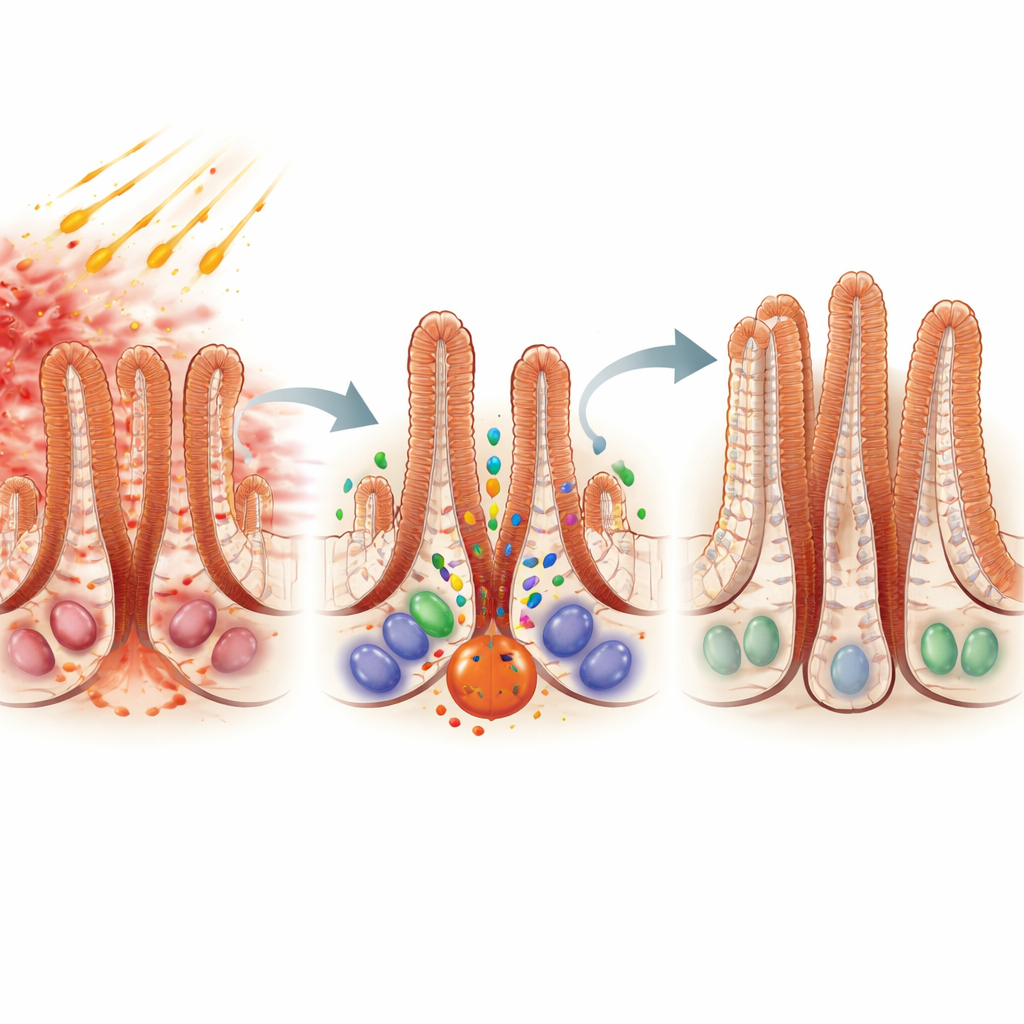
The inner surface of the small intestine is lined with millions of tiny pits and finger-like projections that constantly renew themselves. At the base of each pit sit Paneth cells, best known for secreting antimicrobial substances that keep gut bacteria in check and for supporting nearby stem cells. However, earlier work suggested that, under severe stress, some of these cells can shed their specialized role and behave like stem cells, helping to rebuild the tissue. The new study focuses on a subset called Paneth progenitors and asks what signals tell them when the tissue is in trouble and needs rebuilding.
An Immune Signal that Protects the Gut
The researchers examined a well-known immune messenger, IL-17A, which rises during infection and inflammation and acts through a receptor called IL-17RA on many cell types, including intestinal cells. Using mice lacking IL-17RA, either throughout the body or only in intestinal lining cells, the team exposed the animals to doses of radiation that wipe out the usual stem cells. Without IL-17RA, the gut lining showed more structural damage, shorter villi, fewer dividing cells, and many more bacteria escaping into the liver and spleen. These findings indicated that IL-17RA signaling in the intestinal lining is crucial for maintaining barrier function and driving regeneration after serious injury.
Paneth Progenitors Turn into Emergency Builders
To pinpoint which intestinal cells respond to IL-17A, the team used advanced single-cell analyses and genetic tracing in mice. They discovered that Paneth progenitors, an intermediate stage between stem cells and fully mature Paneth cells, carry particularly high levels of IL-17RA and its partner receptor. After radiation, these progenitors switched on IL-17 receptors even more strongly. In special “lineage tracer” mice where Paneth-derived cells glow green, radiation caused green ribbons of many different cell types to appear along the villi, proving that Paneth-lineage cells had reverted to a more primitive state and rebuilt the tissue. When IL-17A was blocked with antibodies, far fewer green clones emerged, and regeneration worsened; when gut organoids were given extra IL-17A after radiation, more Paneth-lineage cells gained stem-like behavior and could seed entirely new organoids.
A Molecular Switchboard: Nox1 and ADAM17
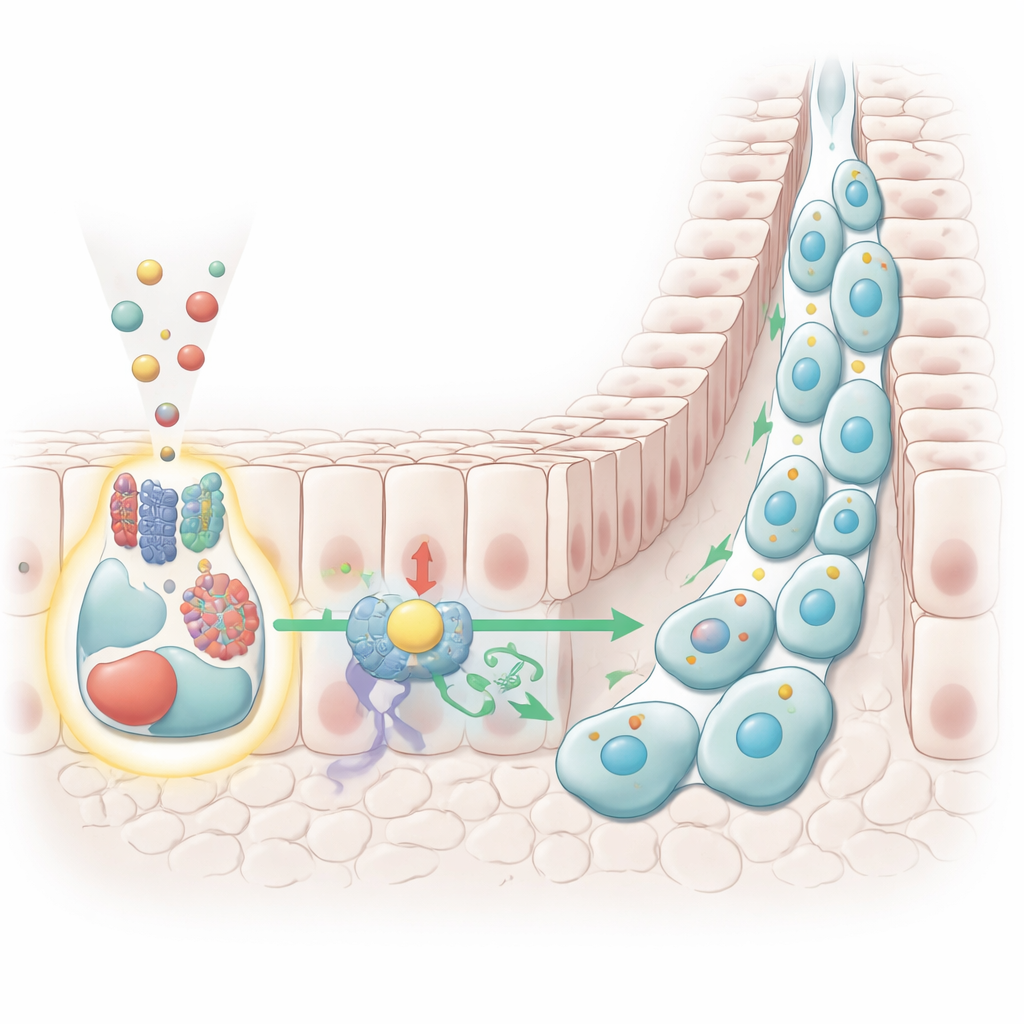
Diving deeper, the researchers asked how IL-17RA signaling inside Paneth progenitors triggers this regenerative program. They found that IL-17A boosts two key players in these cells: Nox1, an enzyme that generates controlled reactive oxygen species, and ADAM17, a membrane-bound protease that can cut and release many growth factors and signaling molecules. Mice lacking IL-17RA specifically in Paneth cells had reduced levels of both Nox1 and Adam17 after radiation, along with poor regeneration. Blocking reactive oxygen with an antioxidant dampened ADAM17 activity and Paneth-lineage stemness, while exposing ADAM17 to hydrogen peroxide increased its activity. Critically, when the team forced extra ADAM17 production using a viral vector, it largely rescued the regeneration defects seen in Paneth-specific IL-17RA knockout mice, restoring tissue structure, boosting cell division, and limiting bacterial spread.
Why This Matters for Patients
Overall, the authors propose that, after severe gut injury, IL-17A from immune cells signals through IL-17RA on Paneth progenitors to raise Nox1 and activate ADAM17, which in turn unleashes a cascade of repair signals that let these cells dedifferentiate and regenerate the epithelium. This pathway appears dispensable in everyday gut maintenance but becomes essential when the usual stem cells are wiped out. The findings help explain why blocking IL-17 in certain patients with intestinal disease can worsen symptoms, and they point to the IL-17RA–ADAM17 axis in Paneth progenitors as a potential target to protect the intestine during radiation therapy or to enhance healing in inflammatory bowel disorders.
Citation: Kempen, C.G., Singh, A., Breau, K.A. et al. IL-17RA signaling promotes the dedifferentiation of Paneth progenitors through ADAM17 to regenerate gut epithelium post-irradiation. Nat Commun 17, 4091 (2026). https://doi.org/10.1038/s41467-026-70479-z
Keywords: intestinal regeneration, Paneth cells, IL-17A signaling, radiation injury, gut epithelium repair