Clear Sky Science · en
Jagged-mediated lateral induction patterns Notch3 signaling within adult neural stem cell populations
Keeping Brain Stem Cells in Balance
Our brains quietly rely on pools of neural stem cells to replace neurons and help with repair throughout life. But these stem cells must strike a delicate balance: stay mostly resting so they are not exhausted, yet activate often enough to generate new brain cells. This study uncovers how a molecular conversation on the surface of adult brain stem cells, driven by a signal called Notch3 and two of its partners, helps keep that balance over time and across space in the brain.
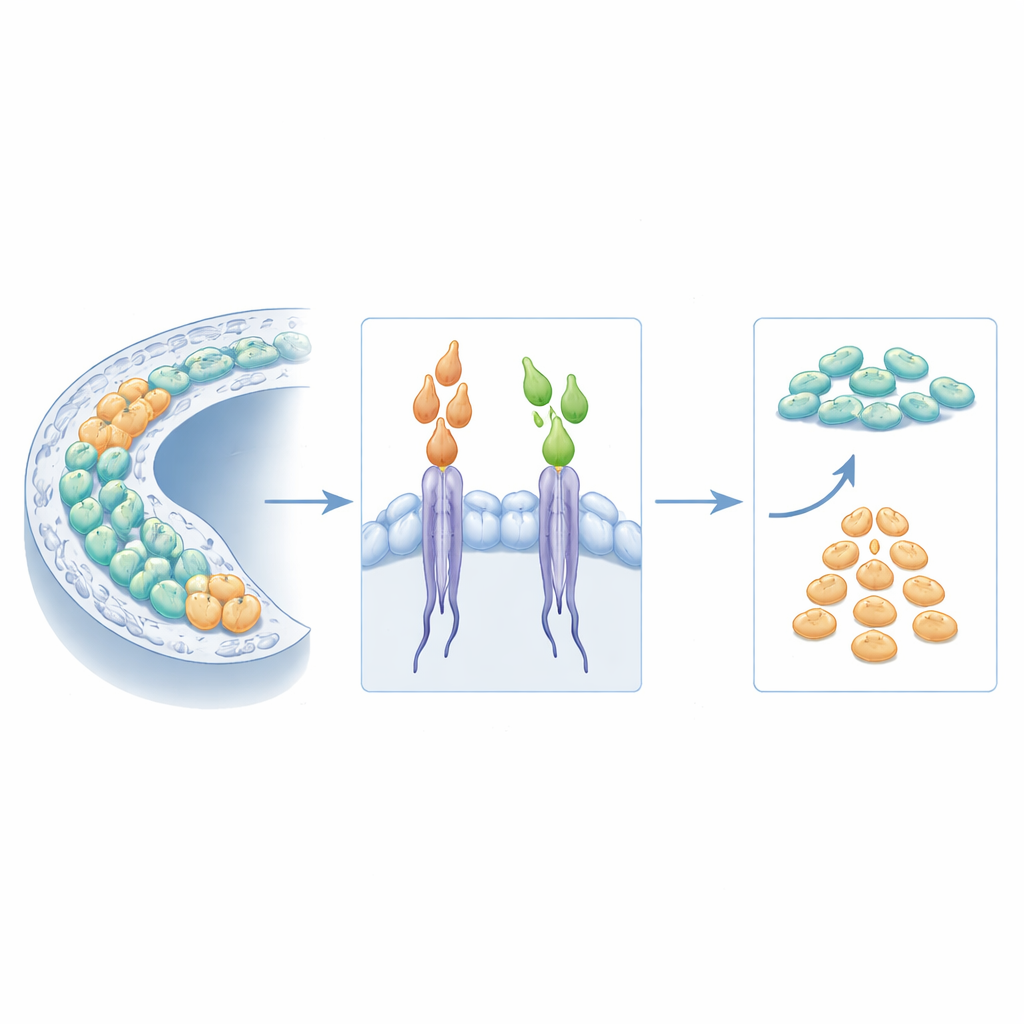
Watching a Silent Signal in Living Brain Cells
To understand how Notch3 behaves inside the adult brain, the researchers worked with zebrafish, whose brains share key features with ours and are especially good for live imaging. They engineered two new fish lines in which the active piece of the Notch3 protein carries a fluorescent tag. When Notch3 is switched on at a cell’s surface, this tagged fragment is cut loose and moves into the nucleus, where it can turn genes on or off. By tracking the brightness of this tag in the nucleus of hundreds of stem cells in intact brains, the team could, for the first time, directly measure how strongly Notch3 is signaling in each individual cell in its natural environment.
Different Neighbors, Different Signals
Not all stem cells in the adult pallium, a brain region involved in learning and memory, receive the same Notch3 signal. Some show high nuclear signal and remain deeply resting; others show lower levels and are closer to dividing or producing more committed progenitor cells. The team discovered that these signal differences are not randomly scattered. Cells with the weakest Notch3 activity tend to be surrounded by neighbors with much stronger activity. This spatial pattern hinted that local cell-to-cell contacts were organizing the way stem cells decide whether to rest or progress along their lineage.
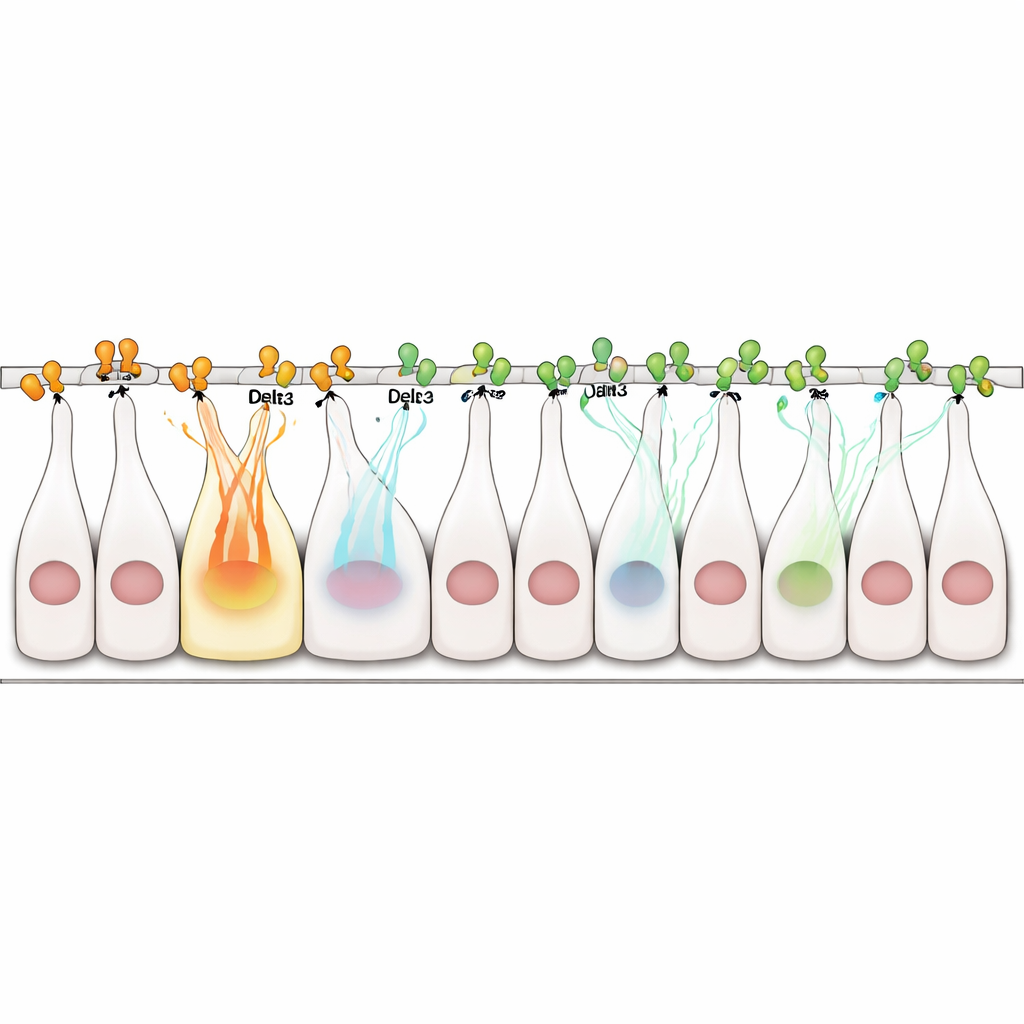
Two Molecular Voices: Delta and Jagged
The key to this pattern lies in two kinds of molecules that bind Notch3: DeltaA and Jagged1b. Using sensitive RNA detection methods, the researchers showed that DeltaA is present at very uneven levels: a minority of cells display it strongly in a “salt-and-pepper” fashion. In contrast, Jagged1b is expressed more evenly across most stem cells. Cells rich in DeltaA typically have low Notch3 activity themselves but are surrounded by neighbors with higher activity, consistent with DeltaA acting as a local brake that pushes nearby cells into a more quiescent, stem-like state. Jagged1b behaves differently: its levels within a given cell tend to rise together with that cell’s own Notch3 activity, suggesting a positive feedback that reinforces a shared stem cell identity.
Tuning the System by Weakening One Partner
To probe how these two voices combine, the team partially blocked Notch signaling with a drug, or specifically reduced Jagged1b using a designer antisense molecule delivered into the brain fluid. When overall Notch activity was dampened by the drug, Jagged1b levels fell sharply, while DeltaA levels rose, as if the system were trying to compensate. When Jagged1b alone was reduced, nuclear Notch3 activity dropped and the stemness factor Sox2 became weaker, yet the overall rate of stem cell division did not immediately change. Importantly, the same spatial pattern remained: cells with low Notch3 activity were still surrounded by cells with higher activity, but the contrast between high and low was reduced. This supports the idea that Jagged1b provides a widespread background signal that stabilizes stem cell identity, while DeltaA carves sharp boundaries between neighboring cells’ fates.
What This Means for Brain Health
Together, the findings paint a picture of adult neural stem cell populations as a self-organizing community. A broadly shared Jagged–Notch3 signal helps all stem cells maintain their potential, while scattered Delta-expressing cells locally push neighbors into rest and shape where and when activation events occur. By precisely reading out Notch3 activity and showing how two ligands combine to sculpt it in space, this work suggests how the brain keeps its stem cell reservoir stable yet flexible over a lifetime. Understanding this logic in simple vertebrates like zebrafish could ultimately guide strategies to better harness or protect stem cells in the human brain during aging, injury, or disease.
Citation: Ortica, S., Martinez Herrera, M., Degroux, L. et al. Jagged-mediated lateral induction patterns Notch3 signaling within adult neural stem cell populations. Nat Commun 17, 3986 (2026). https://doi.org/10.1038/s41467-026-70478-0
Keywords: neural stem cells, Notch signaling, zebrafish brain, Delta and Jagged ligands, adult neurogenesis