Clear Sky Science · en
Liquid metal dispersed single-atom catalyst with high-temperature stability
Why tiny metal atoms in hot liquids matter
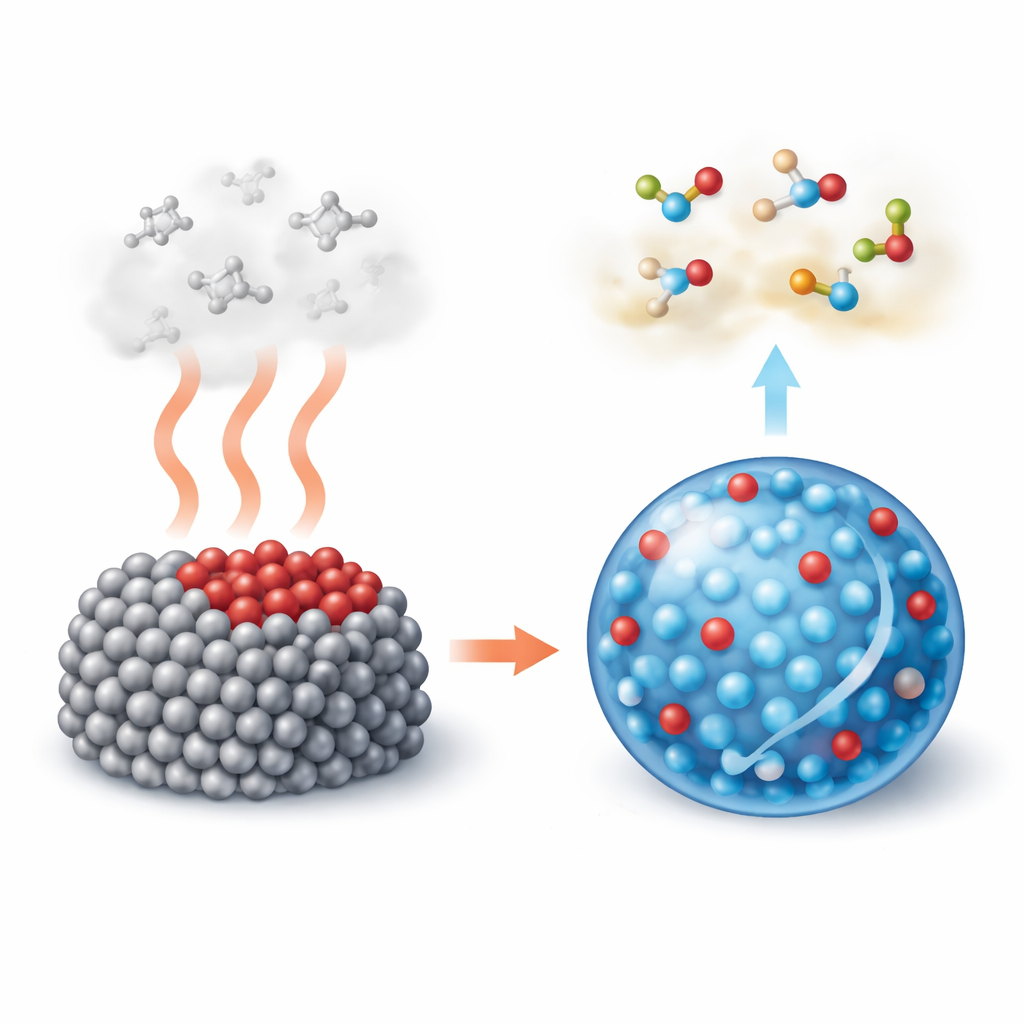
Chemical plants turn simple molecules from oil and natural gas into the fuels and materials that underpin modern life. Many of these steps rely on metal catalysts that must endure fierce heat for days on end. Under such conditions, today’s best catalysts slowly fall apart, wasting precious metals and energy. This study introduces a clever way to keep individual metal atoms separated and active by dissolving them into a liquid metal, allowing them to survive extreme temperatures while still driving important reactions.
The problem with clumping metals
Many cutting-edge catalysts use “single atoms” of a metal such as platinum, each acting like a tiny, efficient factory for transforming molecules. Because every atom is exposed, these catalysts are both powerful and economical. The catch is that isolated atoms are unstable at high temperatures: they wander across the surface and clump into larger particles, a process called sintering. Once that happens, much of their special reactivity is lost. Conventional designs try to pin these atoms onto solid supports such as oxides or porous crystals, but the bonds must be strong enough to prevent motion yet not so strong that they choke off the atom’s activity—a balance that is hard to achieve.
A liquid host for single atoms
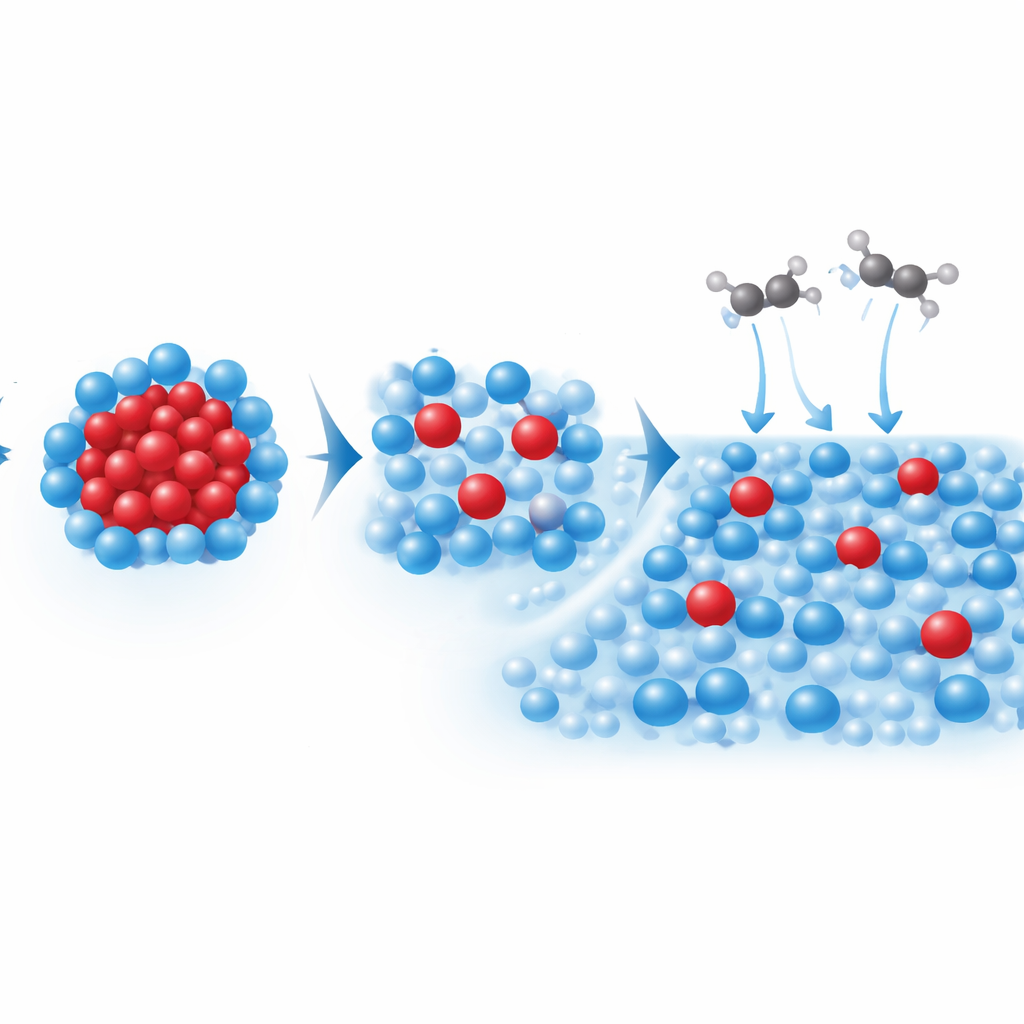
Inspired by the idea that “like dissolves like,” the authors used a liquid metal, gallium, as a flowing host for active metals like platinum. At the high operating temperature, platinum particles sitting on gallium break apart: the bonds between neighboring platinum atoms are disrupted and individual platinum atoms become surrounded by gallium atoms instead. Because gallium and platinum attract each other strongly, these single atoms remain dispersed, forming tiny mixed clusters rather than larger platinum chunks. Computer simulations at the atomic scale showed that this dispersed state is not only possible but energetically favored, and that platinum atoms migrate through the liquid while mostly staying isolated from one another.
Seeing single atoms in a liquid
Proving that atoms stay separated inside a liquid is challenging. The team combined several advanced probes to build a consistent picture. Electron microscopy and elemental mapping showed a uniform distribution of platinum within liquid gallium, with no obvious clumps. X-ray diffraction and pair distribution analysis, which are sensitive to regular atomic spacing, failed to detect platinum–platinum distances typical of larger particles. Instead, X-ray absorption measurements revealed new bond lengths corresponding to platinum–gallium neighbors, confirming that platinum resides as individual atoms bound within the liquid metal environment rather than as metallic grains.
Putting the liquid catalyst to the test
To demonstrate usefulness in a real reaction, the researchers turned to ethane dehydrogenation, an important industrial step that converts ethane from natural gas into ethylene, a building block for plastics and many chemicals. They loaded the platinum–gallium liquid into the pores of a solid zeolite, creating a composite that exposes the liquid surface to flowing gas. In this setup, platinum atoms at the liquid surface activate the carbon–hydrogen bonds in ethane, releasing hydrogen and forming ethylene. Because the liquid is fluid, fresh single atoms continually move to the surface, while the strong platinum–gallium interaction prevents them from merging into larger particles even at 650 °C. Compared with a conventional platinum-on-zeolite catalyst, the liquid system almost doubled ethane conversion and pushed ethylene selectivity to about 98 percent.
Staying strong under harsh conditions
The most striking result is the catalyst’s durability. Under continuous operation at 650 °C for more than 100 hours, the liquid-metal system maintained nearly constant activity and selectivity, with no clear signs of deactivation. Follow-up structural measurements after this long run showed that platinum remained atomically dispersed, mirroring the fresh catalyst. The same strategy also worked for another noble metal, rhodium, hinting that the approach is broadly applicable. By using the natural affinity and fluidity of liquid metals to keep single atoms apart, the authors present a practical route to high-temperature catalysts that waste less precious metal and could make large-scale chemical manufacturing cleaner and more efficient.
Citation: Zeng, Z., Wang, C., Sun, M. et al. Liquid metal dispersed single-atom catalyst with high-temperature stability. Nat Commun 17, 3918 (2026). https://doi.org/10.1038/s41467-026-70476-2
Keywords: single-atom catalyst, liquid metal, platinum gallium, ethane dehydrogenation, high-temperature catalysis