Clear Sky Science · en
CLOUD: A Scalable and Physics-Informed Foundation Model for Crystal Representation Learning
Why learning from crystals matters
We live in a world built from crystals: the chips in our phones, the batteries in electric cars, and the catalysts that clean exhaust all depend on how atoms arrange themselves in repeating patterns. Knowing how a crystal’s structure affects its behavior is key to inventing better materials, but calculating those properties with traditional physics simulations or lab experiments is slow and expensive. This paper introduces a new AI approach, called CLOUD, that learns from millions of known crystals and basic physical principles to rapidly predict how new crystalline materials will behave.
Turning crystal structures into simple strings
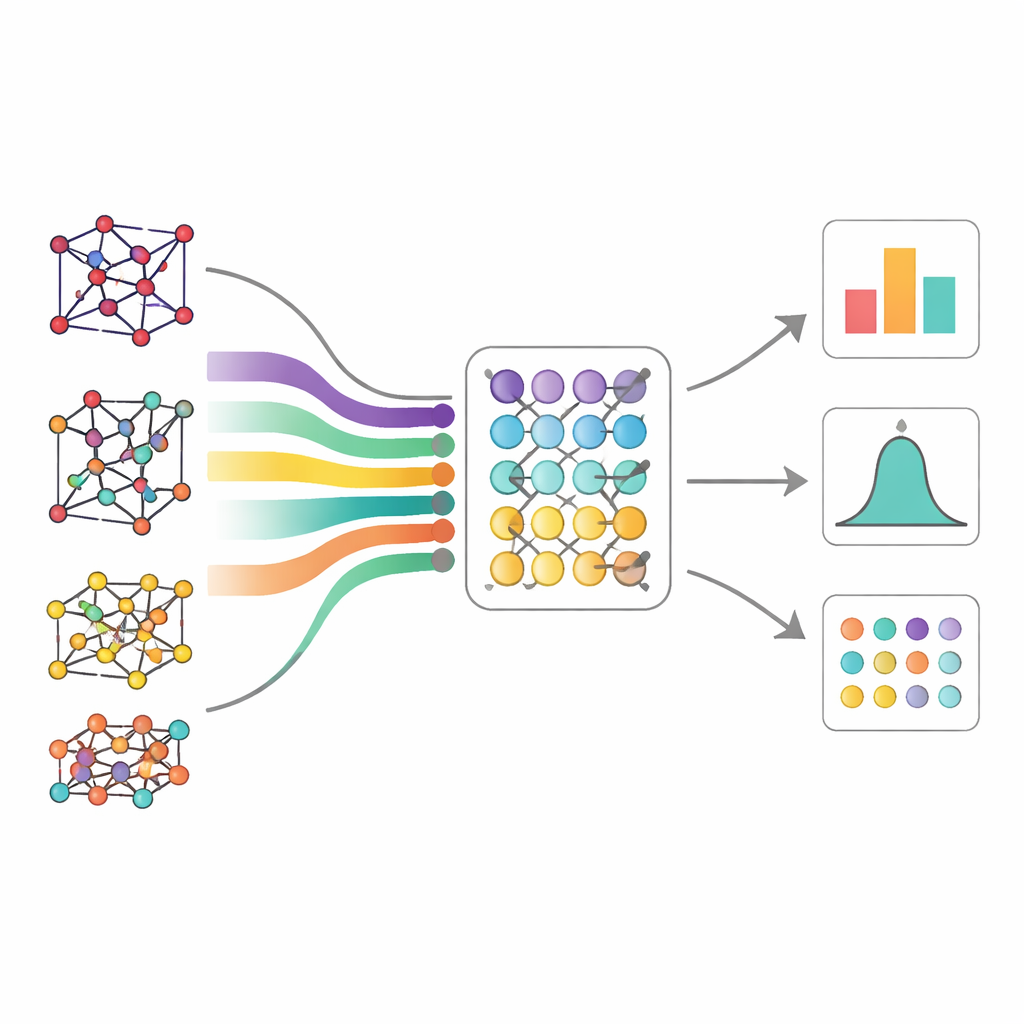
A major challenge in teaching computers about crystals is how to describe a three-dimensional atomic pattern in a form a model can handle efficiently. Rather than feeding in full atomic coordinates, the authors design a compact description called SCOPE. It captures three essential ingredients: the overall symmetry of the crystal, the repeating sets of equivalent atomic sites, and which elements sit where, including their relative amounts. All of this is expressed as a short, coordinate-free string. This string keeps the most important structural information while being cheap to store and easy for a language-style AI model to read.
A language model for materials
Building on SCOPE, the authors create CLOUD, a transformer-based foundation model similar in spirit to those used for natural language. Instead of learning from sentences on the internet, CLOUD is trained on SCOPE strings for more than six million crystals collected from public databases. During this pretraining, the model repeatedly sees partial strings with some tokens hidden and learns to guess the missing pieces, forcing it to internalize patterns that connect symmetry, site arrangements, and composition. Afterward, a simple prediction layer is added on top and the model is fine-tuned on smaller, labeled datasets to predict specific properties such as formation energy, band gap, mechanical stiffness, and dielectric response.
Accurate, scalable, and broadly applicable
When tested on standard materials benchmarks, CLOUD matches or outperforms many existing machine-learning models, including those that rely on full atomic coordinates. It is especially strong when data are scarce or when the test crystals differ from those seen during training, a common situation in real materials discovery. The model also performs well on more complex or “unconventional” structures containing defects, large unit cells, or low-dimensional layers. Analysis of the model’s internal attention reveals that it naturally focuses on the symmetry tokens in SCOPE, confirming that it has learned to use physically meaningful cues. The authors further study how performance improves as they increase both model size and training data and find that CLOUD follows predictable scaling laws, suggesting that even larger, more capable versions could be built in the future.
Blending AI with basic physics
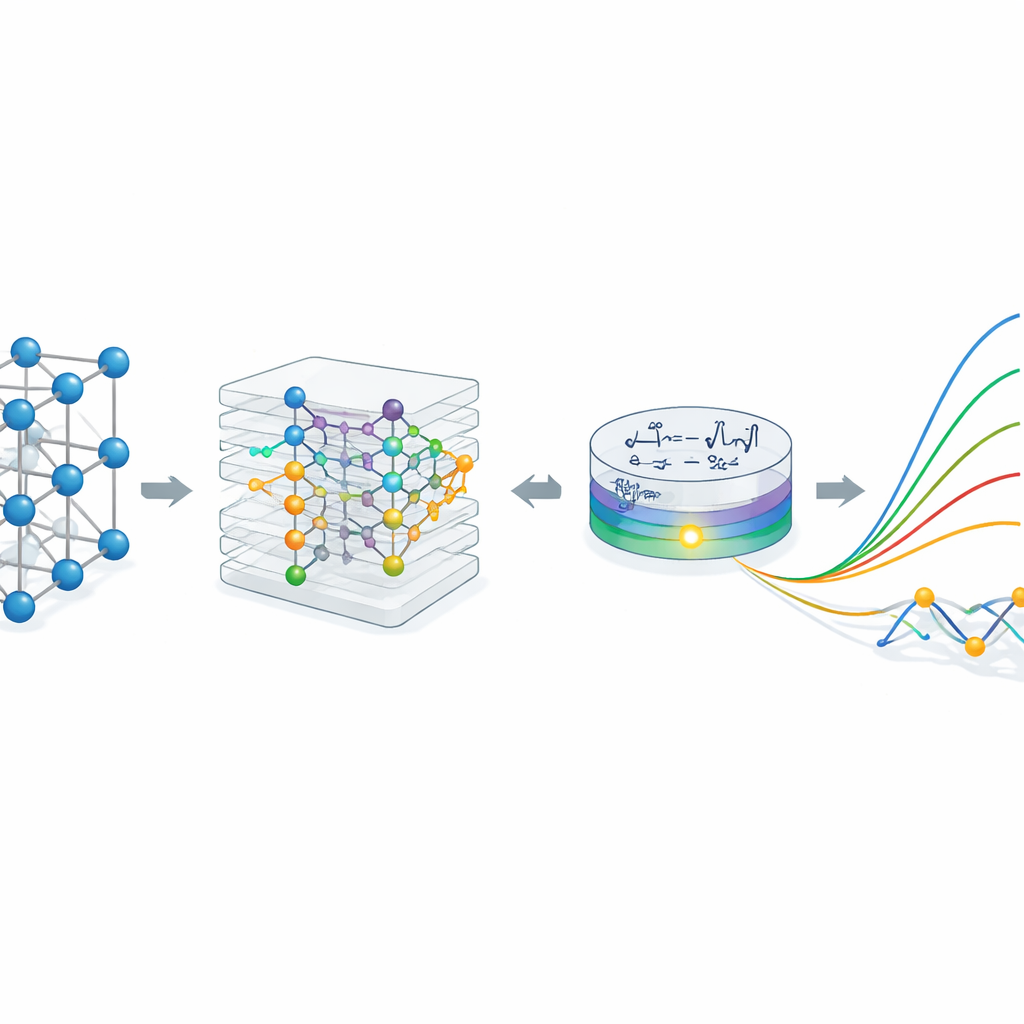
The work goes beyond pure pattern recognition by embedding a classic physics model directly into the learning process. Many important properties, such as heat capacity and internal energy, depend on long-range vibrations of atoms in a crystal and change with temperature. Rather than asking the AI to output these values directly at a single temperature, the authors create CLOUD-DEBYE: CLOUD is trained to predict an intermediate quantity called the Debye temperature, which characterizes how the crystal vibrates, and this prediction is fed into a standard Debye formula that gives heat capacity and energy as a function of temperature. Because the Debye equations are implemented in a way that allows gradients to pass through them, the whole pipeline can be trained end-to-end using only heat-capacity data at one temperature.
What this means for finding new materials
CLOUD-DEBYE not only surpasses advanced graph-based neural networks on predicting vibration-related properties, it also produces results that obey thermodynamic rules over a wide temperature range, even for materials and temperatures it never saw during training. This shows that combining large-scale data-driven learning with well-established physics can yield models that are both accurate and trustworthy. In practical terms, the CLOUD framework can quickly screen vast numbers of hypothetical crystals, estimate many of their properties, and do so in a way that respects basic physical constraints. This opens a path toward faster, more reliable discovery and design of the crystalline materials that underpin future electronics, energy technologies, and structural applications.
Citation: Xu, C., Zhu, S. & Viswanathan, V. CLOUD: A Scalable and Physics-Informed Foundation Model for Crystal Representation Learning. Nat Commun 17, 4074 (2026). https://doi.org/10.1038/s41467-026-70467-3
Keywords: crystal machine learning, materials discovery, foundation models, symmetry-aware representations, physics-informed AI