Clear Sky Science · en
Magnetoreception in a freshwater ciliate arises from endosymbiosis
A Tiny Compass in River Mud
Imagine a single-celled creature living deep in dark river mud that can steer itself using Earth’s magnetic field, much like a built‑in compass. This study reveals such an organism: a freshwater ciliate that has teamed up with several species of bacteria living inside it. Together they form a microscopic partnership that lets the cell find the narrow, oxygen‑poor layers where it thrives, shedding new light on how life evolves complex abilities by sharing tasks across different species. 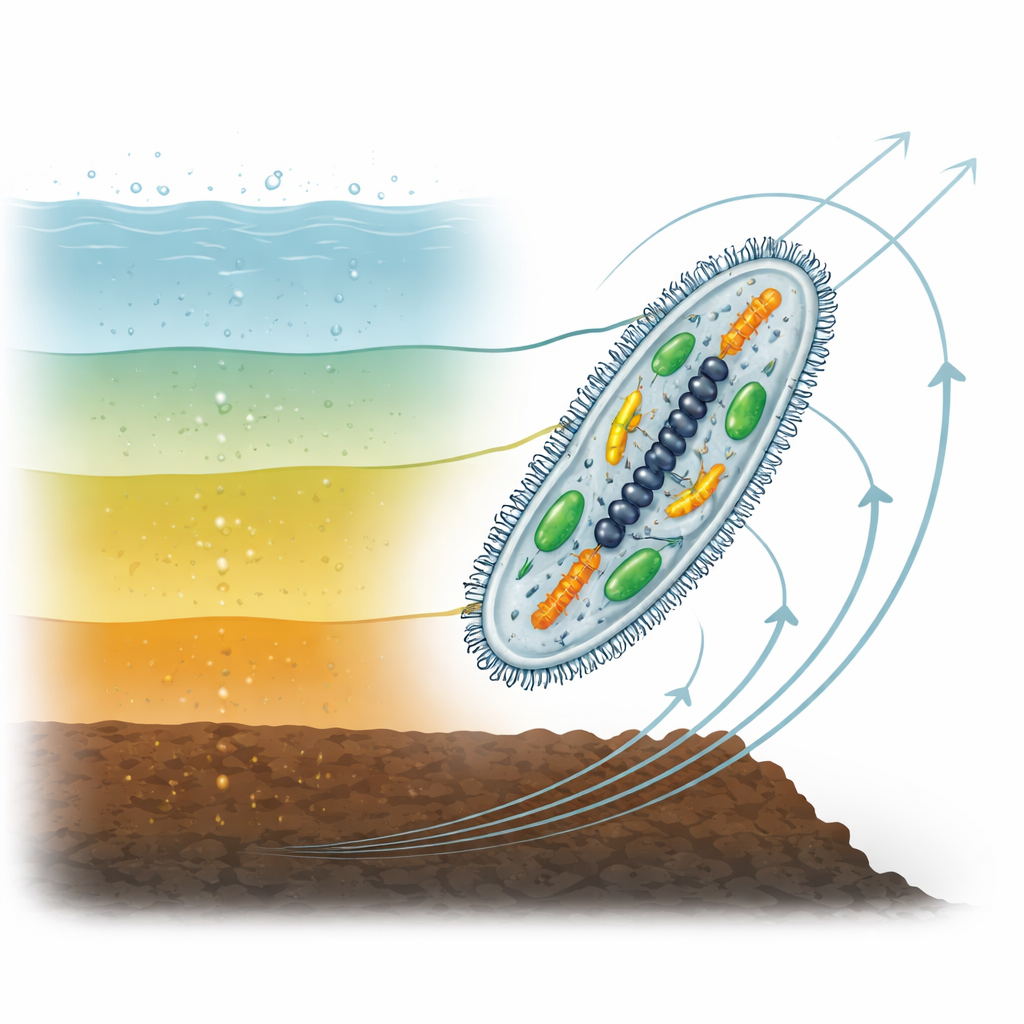
A Hidden World of Partners
For a long time, biologists treated species as self‑contained units, but this view is changing. Many organisms, from corals to termites, rely on close alliances with microbes that help them digest food, capture energy, or defend against enemies. The authors focused on a little‑known group of such partnerships in muddy, low‑oxygen waters, where some microbes use tiny iron crystals as compasses to align with Earth’s magnetic field. Earlier work showed that certain marine protists gain this magnetic sense from bacteria attached to their surface. The new study asks whether a similar strategy exists in freshwater environments, and whether the bacteria might instead live inside their host cell.
Finding a Magnetic Ciliate
Sampling sediments from the Dordogne River in France and several nearby lakes and springs, the team used magnets to concentrate organisms that respond to magnetic fields. Among the usual magnetotactic bacteria, they repeatedly observed a larger, rod‑shaped cell that swam in tight alignment with the field and reversed direction when the field was flipped—behavior that signals true magnetic sensing rather than just swallowing magnetic prey. High‑resolution imaging showed that this swimmer is a previously undescribed ciliate, covered in short hair‑like structures for movement and equipped with a small, helmet‑like opening at its front for feeding. Genetic analysis of its ribosomal DNA placed it near, but distinct from, known prostomate ciliates, suggesting it represents a new branch of this group.
Life Inside a Single Cell
Closer inspection revealed that the ciliate is more like a tiny ecosystem than a lone organism. Using electron microscopy, X‑ray mapping, and fluorescent probes, the researchers found that its interior is crowded with about 50–100 rod‑shaped bacteria, several photosynthetic microalgae such as diatoms, and unusual silica‑rich granules made of quartz clustered near the mouth region. The diatoms still retain internal structures like chloroplasts, though they vary from cell to cell and may be food items or temporary lodgers rather than permanent partners. The quartz granules may act as tiny ballast stones that help the cell sense gravity and hold position in vertical chemical gradients, complementing its magnetic guidance. 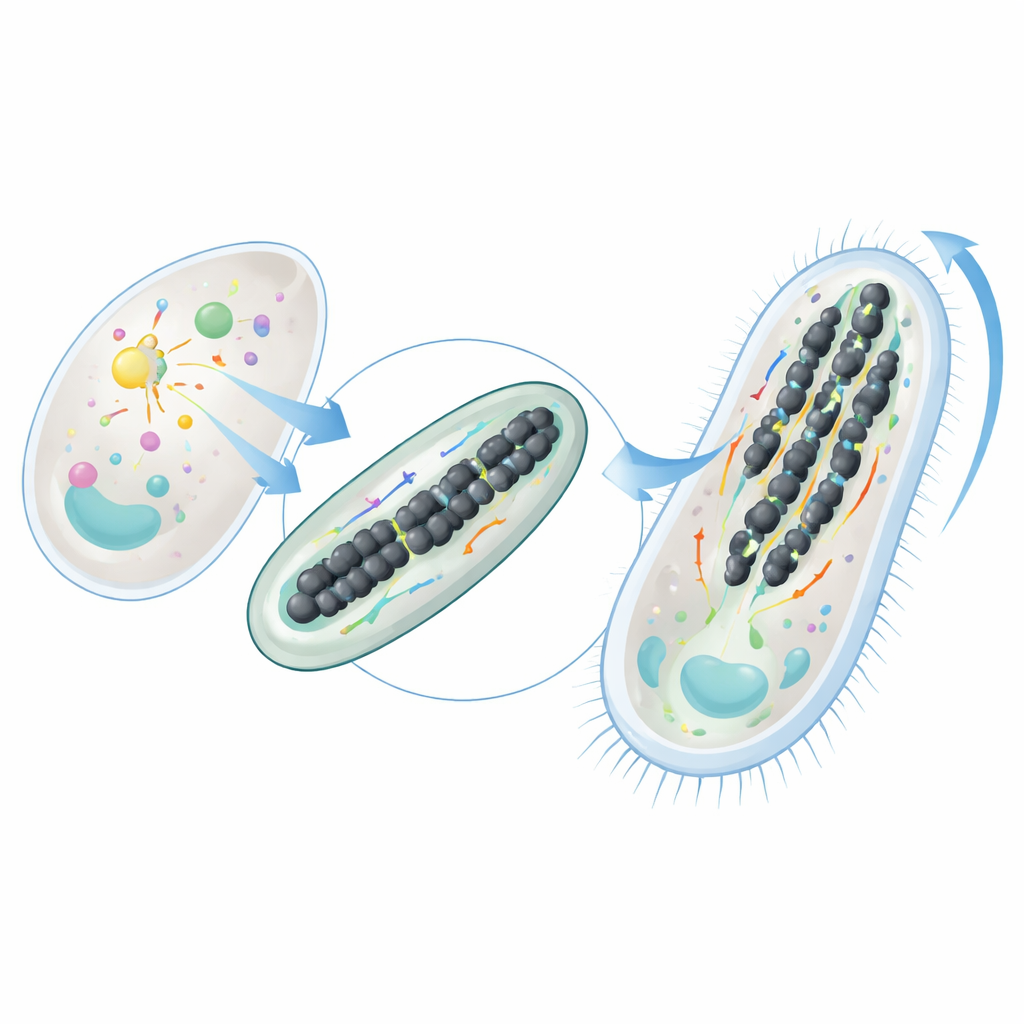
Bacterial Compasses and Shared Metabolism
The key to the magnetic sense lies in one particular bacterial partner. Within the ciliate, a handful of elongated bacterial cells contain densely packed chains of bullet‑shaped magnetite crystals, closely resembling the magnetic structures of known magnetotactic bacteria. These chains are bundled and aligned along the length of the host, giving the whole consortium a strong, unified magnetic moment. DNA sequencing and genome reconstruction showed that this magnetite‑forming symbiont is a sulfate‑reducing bacterium related to Desulfovibrio, while three other endosymbionts belong to different bacterial lineages commonly adapted to life inside host cells. All four have streamlined genomes that have shed many genes for independent living, including those for building flagella, indicating they now depend on the ciliate’s movement and resources.
Sharing Energy in the Dark
By comparing the gene content of the symbionts, the authors pieced together a working model of how energy and nutrients circulate inside this “holobiont” — the host plus its microbes. The ciliate likely breaks down complex organic matter and, via specialized organelles akin to hydrogen‑producing mitochondria, releases hydrogen, carbon dioxide, and small carbon compounds. Two sulfate‑reducing symbionts can use these products to gain energy, converting sulfate into sulfide and, in one case, generating the chemical conditions needed to build magnetite crystals. Other bacterial partners appear to be more dependent, importing energy‑rich molecules or even ATP directly from the host while supplying vitamins and cofactors that neither the host nor the magnetite‑forming bacteria can make on their own. The result is a tightly knit web of exchanges that links magnetic sensing, energy harvesting, and waste processing inside a single cell.
What This Means for the Story of Life
This freshwater ciliate demonstrates that a complex sense like magnetoreception can arise not by evolving a new organ from scratch, but by recruiting and domesticating specialist microbes. Here, a host cell, four kinds of bacteria, and occasional microalgae work together as a single functional unit perfectly adapted to oxygen‑poor river sediments. The discovery shows that magnetosymbiosis — gaining a magnetic compass from bacterial partners — has evolved more than once in very different lineages, hinting that such alliances may be common wherever magnetic bacteria and protists coexist. It also feeds into a broader question: could similar ancient partnerships, and the gradual conversion of symbionts into permanent cell components, have helped early eukaryotes acquire senses like magnetoreception? The answer remains open, but this river‑dwelling “living compass” offers a compelling modern example of how far symbiosis can go.
Citation: Bolzoni, R., Monteil, C.L., Alonso, B. et al. Magnetoreception in a freshwater ciliate arises from endosymbiosis. Nat Commun 17, 3732 (2026). https://doi.org/10.1038/s41467-026-70462-8
Keywords: magnetoreception, symbiosis, ciliate, endosymbionts, freshwater sediments