Clear Sky Science · en
Tunable and nonlinearity-enhanced dispersive-plus-dissipative coupling in photon-pressure circuits
Listening to Tiny Pushes of Light
Modern quantum technologies rely on exquisitely sensitive electrical circuits that can detect and control single particles of light, or photons. This study explores a new way for such superconducting circuits to "feel" the tiny pressure exerted by microwave photons. By engineering this photon pressure in a flexible and tunable way, the authors open up tools that could help read out quantum bits, cool low‑frequency signals towards the quantum limit, and even aid future searches for dark matter using ultra‑sensitive radio receivers. 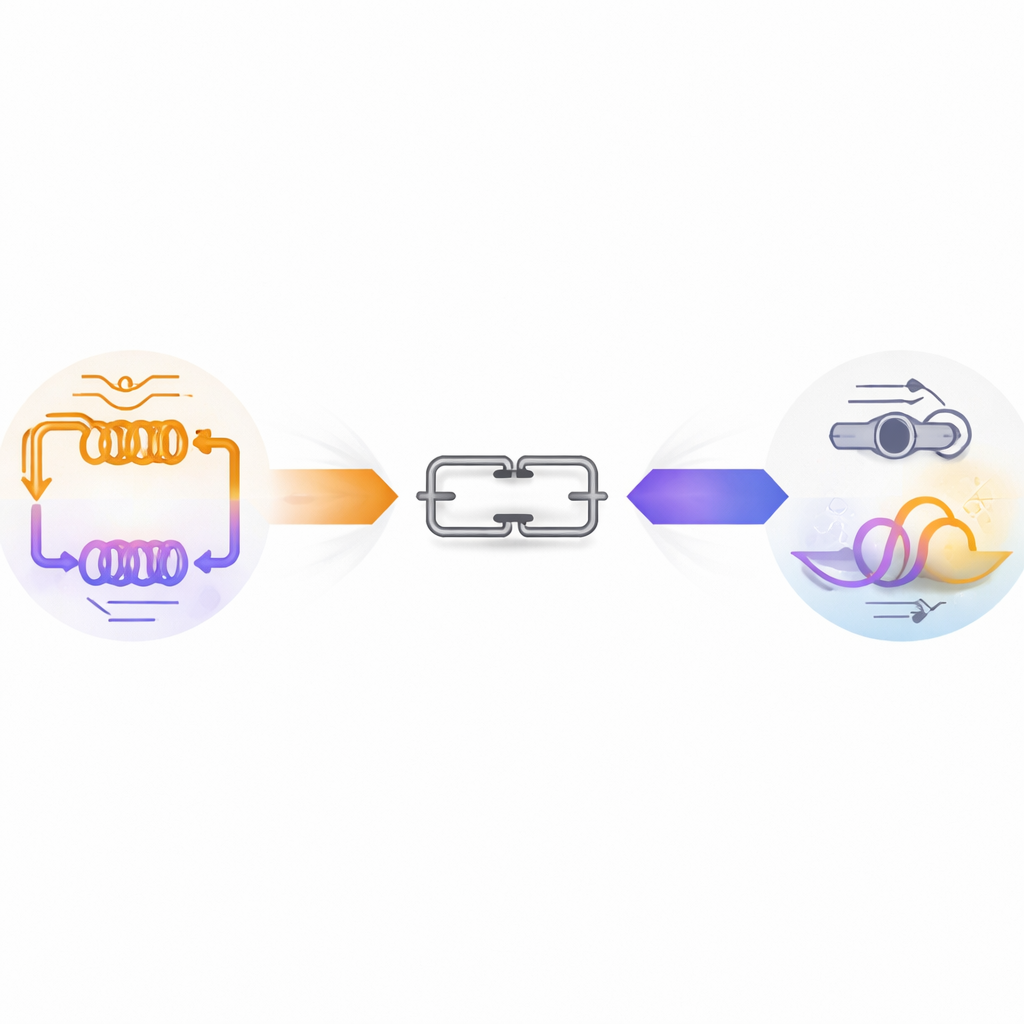
Two Circuits Talking Through One Tiny Bridge
The researchers built a device from niobium, a metal that becomes superconducting at liquid‑helium temperatures. It contains two electrical resonators: one vibrating at high gigahertz frequencies and another at much lower hundreds‑of‑megahertz frequencies. These resonators share a tiny loop known as a SQUID, which acts as a nonlinear bridge between them. A small magnetic field threads this loop and can be adjusted like a control knob. When the low‑frequency circuit jiggles the magnetic flux in the SQUID, it changes how the high‑frequency circuit behaves, and vice versa, letting energy and information flow between the two in a controlled way.
Two Ways Light Can Push: Shifting Pitch and Changing Damping
In most earlier experiments, photon pressure acted only in a "dispersive" way: the motion in one resonator shifted the resonance pitch, or frequency, of the other, much like tightening a guitar string. Here, the team also realizes a strong "dissipative" route: the same motion can change how quickly energy leaks out of the resonator, that is, its damping or linewidth. By sweeping the magnetic field, they map out how both the frequency and the damping of the high‑frequency mode respond. From this, they extract two basic coupling strengths: one linked to frequency shifts and one linked to loss, and show that the loss‑based coupling can even dominate. Crucially, this added dissipation comes from the circuit’s internal elements rather than from its connection to the outside world, giving a clean testbed for theory. 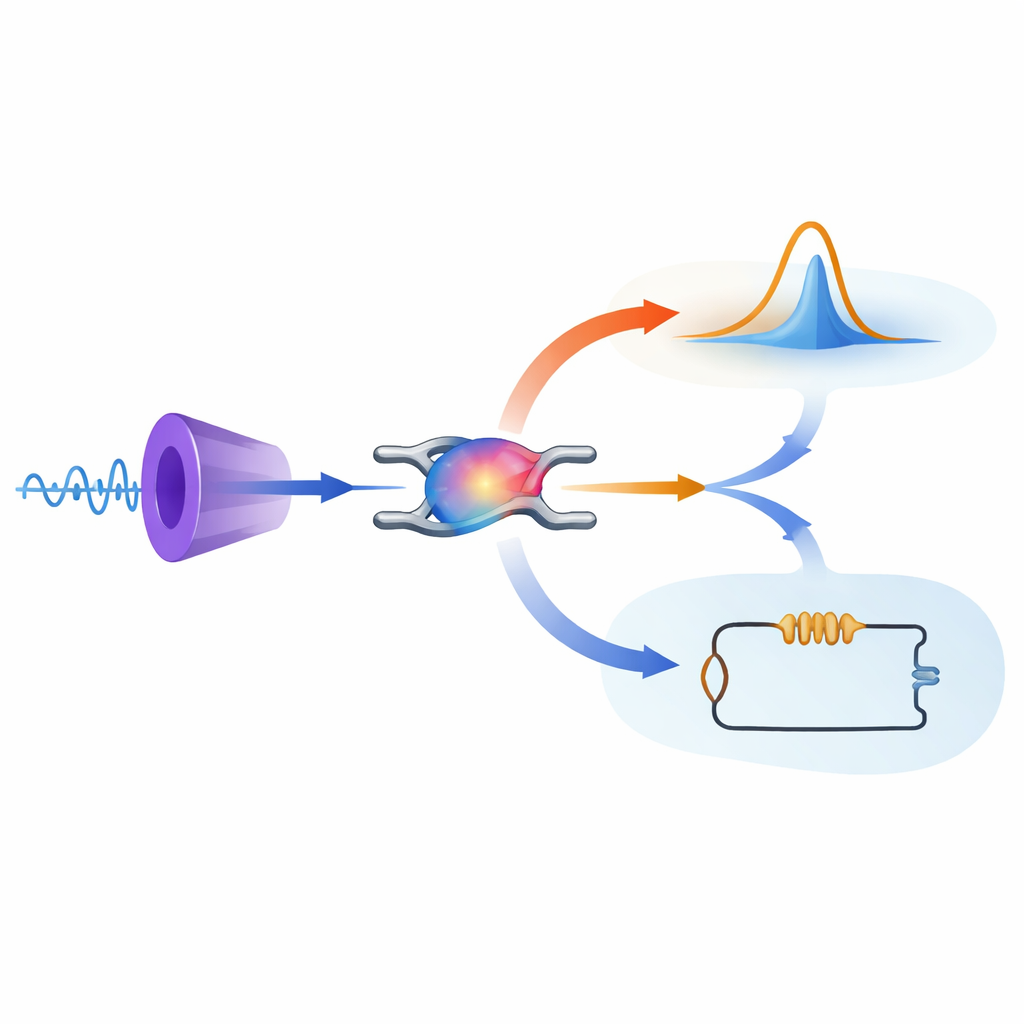
Interference Patterns as a Fingerprint of New Physics
To understand how these two types of coupling interact, the authors drive the high‑frequency circuit with a strong pump tone while probing it with a faint test signal. The low‑frequency circuit then acts a bit like a mediator, creating a narrow transparency window inside the broader high‑frequency resonance—an effect related to electromagnetically induced transparency in atomic gases. When only frequency‑shifting (dispersive) coupling is present, this transparency feature has a simple, symmetric shape. In the new device, the added loss‑based (dissipative) coupling twists this feature into an asymmetric, Fano‑like profile. By analyzing the geometry of this distorted line in the complex plane, the team can directly read off the ratio between dispersive and dissipative effects from a single measurement.
Harnessing Nonlinearity for Stronger Interactions
The SQUID bridge is not a simple, linear component: its response depends on how strongly it is driven. As the pump power is increased and more photons fill the high‑frequency circuit, the resonance not only shifts but also broadens in a nonlinear way. The authors show that these nonlinearities feed back into the effective coupling between the two resonators. Instead of growing only with the square root of the photon number—as simple theory would predict—the measured couplings rise much faster, with extra contributions that scale like higher powers of photon number. In practical terms, this nonlinearity amplifies the effective interaction between the modes by factors of about three to four, without requiring prohibitively large drive powers.
Shaped Backaction and Surprising Instabilities
When the high‑frequency circuit is strongly driven, its response in turn alters the behavior of the low‑frequency mode—a phenomenon known as dynamical backaction. By monitoring the low‑frequency resonance while sweeping the pump, the authors observe how its frequency and damping change in a highly non‑Lorentzian, interference‑like fashion that matches their theoretical model including dissipative coupling and nonlinear effects. Remarkably, for certain pump settings that are still nominally red‑detuned, the backaction becomes negative and can cancel the natural damping of the low‑frequency mode, pushing the system into a parametric instability. This counter‑intuitive behavior is a clear hallmark of the new dissipative pathway.
Why This Matters for Future Quantum Devices
To a non‑expert, the key message is that the team has built a microwave circuit platform where two ways of photon pressure—shifting pitch and changing damping—can be tuned, combined, and strongly enhanced by design. They demonstrate how this mixture leads to distinctive interference signatures, stronger effective interactions, and unusual backaction, all while operating in a relatively simple liquid‑helium setup. Such control over low‑frequency photons and losses could be vital for ultra‑sensitive radio‑frequency quantum sensors, including proposed detectors for dark matter axions, and positions photon‑pressure circuits as a powerful model system for exploring radiation‑pressure physics in both quantum and thermal regimes.
Citation: Kazouini, M., Peter, J., Guo, Z.E. et al. Tunable and nonlinearity-enhanced dispersive-plus-dissipative coupling in photon-pressure circuits. Nat Commun 17, 2789 (2026). https://doi.org/10.1038/s41467-026-70459-3
Keywords: photon-pressure circuits, dissipative coupling, superconducting microwave resonators, SQUID-based quantum devices, quantum sensing