Clear Sky Science · en
Multi-functional photonic crystals of modular nanosheets
Color from structure, not from dye
Many of the brightest colors in nature come not from paint or pigment, but from tiny structures that bend and bounce light in special ways. This study explores how to build such "structural colors" into smart materials that can also glow, absorb light like metals, and respond to magnets and light. The work shows a recipe for making thin, sheet-like building blocks that snap together on their own into ordered stacks with tunable colors and multiple optical tricks in one material. 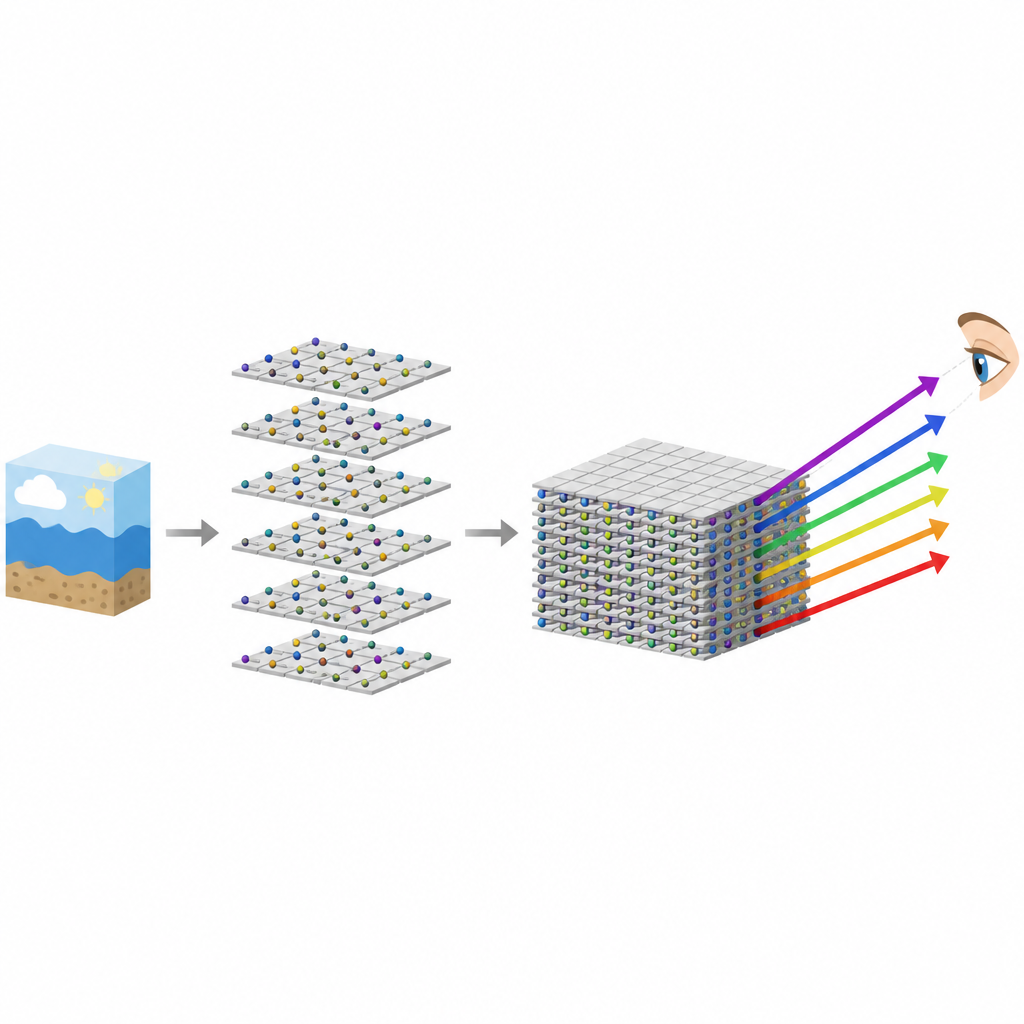
Stacking ultra-thin sheets like Lego bricks
The researchers start with titanate nanosheets, which are incredibly thin, flat pieces of inorganic material only about a billionth of a meter thick but several micrometers wide. In water, these charged sheets naturally repel each other and line up into evenly spaced stacks, creating a photonic crystal that reflects specific colors of light. The key idea of the paper is to keep this color-forming behavior while decorating each sheet with tiny functional nanoparticles, like gold particles and glowing silica beads, so that several optical functions coexist in the same ordered structure.
Adding shine, glow, and control to each sheet
To do this, the team uses simple electrostatic attraction. The bare nanosheets are negatively charged, while the chosen nanoparticles are made positively charged. When mixed carefully at the right concentrations, the gold spheres, gold rods, and fluorescent silica particles attach to the sheet surfaces without overloading them. This balance keeps the overall sheets still negatively charged and well separated in water, so they continue to form liquid-crystal-like dispersions. Microscopy and optical tests confirm that the nanoparticles stay firmly attached, keep their own optical signatures, and that the hybrid sheets remain stable for weeks and at elevated temperatures.
From simple liquids to smart, colorful crystals
By removing dissolved salts and concentrating the dispersions, the team strengthens the repulsion between sheets and pushes them into ordered stacks spaced by hundreds of nanometers, the right scale to generate vivid structural color. When the sheets carry gold nanoparticles or nanorods, the resulting crystals combine structural color with metallic light absorption; when they carry fluorescent silica, they combine color with glow; and when both are present, all three effects appear together. Because the fluorescent particles sit on the sheets themselves, the authors can use confocal microscopes to map the three-dimensional arrangement of individual sheets inside the stacked crystal, an unusual view of such delicate self-assembled structures. 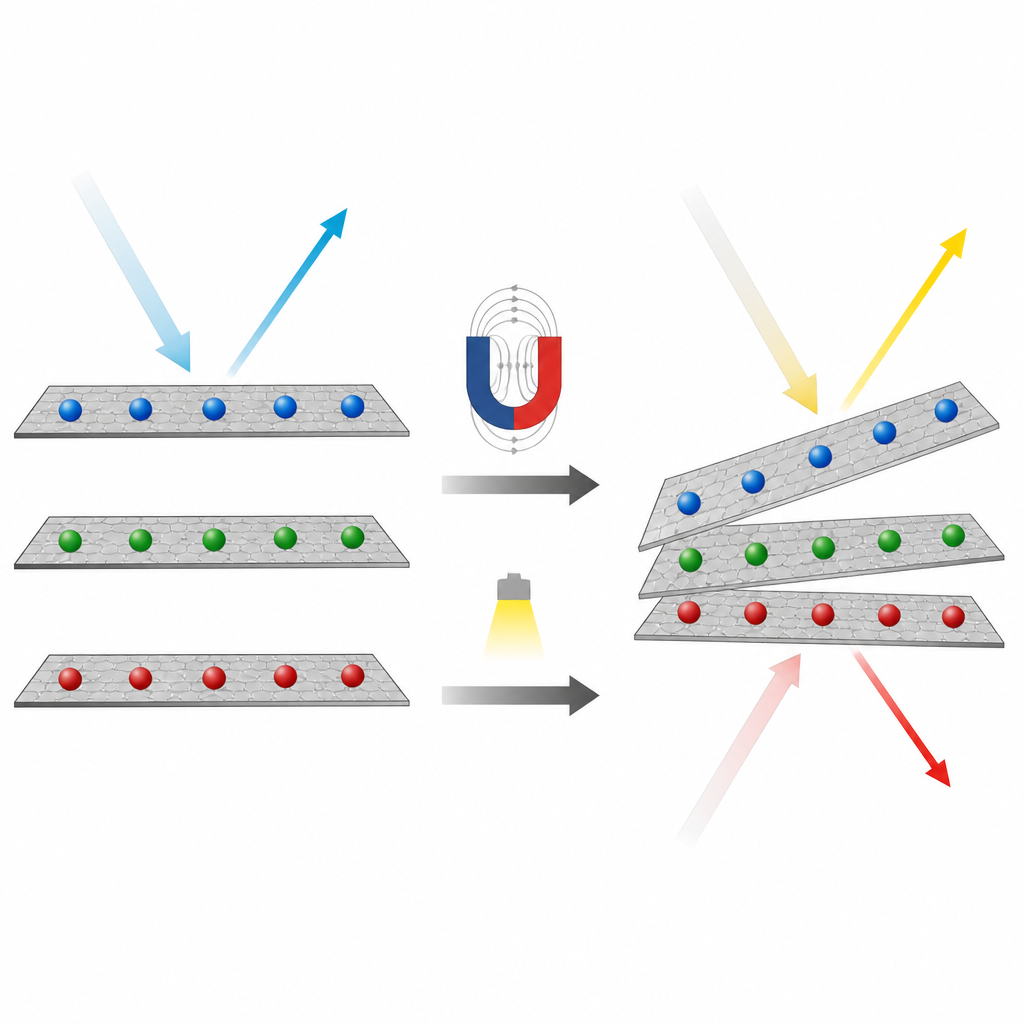
Steering color with magnets and light
The titanate sheets are also weakly magnetic in a way that lets a strong magnetic field line up their flat faces. The researchers show that, in these hybrid crystals, applying a magnetic field can rotate the sheets as a group, switching the observed color on or off depending on viewing direction. With gold nanoparticles present, light that matches their absorption wavelength can gently heat the material. This heat shrinks the spacing between sheets and shifts the structural color toward shorter wavelengths. Turning the light off lets the material cool and the color shift back, allowing reversible light-driven color tuning reminiscent of marine organisms whose hues change with illumination.
Why this matters for future smart materials
For a non-specialist, the key outcome is a modular recipe: start with a known color-forming sheet, snap on chosen nanoparticles, and let the mixture assemble itself into a solid that reflects, absorbs, and glows in programmable ways while still responding to magnets and light. This approach could help designers create next-generation optical materials for sensors, displays, inks, or security features, where a single compact material can show rich, controllable visual effects without traditional dyes.
Citation: Yui, S., Mihara, T., Nishimura, T. et al. Multi-functional photonic crystals of modular nanosheets. Nat Commun 17, 4517 (2026). https://doi.org/10.1038/s41467-026-70456-6
Keywords: photonic crystals, structural color, nanosheets, gold nanoparticles, stimuli responsive materials